Yang Jinsu, Head of HMG Management Research Institute,
Predicts Key Issues in the Automotive Industry for This Year
- Electrification trends vary by region; profitability remains a challenge
- European automakers to boost electric vehicle sales despite losses
- Chinese companies to expand PHEV and EREV sales, increase global influence
- Partnerships and alliances among global automakers expected to intensify
- BYD's domestic market entry could shift perceptions of Chinese brands
This year and beyond, it is forecasted that sales of electrified vehicles will show steady growth, particularly in advanced markets such as Europe and the United States. However, due to stricter environmental regulations and an increase in low-cost models, it is expected that profitability will not improve significantly from the perspective of automakers.
Yang Jin-su, head of the Mobility Industry Research Division at HMG Management Research Institute under Hyundai Motor Group, highlighted at a seminar hosted by the Korea Automobile Journalists Association on the 15th that one of the key issues to watch in the global automotive market this year is the differing characteristics of electrification transitions by region. In Europe, due to tightened emission regulations, automakers must increase the share of electric vehicle sales instead of internal combustion engines, and it is likely that major automakers will strengthen promotions centered on electric vehicles even if it means incurring some losses.
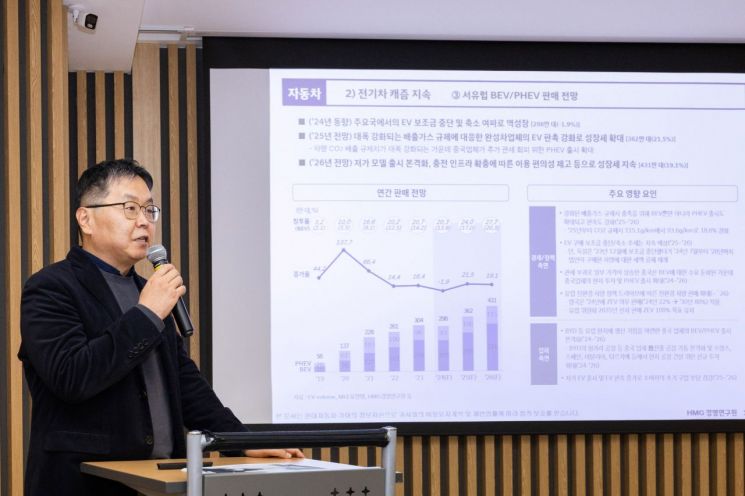 Yang Jin-su, Head of the Mobility Industry Research Office at HMG Management Research Institute, is presenting on the major issues in the automotive industry this year at the New Year seminar hosted by the Korea Automobile Journalists Association on the 15th. Photo by Korea Automobile Journalists Association
Yang explained, "Due to emission regulations, some companies are pursuing pooling (forming a consortium to trade surplus carbon emission credits) with electric vehicle manufacturers like Tesla, while responding by raising prices of internal combustion engine vehicles (to reduce sales) or lowering prices of electric vehicles. Each company is in a situation where they must artificially increase electric vehicle sales."
Additionally, low-cost, entry-level electric vehicles are also set to be launched one after another. Considering that most automakers currently have not reached the break-even point per electric vehicle, securing profitability has become more challenging. From the consumer’s perspective, this is not a bad situation.
Chinese companies, whose price competitiveness has weakened due to tariffs, are expected to intensify their offensive mainly with plug-in hybrid electric vehicles (PHEVs) while steadily continuing investments in production facilities overseas. Chinese companies have improved the product competitiveness of PHEVs and are currently offering them to the market at prices lower than internal combustion engine vehicles of the same class.
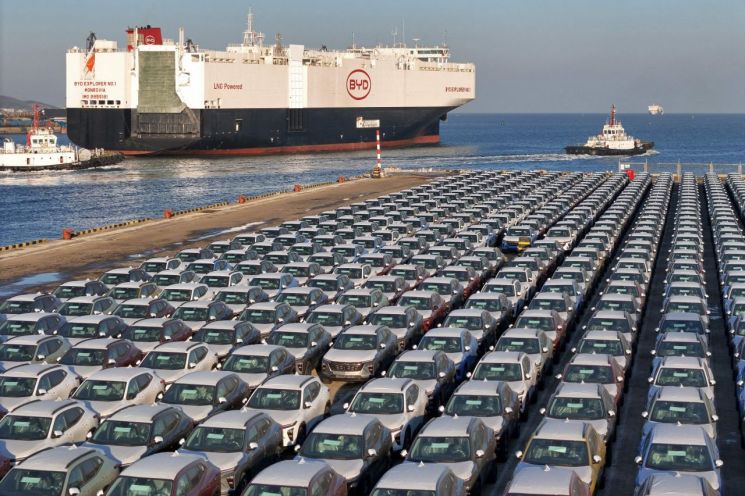 BYD vehicles waiting for export shipment at Yantai Port, Shandong Province, China. Photo by Yonhap News
Yang forecasted that sales in China will increase mainly for PHEVs and extended-range electric vehicles (EREVs). When considering price, total cost of ownership, and charging concerns comprehensively, there is a growing perception that these are better than battery electric vehicles. The penetration rate of electric vehicles in China surpassed 50% last year and is expected to reach 59% this year. Recently, the spread of PHEVs has been increasing faster than battery electric vehicles.
Yang said, "In large metropolitan areas equipped with charging infrastructure, the adoption of battery electric vehicles is easier, but in smaller cities and rural areas, the spread of PHEVs is much faster due to charging and other reasons. Traditional automakers operating in China are not adapting quickly enough to these changes."
He also predicted that the influence of Chinese companies is likely to increase further. Since becoming the largest automobile exporter in 2023, China has widened the gap last year. It is expected that the smart car trend, including autonomous driving that integrates advanced information and communication technology beyond electrification, will spread throughout the market. Last year, Chinese companies entered various emerging markets including Hungary, Spain, and Turkey in Europe, and their global sales base is expected to expand significantly.
Yang also pointed out that as global automakers face sluggish business in China, partnerships with local companies are increasing to compensate. Efforts to secure allies within China and to learn technologies in electrification and smart cars are also intensifying. He forecasted that alliances between companies with declining profitability, such as the merger efforts by Japan’s second and third largest automakers Honda and Nissan, are likely to become more active.
Regarding BYD, which is preparing to launch passenger cars domestically, Yang sees sufficient potential depending on its business strategy. He mentioned the increasing market share of Chinese brands in some home appliances like robotic vacuum cleaners and said, "There is a need for (domestic companies) to feel a sense of crisis." He added, "Although there is a perception that domestic consumers have a negative view of Chinese brands, this can change significantly depending on how business is conducted and relationships with domestic customers are built."
© The Asia Business Daily(www.asiae.co.kr). All rights reserved.
![Clutching a Stolen Dior Bag, Saying "I Hate Being Poor but Real"... The Grotesque Con of a "Human Knockoff" [Slate]](https://cwcontent.asiae.co.kr/asiaresize/183/2026021902243444107_1771435474.jpg)


















