A Candle That Never Goes Out:
Choe Jae-chun on the Disappearance of Conscience
and the Need for Equity in Society
"I was never unaware that soldiers are overwhelmingly powerful. The strange thing, however, was that something just as intense as their strength was overwhelming me. Conscience. Yes, conscience. That is the most frightening thing in the world. I was surprised to discover something pure within myself, something I had never noticed before. I felt no longer afraid, I felt as though I could die right now and be at peace. ... I sensed the pulse of the greatest and most sublime heart in the world. I dared to feel that I had become a part of it."
This is a passage from "Human Acts" by Han Kang, who won the Nobel Prize in Literature last year. Ecologist Choe Jae-chun, a distinguished professor at Ewha Womans University, said this was the part that moved him most deeply while reading "Human Acts." He shared this at a press conference for the publication of his new book "Conscience" held at the Korea Press Center in Jung-gu, Seoul, on January 14.
Professor Choe said, "I wrote this book in the hope that our society will once again talk about conscience, and that it will become a society where individuals who are troubled by their conscience come together."
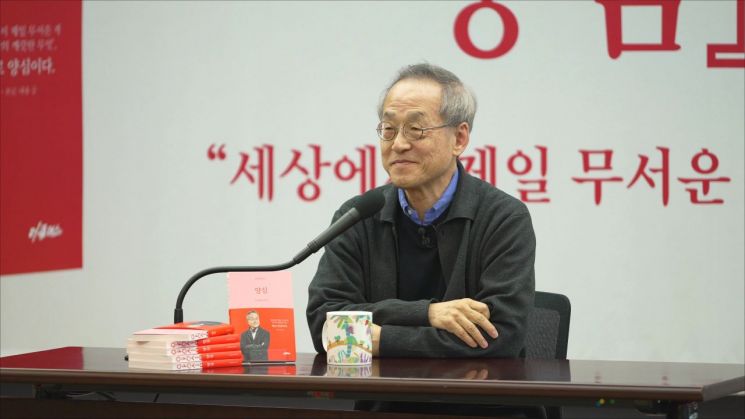
Professor Choe runs the YouTube channel "Choe Jae-chun's Amazon," which has 7.4 million subscribers. The channel features more than 300 videos. Each video takes about 1 hour and 30 minutes to 2 hours to film, but the videos uploaded to YouTube are only about 10 minutes long. Professor Choe explained that he selected 7 videos related to conscience from the 300, and included in his book the content that could not fit into the videos.
Professor Choe expressed regret that the word "conscience" seems to be gradually disappearing from our society.
"When I was a young man before studying in the United States, and when I lived as a boy in Korea, I would hear the word 'conscience' every day in ordinary conversation. One day I realized that the word had disappeared from our daily conversations. People are no longer harshly criticized for living without conscience, and sometimes it even seems that those who live unconscionably are better off. I found this uncomfortable to watch. If this social atmosphere continues, our lives will inevitably become more impoverished. That is why, at this moment, I wanted to raise the topic of conscience."
Professor Choe also referred to the book "The Age of Empathy" (original title: The Age of Empathy) by Dutch-born animal behaviorist Frans de Waal, which he translated last year, saying that conscience is an innate trait possessed by all mammals. According to Frans de Waal, if several mice are kept in separate compartments and only one is given food, that mouse will eventually stop eating as well, because it hears the cries of hunger from the other mice nearby.
Professor Choe also described conscience as an unextinguishable candle in our hearts.
"When I gave a commencement speech at Seoul National University in 2023, I said that conscience is like a candle. There is a small candle burning in my heart, and this candle called conscience cannot be blown out, no matter how hard you try."
He added that, although he is inherently a timid person, it was because of this unextinguishable candle of conscience in his heart that he spoke out against the abolition of the family registry system and the Four Major Rivers Project during the Lee Myung-bak administration.
Professor Choe said that the presence or absence of conscience allows us to distinguish between equality and equity. He emphasized that equity is only achieved when conscience is added to equality. To explain the difference between equality and equity, he referenced the famous illustration of three people of different heights watching a baseball game over a fence.
In the illustration, only the tallest person can see the baseball game. When each of the three stands on a wooden box, the person of average height can also see the game. This situation, where each person is given one box, is called "equality." However, even then, the shortest person still cannot see the game. When the tallest person gives their box to the shortest person, allowing the shortest person to stand on two boxes and all three to see the game, this represents "equity."
Professor Choe explained that the uncomfortable feeling we get when we see the shortest person still unable to watch the game, even in an equal situation, is conscience, and it is only then that true equity can be achieved.
"Although the word 'equity' is used frequently in our society, in reality, what we call equity often amounts to mere equality at best. We think we've done our part by giving everyone the same, because it's not acceptable to give to some and not to others. But I feel that this is somewhat lacking. Those who have received more should yield so that those who cannot enjoy can also participate. In such cases, active yielding is needed, but some people see this as oppression. There are too many people in our society who, even though they could still see the game after giving up their box, refuse to do so. I hope that there will be an open and free public discussion on this issue in our society."
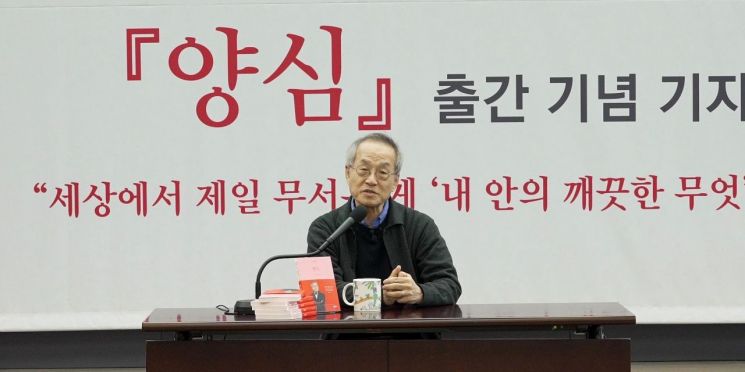
Professor Choe also said that we need to reflect on the issue of conscience in light of the growing social confusion in recent times. He emphasized the importance of not deceiving oneself.
"It is truly difficult to keep one's conscience. This is because the standard is entirely personal. As long as you can control only yourself, you can easily live without conscience. I may have deceived the whole world, but there is one person I cannot deceive. That one person is myself. Many of us make the right choices and act correctly because we cannot deceive ourselves. If those who are responsible for national affairs act according to the standards of conscience, our society will become much better."
© The Asia Business Daily(www.asiae.co.kr). All rights reserved.
![Clutching a Stolen Dior Bag, Saying "I Hate Being Poor but Real"... The Grotesque Con of a "Human Knockoff" [Slate]](https://cwcontent.asiae.co.kr/asiaresize/183/2026021902243444107_1771435474.jpg)

















