A Total Budget of 2.1 Billion KRW to Support 27 Traditional Markets and Alley-type Shopping Streets
Strengthening Competitiveness and Revitalizing the Local Economy
Promoting 19 Projects in Four Key Areas:
Business Modernization, Facility Modernization, Safety Enhancements, and Byeolbit Sinsari Commercial District Revitalization
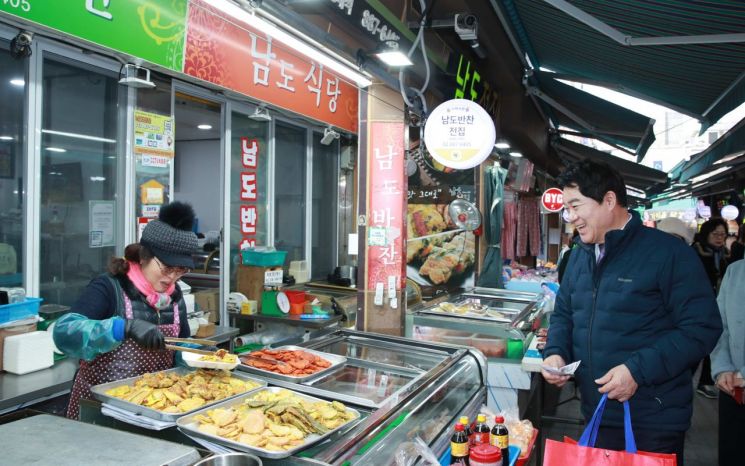
Gwanak-gu (Mayor Park Jun-hee) is set to fully implement the "2025 Traditional Market Revitalization Plan," a key initiative to invigorate local commercial districts and revive the livelihood economy.
This year, the district will allocate a total budget of 2.1 billion KRW to support traditional markets facing management difficulties due to the expansion of large-scale distribution, changes in consumer purchasing patterns, and unstable national affairs.
The plan focuses on 19 projects across four main areas: ▲business modernization ▲facility modernization ▲safety inspections and repairs ▲and the Byeolbit Sinsari Commercial District Renaissance Project.
First, 1.4 billion KRW will be invested in the "business modernization" of traditional markets and shopping streets to energize the commercial districts.
In particular, "Bongridan-gil Alley Shopping Street" and "Bongcheon Jeil General Market" have been selected for the "Specialized Market Development Project" led by the Ministry of SMEs and Startups, receiving up to 1 billion KRW in support through 2026.
The district was chosen for the "Cultural Tourism-type" specialized market project and plans to maximize the unique characteristics and strengths of the markets by linking traditional markets with local cultural tourism resources.
For traditional markets and shopping streets equipped with delivery infrastructure, labor costs for "joint delivery services" will be supported to provide convenient non-face-to-face shopping services to residents.
Additionally, "traditional market managers" and "dedicated coordinators" will be assigned to assist the administrative tasks of merchant associations, which often lack manpower, thereby strengthening the self-sustainability of small business owners.
A new initiative called "Our Neighborhood Market Outing" will be introduced, hosting resident participation events such as shopping experiences and plogging that reflect the unique character of each market, promoting a friendly market image to the community.
Furthermore, efforts will be made to expand the designation of alley-type shopping streets, laying the groundwork for Onnuri gift certificate membership and various revitalization project supports. Last year, the district designated a total of six alley-type shopping streets, securing the largest number among Seoul’s autonomous districts.
For "facility modernization" and "safety inspections and repair projects," 500 million KRW and 120 million KRW will be allocated respectively to create markets where residents can visit with peace of mind.
The district will install various convenience facilities for visitors, including ▲customer convenience centers (Gangnam Alley Market, Nangok Alley Shopping Street) ▲customer rest areas (Gwanak Jungbu Market) ▲and public restrooms. Support will also be provided for replacing outdated CCTV systems (Shinwon Market, Inheon Market) and subscribing to fire insurance, focusing on creating a more comfortable and safe traditional market environment.
Meanwhile, the "Byeolbit Sinsari Commercial District Renaissance Project" will conclude its five-year run this March. Accordingly, the district has allocated 80 million KRW this year for facility maintenance and specialized projects to continue revitalizing the Byeolbit Sinsari commercial district.
Mayor Park Jun-hee stated, "We are making every effort to recover the livelihood economy amid prolonged domestic and international instability and economic downturn," adding, "We will pursue any project that benefits the traditional markets and alley-type shopping streets, which are the core of our district’s local economy."
© The Asia Business Daily(www.asiae.co.kr). All rights reserved.
![Clutching a Stolen Dior Bag, Saying "I Hate Being Poor but Real"... The Grotesque Con of a "Human Knockoff" [Slate]](https://cwcontent.asiae.co.kr/asiaresize/183/2026021902243444107_1771435474.jpg)











