The Ministry of Justice is set to establish a system that detects signs of recidivism among high-risk sex crime electronic monitoring subjects using artificial intelligence (AI) technology. To ensure effective recovery of criminal proceeds, it plans to introduce an 'independent confiscation system' and establish new offenses such as 'public intimidation' and 'possession of weapons in public places' to prevent crimes targeting unspecified masses.
Kim Seok-woo, Acting Minister of Justice, reported the '2025 Major Work Promotion Plan' containing these details to Acting President Choi Sang-mok at a key issue resolution meeting held at the Government Seoul Office on the 14th.
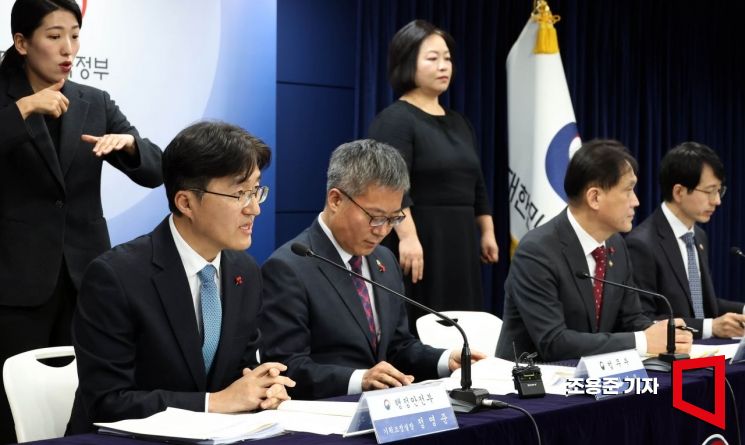 On the 13th, Jeong Young-jun, Director of Planning and Coordination at the Ministry of the Interior and Safety, is presenting on current issues at the '2025 Major Issues Solution Meeting Pre-Joint Briefing' held at the Government Seoul Office in Jongno, Seoul. Attending the briefing were Director Jeong, Kim Seok-woo, Vice Minister of the Ministry of Justice, Kim Tae-gyu, Vice Chairman of the Korea Communications Commission, and Park Jong-min, Vice Chairman of the Anti-Corruption and Civil Rights Commission (from left). Photo by Jo Yong-jun
The Ministry of Justice identified four core tasks for this year: ▲ Strict crime response to protect public safety ▲ Legal and institutional improvements for a society safe from crime ▲ Warm rule of law centered on human rights ▲ Legal administration contributing to national interests and the economy.
Strict Response to Random Murders, Deepfake, Stalking, and Drug Crimes
First, the Ministry of Justice named protecting public safety through strict crime response as the top priority this year.
To this end, the Ministry plans to establish new punishment provisions such as ‘possession of weapons in public places’ and ‘public intimidation’ to strictly punish public safety-threatening offenders who cause anxiety among the public, including ‘random motive violent crimes’ and ‘online murder threats’ targeting unspecified masses.
Additionally, for digital sex crimes like deepfake that destroy the victim's dignity, the Ministry announced it will introduce digital evidence preservation measures and strengthen investigative capabilities by joining international cybercrime conventions to build an international cooperation system.
To prevent secondary harm to stalking crime victims, electronic tracking devices will be actively attached to stalking offenders from the early stages of investigation, and public defenders will be appointed for victims.
Furthermore, the Ministry will continue operating a government-wide joint investigation system against voice phishing and jeonse fraud crimes, which remain rampant, and will work on repatriating overseas members of voice phishing organizations, including masterminds, through international cooperation. Organized illegal private loan groups threatening the lives of ordinary citizens will be prosecuted as ‘criminal organizations’ and investigated under detention.
To restore the status of a drug-free country, the Ministry plans to operate a ‘dark web specialized investigation team’ and develop AI-based technology to thoroughly track drug transactions and arrest masterminds. It will also dispatch additional dedicated investigators to major drug shipping countries to strengthen joint investigations against smuggling organizations abroad.
Alongside strong crackdowns on drug offenders, the Ministry will collaborate with the Ministry of Food and Drug Safety and the Ministry of Health and Welfare to solidify tailored treatment and rehabilitation programs to suppress drug demand.
Lastly, the Ministry of Justice will cooperate with the Financial Services Commission to restrict former offenders of unfair trade practices from becoming executives of listed companies, thoroughly crack down on market-disturbing acts such as bid rigging, subsidy embezzlement, and tax evasion, as well as national fiscal crimes. It also plans to promote swift rights remedies in technology leakage cases by utilizing ‘technology dispute mediation’ and ‘criminal investigation fast-track’ systems.
Development of Recidivism Sign Detection System for Sex Crimes Using AI Technology... Promotion of 'Independent Confiscation System'
The Ministry of Justice also revealed plans for legal and institutional improvements.
First, the Ministry plans to develop a system using AI technology to detect signs of recidivism among high-risk sex crime electronic monitoring subjects and establish grounds for probation officers to access the residences of electronic monitoring subjects. It will also expand the scope of electronic monitoring application to build a recidivism prevention system.
Additionally, to ensure effective recovery of criminal proceeds, the Ministry plans to revise search and seizure laws and introduce an ‘independent confiscation system’ that allows recovery of criminal proceeds even in cases where prosecution is difficult due to death or escape.
Moreover, the Ministry will consider introducing advanced criminal justice systems such as the crime of judicial obstruction and penalty reduction for judicial collaborators to prevent investigation and trial delays and distortion of substantive truth, and will prepare thoroughly for the full digitization of criminal justice procedures.
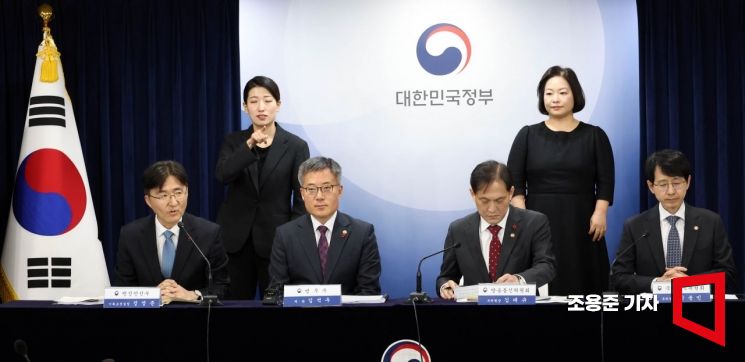 On the 13th, Jeong Young-jun, Director of Planning and Coordination at the Ministry of the Interior and Safety, is presenting on current issues at the '2025 Major Issues Solution Meeting Pre-Joint Briefing' held at the Government Seoul Office in Jongno, Seoul. Attending the briefing were Director Jeong, Kim Seok-woo, Vice Minister of the Ministry of Justice, Kim Tae-gyu, Vice Chairman of the Korea Communications Commission, and Park Jong-min, Vice Chairman of the Anti-Corruption and Civil Rights Commission (from left). Photo by Jo Yong-jun
Implementing a Warm Rule of Law Centered on Human Rights
The Ministry of Justice plans to revise the system to allow the appointment of public defenders for victims of violent crimes such as murder and robbery who are not currently eligible for public defender support under existing law.
When courts deny victims access to trial records for viewing or copying, they will be required to notify the reasons, and the system will be improved to automatically notify victims of key criminal procedure information to guarantee victims' participation rights in criminal procedures.
To enhance legal aid service accessibility for vulnerable groups, a ‘integrated platform’ involving a total of 35 institutions will be established, and bankruptcy procedures will be revised, including exemptions for essential business assets, to provide a stepping stone for small and medium-sized enterprises and micro-business owners to make a fresh start.
Additionally, the Ministry announced plans to expand human rights-friendly correctional infrastructure by improving medical environments in correctional institutions and constructing or expanding correctional facilities, and to work on alleviating overcrowding.
Legal Administration Contributing to National Interests and the Economy
The Ministry of Justice plans to activate shareholder meetings by introducing electronic shareholder meetings and improve corporate legal systems to prevent shareholders from suffering unfair losses during organizational restructuring such as mergers of listed companies.
Building on last year's announcement of the ‘New Immigration and Immigration Policy,’ the Ministry will actively promote it this year by creating a tailored ‘Top-Tier Visa’ for attracting high-level talent in advanced fields such as AI, robotics, quantum technology, and space engineering, and preparing a ‘Youth Dream Visa’ that offers cultural training and employment opportunities in Korea for young people from countries that participated in the Korean War.
To systematically reflect the industrial sector's position as a core demand for foreign labor in visa systems, the Ministry will fully implement the ‘Visa and Stay Policy Proposal System’ and inject vitality into regional economies through pilot operations of the ‘Metropolitan Visa System’ tailored to the characteristics of each local government.
Furthermore, the Ministry of Justice stated it will enhance the nation's stature by enabling more foreigners to visit Korea through the introduction of electronic entry declarations, extension of the temporary exemption for electronic travel authorization, promotion of medical tourism, and introduction of automated immigration inspection gates at the Jeju cruise terminal.
© The Asia Business Daily(www.asiae.co.kr). All rights reserved.


















