"Separate Fuel Efficiency Standards for Medium and Large Electric Vehicles"
Expansion of Large-Capacity Hydrogen Charging Stations to 119 Locations
Core Mineral Technology for Secondary Batteries Added to National Strategic Technologies
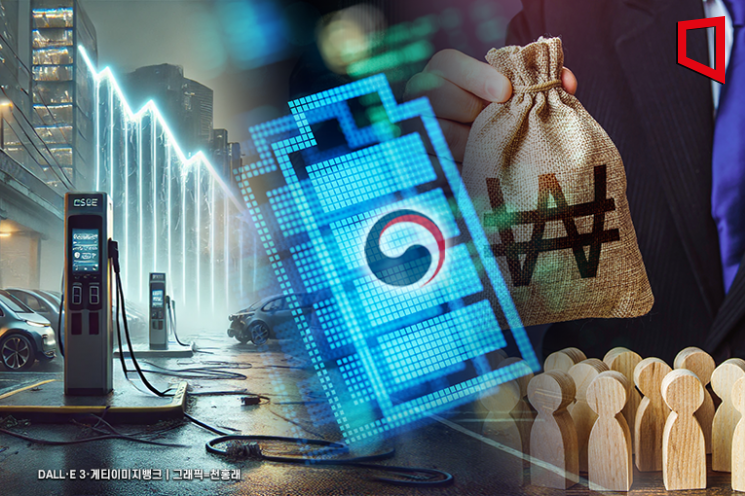
The government has decided to provide 7.9 trillion won in policy financing to secondary battery companies struggling with the electric vehicle chasm (Chasm: temporary demand stagnation). It will also expand electric vehicle purchase subsidies and increase large-capacity hydrogen charging stations.
On the 15th, the government held an Economic Ministers' Meeting on Strengthening Industrial Competitiveness, chaired by Acting President and Deputy Prime Minister for Economy and Minister of Strategy and Finance Choi Sang-mok, and announced the "Plan to Strengthen Competitiveness of Eco-friendly Vehicles and Secondary Batteries."
This is effectively the first time the government has prepared a comprehensive measure related to eco-friendly vehicles and secondary batteries. According to the Ministry of Trade, Industry and Energy, domestic electric vehicle sales recorded 164,000 units in 2022, 162,000 units in 2023, and 147,000 units in 2024, marking two consecutive years of decline, the only case among major countries. Hydrogen vehicle sales also sharply declined from 10,000 units in 2022 to 4,000 units in 2024. Due to the electric vehicle chasm, the domestic battery industry, a related sector, is worsening.
"Separate Fuel Efficiency Requirements for Medium and Large Electric Vehicles"
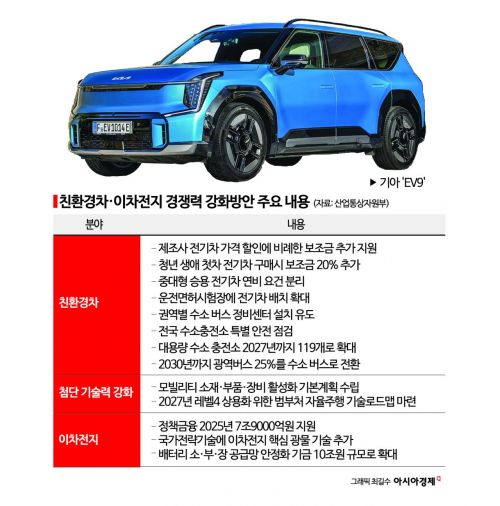
To overcome this situation, the government will first reform the purchase subsidy system to expand domestic electric vehicle adoption. From January, the Ministry of Environment will provide additional subsidies proportional to the manufacturer's electric vehicle discount amount. Currently, an additional subsidy is paid at 20% of the discount amount, but going forward, the support rate will increase to 40% for discount amounts exceeding 5 million won (2 million won for entry-level models). Also, all young people, regardless of income level, will receive a 20% additional discount benefit when purchasing their first car as an electric vehicle. The toll reduction for eco-friendly vehicles on highways will be extended until 2027.
The Ministry of Trade, Industry and Energy will separate the fuel efficiency requirements for medium and large passenger electric vehicles, which are the criteria for exemptions from individual consumption tax and acquisition tax on electric vehicles. Currently, both medium and large vehicles with fuel efficiency of 3.7 km/kWh or higher receive tax exemptions, but in the future, the medium vehicle fuel efficiency standard will be strengthened to 4.2 km/kWh, and the large vehicle standard will be relaxed to 3.4 km/kWh. Accordingly, large electric vehicles such as the EV9 and Ioniq 9 are expected to qualify for individual consumption tax and acquisition tax exemptions.
The Ministry of Land, Infrastructure and Transport will consider revising the Automobile Management Act to allow separation of battery ownership. If battery ownership separation becomes possible, electric vehicles can be purchased affordably through subscription services.
To improve convenience for electric vehicle users, the government plans to expand 4,400 fast chargers this year and promote mobile charging services. It also plans to amend the Eco-friendly Vehicle Act to allow installation of chargers in shared properties such as public parking lots without the consent of local councils. Additionally, medium-speed chargers suitable for large supermarkets and theaters will be introduced.
The National Police Agency is preparing evaluation standards for electric vehicle driving license tests and is considering allocating 10% of test vehicles as electric vehicles this year.
Expansion of Large Hydrogen Charging Stations to 119 Locations
The government plans to expand hydrogen mobility by supplying 13,000 hydrogen vehicles this year with an investment of 717.7 billion won. A total of 460.5 billion won will be spent this year to supply 2,000 hydrogen buses. The Ministry of Environment plans to provide subsidies differentiated by performance to promote high-performance hydrogen buses. The government aims to convert 25% of metropolitan buses to hydrogen buses by 2030. It will also increase hydrogen fuel subsidies and extend the reduction of natural gas fees for hydrogen fuel use until 2027.
The government plans to expand the current 56 large-capacity hydrogen charging stations to 119 by 2027 and encourage the establishment of at least one hydrogen bus maintenance center per region. Furthermore, a special safety inspection of all hydrogen charging stations nationwide will be conducted by January this year, followed by the establishment of hydrogen safety management measures.
The government plans to prepare a cross-ministerial integrated autonomous driving technology roadmap for commercialization of Level 4 autonomous driving by the first half of this year. A next-generation vehicle platform integrating vehicle control functions will also be developed by 2026.
Core Mineral Technology for Secondary Batteries Added to National Strategic Technologies
To minimize investment risks for battery companies facing difficulties due to the electric vehicle chasm, the government will invest 7.9 trillion won in policy financing for the secondary battery sector this year, an increase of more than 30% from last year's 6 trillion won.
The supply chain stabilization fund for diversifying core materials and minerals, which was 5 trillion won last year, will be expanded to 10 trillion won, double the previous amount. In addition, core mineral manufacturing and processing technologies for secondary batteries will be selected as national strategic technologies, applying preferential tax credit rates for research and development (R&D 30-50%, investment 15-35%).
Technology development to diversify battery applications beyond electric vehicles will also be supported. This year, 25.4 billion won will be invested in small solid-state lithium polymer battery technology for wearable devices, and next year, technology development will be promoted to create battery demand in industries other than electric vehicles, such as urban air mobility (UAM) and ships.
To respond to external uncertainties such as the inauguration of the new U.S. administration, the government will prepare response strategies including local job creation, regional revitalization, and technology and supply chain cooperation for Korean companies. It will strengthen cooperation with groups favorable to Korea, such as governors and members of the U.S. Congress. Furthermore, it plans to expand the foundation for entering emerging markets by utilizing free trade agreement (FTA) negotiations and official development assistance (ODA).
© The Asia Business Daily(www.asiae.co.kr). All rights reserved.


















