Minimum Wage Up About 15% in 5 Years
Both Self-Employed and Young Job Seekers Face Growing Hardships
With the minimum wage exceeding 10,000 won this year, self-employed business owners who hire part-time workers are facing increasing difficulties. As business owners try to cut labor costs, it appears to be having a negative impact on young people and economically vulnerable groups who relied on part-time jobs to earn living expenses.
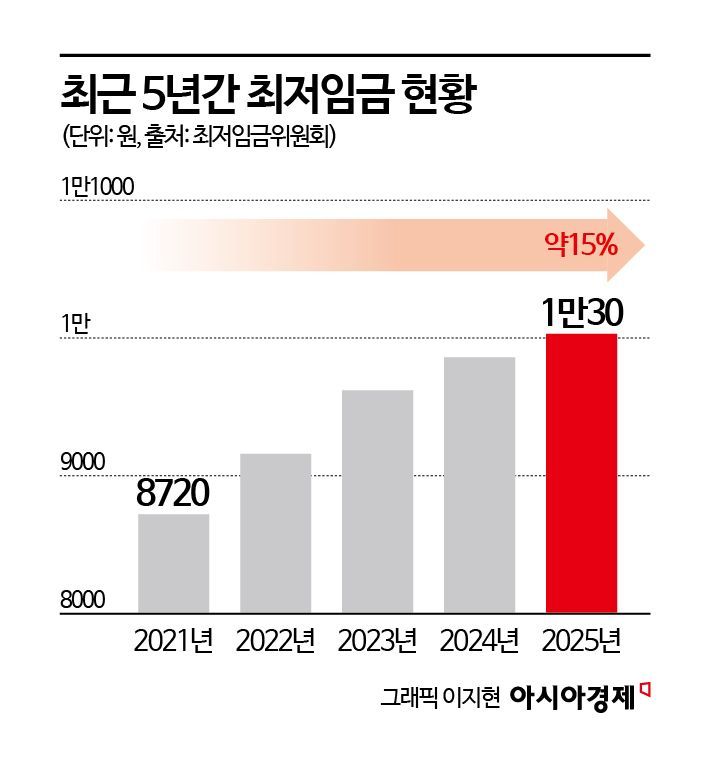
According to the Minimum Wage Commission on the 15th, the minimum wage has risen about 15% over five years: 8,720 won in 2021, 9,160 won in 2022, 9,620 won in 2023, 9,860 won in 2024, and 10,030 won in 2025.
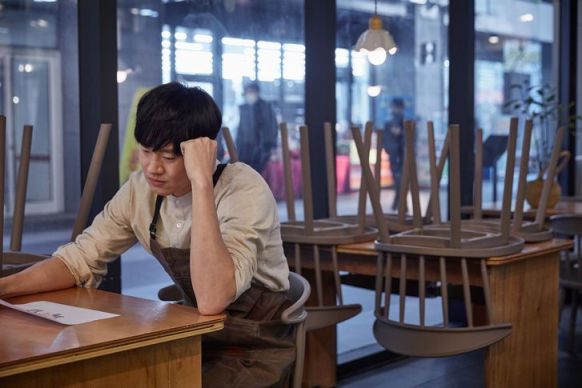
With the minimum wage surpassing 10,000 won, self-employed business owners are deeply concerned. Kim (42), who runs a Korean restaurant in front of Soongsil University in Dongjak-gu, Seoul, said, “Every time the minimum wage goes up, I sigh first,” adding, “Right now, since it’s university vacation, I’m employing only one hall part-timer, but I’m worried about what to do after the semester starts.”
Yu (57), a convenience store owner near City Hall Station in Jung-gu, Seoul, also lamented, “When you include the minimum wage and weekly holiday allowance, it actually costs more than 12,000 won per hour, so the burden is not light. My family members take turns working night and weekend shifts.” Lee (55), a Chinese restaurant owner nearby, also wore a distressed expression, saying, “When the minimum wage goes up, the four major insurances and severance pay also increase accordingly. Only the owner suffers.”
The worries of business owners directly hit part-time workers as well. Heo (20), a university student working at a cafe in Ansan, Gyeonggi Province, said, “The owner told me not to come on weekends anymore and only sent me the pay for the hours I worked,” adding, “I was suddenly kicked out, so I have to find another part-time job, which is overwhelming.” Kim Jun-young (26), who worked at a restaurant in Bongcheon-dong, Gwanak-gu, Seoul, said, “My current boss properly provides weekly holiday allowances, but I often hear about cases around me where workers don’t even get basic allowances and are abruptly fired,” adding, “Hearing such stories makes me uneasy, as it doesn’t feel like someone else’s problem.”
Experts point out that the minimum wage increase is pouring cold water on an already difficult economic situation. Kang In-su, a professor in the Department of Economics at Sookmyung Women’s University, said, “Those who pay the minimum wage and employ workers are small and medium-sized enterprises or self-employed business owners. When the economy is sluggish and labor costs rise, employment contracts, which leads to reduced consumption,” adding, “Although this year’s increase rate was not high, surpassing the psychological threshold of 10,000 won for the minimum wage creates an illusion that it has risen significantly, and the negative impact on the economy is greater.”
Choi Cheol, a professor in the Department of Consumer Economics at Sookmyung Women’s University, also advised, “While the minimum wage increase can be a huge burden for self-employed business owners, it is not an option to lower or freeze the minimum wage,” adding, “Support measures are needed to reduce the employment burden mainly on vulnerable self-employed business owners or small merchants.”
© The Asia Business Daily(www.asiae.co.kr). All rights reserved.


















