Establishing Standards for Unfair Discrimination as Follow-up to 'Mobile Terminal Act Repeal'... Continuous Monitoring
Stricter Regulation on Platforms... Enactment of Korean Version of Digital Services Act
Establishing AI User Protection System... Presenting Mid- to Long-term Media Development Plan
The Korea Communications Commission (KCC) announced that following the passage of the bill to repeal the Act on the Improvement of Distribution Structure of Mobile Communication Terminals (hereinafter referred to as the Mobile Terminal Act) by the National Assembly, it will proceed with system improvements and other follow-up measures this year. A comprehensive plan will also be prepared to prevent user damages such as unfair discrimination that may occur after the repeal of the law.
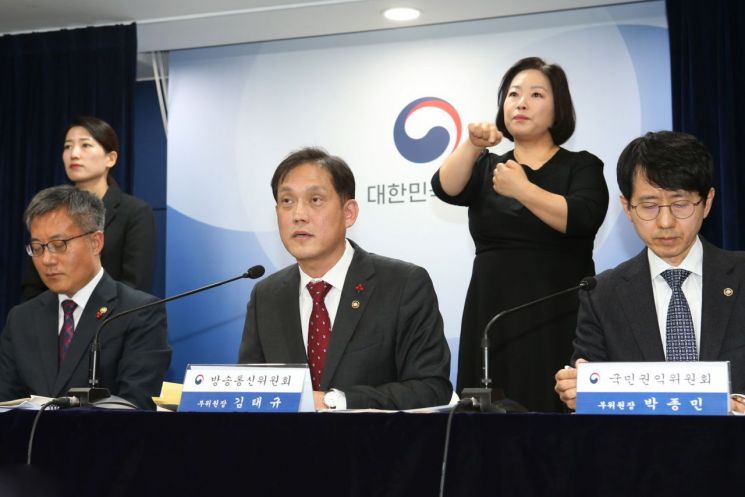 Kim Tae-gyu, Acting Chairman of the Korea Communications Commission, is speaking at the preliminary joint briefing for the 2025 Major Issues Solution Meeting held at the Government Seoul Office Building on the 13th. Photo by Korea Communications Commission
On the 14th, the KCC announced its 2025 work plan with the goal of "realizing a trustworthy and vibrant digital and media coexisting society." The main contents include ▲ follow-up measures after the repeal of the Mobile Terminal Act ▲ enactment of the Online Service User Protection Act (tentative name) ▲ establishment of legal grounds for preemptive temporary blocking of suspected illegal filming such as deepfake sexual crime videos ▲ comprehensive plan for AI user protection ▲ and presentation of a mid- to long-term media development strategy.
Establishing Standards for Unfair Discrimination as Follow-up to 'Mobile Terminal Act Repeal'... Continuous Monitoring
First, the KCC will proceed with follow-up measures such as revising subordinate statutes following the passage of the Mobile Terminal Act repeal bill in the plenary session of the National Assembly in December last year. The main points include abolishing regulatory notices such as subsidy disclosure standards and preparing types and standards for unfair subsidy discrimination through amendments to the Enforcement Decree of the Telecommunications Business Act. To prevent unfair practices and user damages arising from the repeal of the Mobile Terminal Act, a 'Comprehensive Plan for Improving the Mobile Terminal Distribution Environment' will also be prepared. Kim Taegyu, Acting Chairman of the KCC, stated, “We will prepare amendments to the Enforcement Decree of the Telecommunications Business Act before the Mobile Terminal Act enforcement to ensure there are no disruptions in the law’s implementation.”
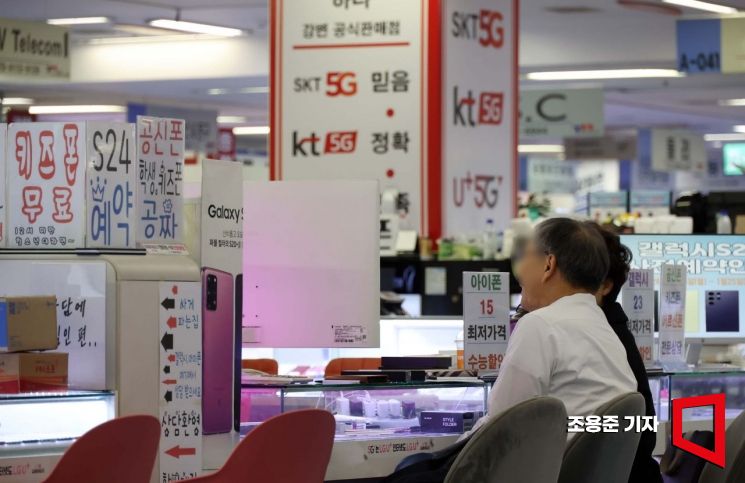 Mobile phone store related to the abolition of the Mobile Phone Special Price Law. Photo by Jo Yongjun jun21@
However, it remains uncertain whether the KCC, currently operating under a single-person system for an extended period, can properly prepare follow-up measures. Acting Chairman Kim also responded regarding follow-up measures, saying, "The commission’s functions must operate properly to prepare these, so this could be a variable." Nevertheless, he added, "The KCC’s role will also increase regarding side effects arising from the repeal," and said, "We will continue monitoring and conducting fact-finding inspections on side effects such as market confusion, exaggerated advertising, and coercion into expensive plans."
Stricter Regulation on Platforms... Enactment of Korean Version of Digital Services Act
To strengthen the social responsibility of platform operators, the Korean version of the Digital Services Act (DSA), called the 'Online Service User Protection Act (tentative name),' will also be enacted. The bill may include provisions to prevent the distribution of illegal and harmful information on platforms and to disclose content exposure standards. The DSA is a law holding online platform services accountable for illegal information and content, which has been enforced in the EU since August 2023.
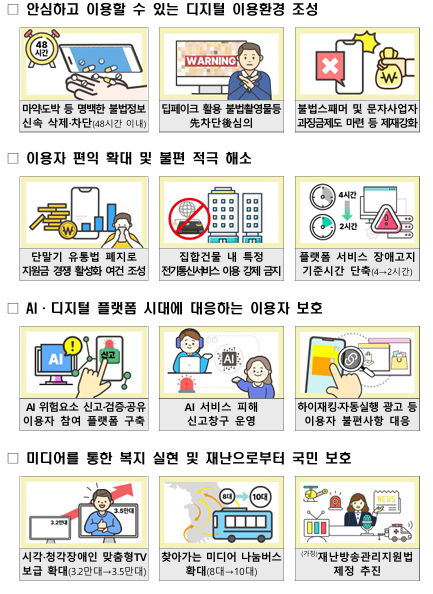
Blocking of illegal and harmful digital information will also be strengthened. To swiftly block illegal information such as drugs and gambling, if related agencies determine information to be clearly illegal and request it, the KCC will be able to directly request operators to delete or block such content.
Legal grounds will be established to allow preemptive temporary blocking and subsequent review of suspected illegal filming videos such as deepfake sexual crime materials. To prevent the spread of false manipulated information, a joint public-private self-regulation recommendation will be prepared to encourage operators’ self-purification activities and establish a phased regulatory system for information creation and distribution.
Strict measures will be taken against acts that restrict user choice on platforms closely related to daily life services such as shopping, delivery, and education, including dark patterns (comprehensive, insufficient, false, or exaggerated disclosure of important information), hijacking, and auto-play advertisements (ads that move users to specific platforms without their consent). A regulatory system for prohibited platform acts will be established, and fines imposed for violations will be raised to global regulatory levels. Regulatory enforcement will be strengthened by improving the domestic agent system for overseas operators.
Establishing AI User Protection System... Presenting Mid- to Long-term Media Development Plan
Regarding artificial intelligence (AI), a 'Comprehensive Plan for AI User Protection' will be established with the aim of protecting users. As a management system for user protection, a 'Generative AI User Protection Guideline' and an 'AI User Protection Act' will be enacted.
The guideline will be non-binding legally but will be created in a form that encourages voluntary regulation by providing specific methods to operators, such as ensuring service explainability, filtering, and reporting, based on transparency and explainability of generative AI content. The AI User Protection Act will stipulate differentiated regulations by AI type, evaluation of user protection tasks, and dispute mediation systems. Acting Chairman Kim explained about the guideline, “If it enters legal regulation, it will be difficult to operate in this form,” adding, “It plays a complementary role to legal regulation.”
Regarding media, a mid- to long-term development strategy will be presented. A broadcasting innovation strategy will be established, including policy reform plans for existing terrestrial media such as UHD, DMB, and AM radio. To establish a consistent regulatory system for new and old media such as broadcasting and online video services (OTT), the preparation of integrated media legislation to consolidate and revise regulations scattered across individual laws will also be pursued.
Acting Chairman Kim said, “The KCC will prioritize the protection and enhancement of citizens’ rights and interests and implement policies that citizens can feel across all areas including AI, digital platforms, and broadcasting,” adding, “Although there are difficulties in policy promotion due to the current vacancy in the commission, we will prepare practical measures to normalize work as soon as the commission is reconstituted.”
© The Asia Business Daily(www.asiae.co.kr). All rights reserved.



















