Labor and Working Conditions Inspections Underway
Various Safety Violations Detected at Work Sites
Fines Imposed for Late Industrial Accident Reports
KakaoTalk Messages of 1,245 Quickplacers at Sales Offices Fully Analyzed
Quickplacers Difficult to Classify as Workers Under Labor Standards Act
Ministry of Employment and Labor: "Will Guide Improvements and Monitor Implementation"
The government has imposed four legal actions and a fine of 92 million KRW on Coupang CLS (Coupang Logistics) for violations of the Industrial Safety and Health Act and related regulations through various forms of labor inspections. The inspection results revealed that issues such as the failure to conclude labor contracts and fake 3.3 contracts at Coupang CLS remain unresolved. Regarding the illegal dispatch issue between Coupang CLS and delivery drivers (Quickplacer), the government determined that a dispatch relationship does not exist.
The Ministry of Employment and Labor announced on the 14th the comprehensive results of labor inspections conducted in three areas against Coupang CLS, where various industrial safety and health and labor condition issues were raised: ▲planned inspections on industrial safety and health ▲basic labor order inspections including fake 3.3 contracts for daily workers ▲illegal dispatch inspections of delivery drivers.
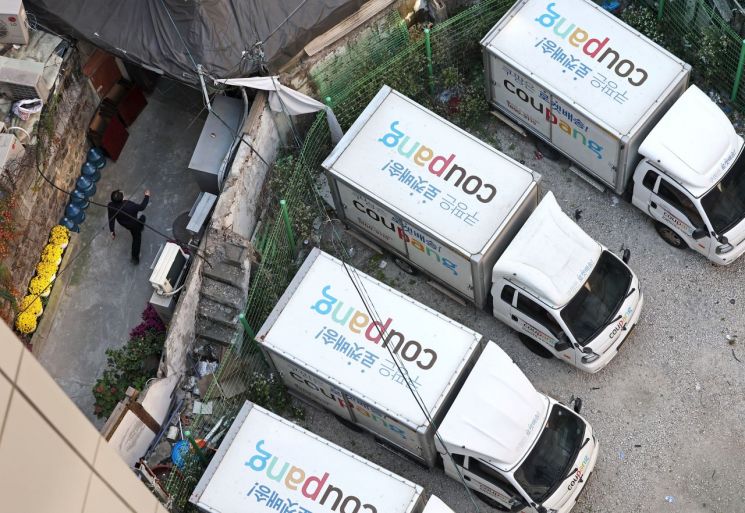
Violations of Safety Measures at Coupang CLS Conveyor Belts, etc.
For the planned industrial safety and health inspection, a total of 82 locations were targeted, including 34 headquarters and sub-hubs, 12 delivery camps, and 35 courier sales offices. The inspections were conducted over about a month from October 8 to November 14 last year during vulnerable delivery business hours at night (8 PM to midnight) or early morning (4 AM to 8 AM). As a result, violations of the Industrial Safety and Health Act were detected at 41 locations including sub-hubs, delivery camps, and courier sales offices, leading to four legal actions, 53 fines totaling 92 million KRW, and 34 corrective orders.
A sub-hub refers to a place where courier packages are sorted by region via conveyor belts. A delivery camp is where packages sorted at the sub-hub are gathered and handed over to delivery drivers to prepare for customer delivery. Courier sales offices contract with Coupang CLS and receive labor from Quickplacers under consignment contracts to deliver packages to customers.
According to Article 99 of the Enforcement Rules of the Industrial Safety and Health Standards, machinery operating devices must have locking devices with keys managed separately, but at Coupang CLS sub-hubs, forklift keys were left unattended even when the forklift operation was stopped. Article 42 requires installation of work platforms when working on operating conveyors, but appropriate installation was not done at the sub-hubs.
Also, Article 301 requires protective measures for energized parts posing electric shock risks when workers approach, but no such measures were taken for conveyor energized parts at the sub-hubs despite the risk. According to Article 87 of the Industrial Safety and Health Act, lifts must be certified for safety when installed and used, but the sub-hubs did not obtain such certification.
The Ministry of Employment and Labor confirmed that despite injuries or illnesses requiring more than three days of leave occurring at Coupang CLS delivery camps and sub-hubs, industrial accidents were reported more than one month late, resulting in a fine of 21 million KRW. Some courier sales offices failed to provide initial labor training to delivery drivers classified as special-type workers, leading to a fine of 15.14 million KRW. Additionally, a fine of 5.4 million KRW was imposed for failure to conduct special health examinations for night workers at Coupang CLS sub-hubs and subcontractors.
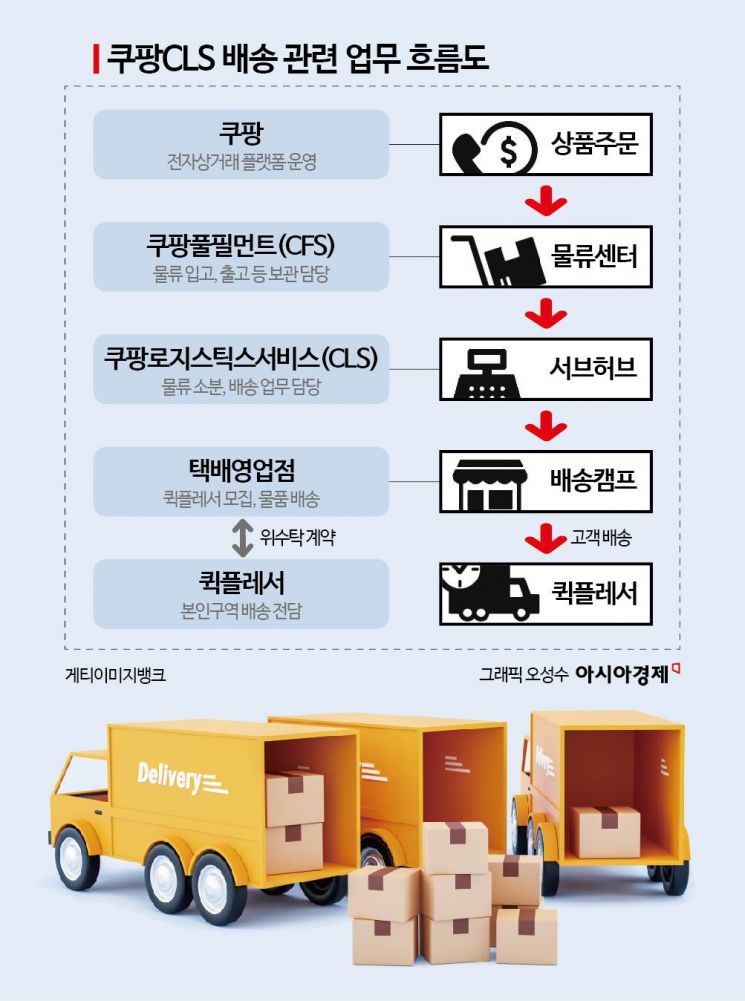
Ministry of Employment and Labor Determines Illegal Dispatch of Quickplacers Not Established
The Ministry also conducted labor condition protection inspections regarding whether daily workers at sub-hubs and delivery camps had labor contracts. The inspection covered a total of 42 locations, including eight Coupang CLS subcontractors and 22 directly managed sites where fake 3.3 contracts (a method disguising employees as individual business owners to avoid enrolling them in the four major social insurances and making workers pay 3.3% business income tax) were an issue, as well as 12 courier logistics centers including CJ Logistics and Lotte.
As a result, three Coupang CLS subcontractors did not conclude labor contracts, and four subcontractors were collecting 3.3% business income tax from 350 daily workers. Additionally, 39 locations including Coupang CLS subcontractors and other logistics centers showed 136 violations of the Labor Standards Act, such as unpaid holiday work allowances totaling 150 million KRW and failure to provide written labor condition notices. The Ministry issued corrective orders and notified the Korea Workers' Compensation and Welfare Service to enforce compulsory enrollment in the four major social insurances where applicable.
Regarding the allegation that Coupang CLS illegally dispatched Quickplacers by directing and supervising them via KakaoTalk, the Ministry conducted illegal dispatch labor inspections from October to November targeting Coupang CLS headquarters, 11 delivery camps, and 34 courier sales offices. The conclusion was that Quickplacers are difficult to classify as workers under the Labor Standards Act and that no dispatch relationship was established.
The Ministry reasoned that a dispatch relationship can only be established if Quickplacers are considered workers under the Labor Standards Act. During the inspection period, 83 on-site investigations and face-to-face interviews with 137 Coupang CLS employees and Quickplacers were conducted. KakaoTalk messages of 1,245 Quickplacers at 34 courier sales offices over the past year were analyzed to verify worker status and dispatch facts.
The Ministry explained that Quickplacers own the cargo vehicles necessary for delivery, bear vehicle maintenance costs themselves, manage their vehicles at their own responsibility, and perform delivery work. They can hire part-time workers or deliver with family members, adjust their start times at their discretion, and finish work without returning to the company or waiting. They do not receive separate instructions on delivery routes or order from Coupang CLS or sales offices, are not subject to employment rules or work regulations, and receive no fixed base salary but are paid per delivery. These factors formed the basis of the Ministry's judgment.
The Ministry also noted that KakaoTalk conversations between Coupang CLS and Quickplacers averaged fewer than five messages per day, mainly used for guidance or information in response to Quickplacer inquiries. A Ministry official stated, "(The KakaoTalk full analysis) showed that the main content was responses to procedural questions about how to handle misdeliveries or damages," and "overall, it was difficult to regard the content as binding work instructions."
Ministry of Employment and Labor: "Will Guide Improvements and Monitor Implementation"
Since this is the first inspection of the 24-hour delivery business, the Ministry of Employment and Labor demanded that Coupang CLS not only address violations but also prepare plans to protect the health rights of workers and Quickplacers and improve working conditions. The Ministry visited other courier businesses to identify applicable cases for Coupang CLS's working environment and reflected necessary improvements based on interviews with workers.
The Ministry presented improvement demands by category to induce protection of workers' health rights and working environment improvements, including ▲working hours and intensity ▲health management ▲work environment ▲others (safety and health systems within workplaces). The demands included measures to reduce night work for Quickplacers and regular health checkups to prevent diseases.
However, questions remain whether these demands, being advisory in nature, will lead to substantial improvements. The Ministry stated it will guide Coupang CLS to resolve legal violations and develop concrete plans to implement the improvement demands, while monitoring progress.
Choi Tae-ho, Director of Industrial Accident Prevention and Inspection Policy at the Ministry, said, "We expect that once improvement demands are made to Coupang CLS, appropriate measures will be prepared and implemented," adding, "We will guide and monitor to ensure faithful implementation and strive to prevent many fatal accidents or injuries at Coupang CLS workplaces this year as occurred last year."
© The Asia Business Daily(www.asiae.co.kr). All rights reserved.



















