Announcement of the '2025 Major Work Plan' by the Ministry of Land, Infrastructure and Transport
Plan to Foster 'Regional Versions of Pangyo-type Technovalley'
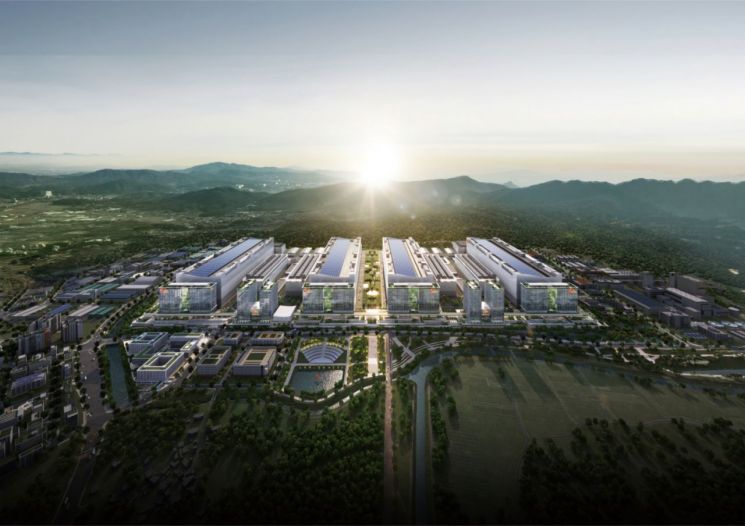
The Ministry of Land, Infrastructure and Transport announced plans to accelerate the development of 14 new national industrial complexes in regional areas to enhance local competitiveness. The Yongin Semiconductor National Industrial Complex, targeted to begin construction by December 2026, will initiate land compensation procedures and promote infrastructure development such as road construction contracts.
On the 13th, the Ministry revealed its '2025 Major Work Plan' stating, "Through the strategy to foster '8 major economic and living zones,' we will alleviate the concentration in the metropolitan area and strengthen support to revive the stagnant regional economy." The 8 major economic and living zones are divided into five super metropolitan areas (the Seoul metropolitan area plus four other super metropolitan areas), one metropolitan area (Jeonbuk), and two special zones (Gangwon and Jeju).
The Ministry plans to first conduct preliminary feasibility studies for 14 new national industrial complexes in regional areas. Two sites exempt from preliminary feasibility studies are Goheung and Uljin, with industrial complex plan approval applications expected in the first half of this year. Five sites that applied for expedited feasibility studies are Gwangju, Daegu, Daejeon, Andong, and Wanju, with plans to complete the studies within this year. Seven sites including Gangneung and Hongseong will supplement their project plans and proceed with feasibility studies within this year.
According to the Greenbelt Regulation Innovation Plan established in February last year, regional strategic projects will be selected next month to utilize greenbelt areas as a foundation for job creation. In the second half of this year, Korean-style 'White Zones'?urban innovation zones with significantly relaxed urban regulations?will also be identified.
To foster 'regional versions of Pangyo-type Technovalley,' a comprehensive development plan will be established in the second half of this year to create a corporate investment environment by linking five urban convergence special zones (Busan, Daegu, Gwangju, Daejeon, Ulsan) with opportunity development zones. In March this year, corporate move-ins will begin at Hannam University Campus Innovation Park, which supports collaboration among regions, companies, and universities, and the second Campus Innovation Park will be completed within the year.
In the first half of this year, an international integrated design competition will be held in Sejong City to establish the President’s second office and the National Assembly Sejong Hall. At Saemangeum, reflecting corporate demand, an additional 200,000 pyeong of industrial land will be expanded within the national industrial complex, and a development plan for the second industrial complex will be established within the year.
To unify each zone into a single economic and living area, the metropolitan transportation network will also be expanded. This includes completing a private investment feasibility study for the Chungcheong Regional Express Railway (CTX) next month and promoting regional metropolitan railway projects. In December this year, the Seodaejeon IC to Dugye 3-ga (Gyeryong) metropolitan road will open. Connection road networks within the zones, such as the Dasa to Waegwan metropolitan road, will also be expanded.
© The Asia Business Daily(www.asiae.co.kr). All rights reserved.
![Clutching a Stolen Dior Bag, Saying "I Hate Being Poor but Real"... The Grotesque Con of a "Human Knockoff" [Slate]](https://cwcontent.asiae.co.kr/asiaresize/183/2026021902243444107_1771435474.jpg)
















