It cost 940.7 billion won to support free high school education
This year’s budget is only about 5.27 billion won from last year’s settlement
“Financial management burden in the process of securing funds”
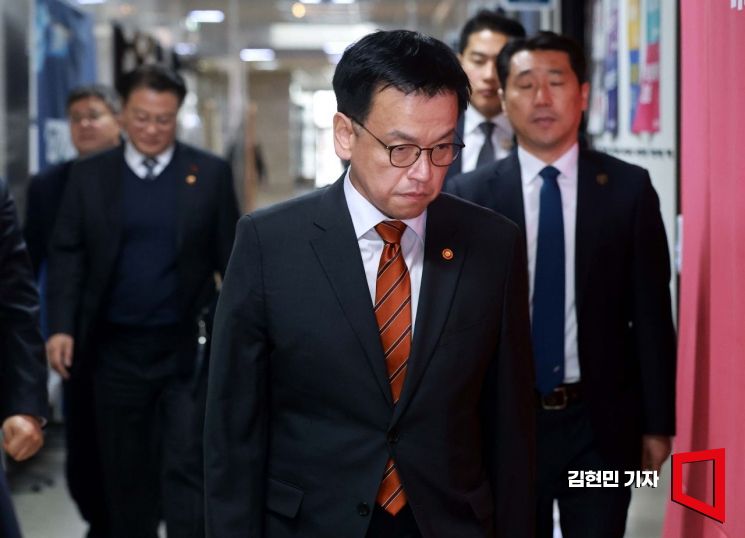
Choi Sang-mok, Acting President and Deputy Prime Minister as well as Minister of Strategy and Finance, plans to exercise the right to request reconsideration (veto power) on the amendment related to free high school education. From this year, the burden that was previously on the government until last year has been shifted to the education offices, but the government’s position is that if the bill passes, it will cause confusion in budget order, such as reducing the educational projects planned for this year or spending contingency funds that should be reserved for disaster preparedness.
According to government officials on the 13th, Acting President Choi is expected to exercise the veto power on the “Local Education Finance Grant Act (Grant Act) amendment” that the opposition party passed unilaterally at the Cabinet meeting on the 14th. This law includes extending the national government’s support for free high school education, which ended last year, until 2027. Free high school education began in 2019, with the government temporarily covering 47.5% of the funding. From this year, the education offices were supposed to bear the full cost, but if the bill passes, the government will have to pay again.
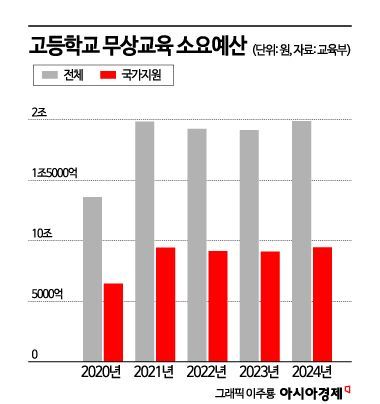
The problem is that there is no related budget for this year. Last year, free high school education cost a total of 1.9889 trillion won, with the government spending 944.7 billion won. However, this year’s free education budget is only 5.267 billion won from last year’s settlement. Unless a supplementary budget is prepared, even if the law passes, there is no money to execute it. A government official explained, “The opposition party did not reflect the budget during the process of passing the unilateral reduction bill last year,” adding, “There is no choice but to bear the burden in financial management while trying to secure funds somehow.”
The Democratic Party of Korea stipulated that contingency funds could be used for education if the bill passes, but the government considers this inappropriate. Contingency funds, which are emergency funds, are supposed to be used only in crises such as natural disasters or sudden exchange rate fluctuations. The size of the contingency fund is only 1.6 trillion won, so having to use more than half of it is also a burden.
The Ministry of Education is concerned that unexpected expenditures of about 1 trillion won could disrupt existing educational projects. Lee Ju-ho, Deputy Prime Minister and Minister of Education, appeared before the National Assembly’s Legislation and Judiciary Committee in November last year and said, “(If the bill passes) we will have no choice but to cut the higher education budget, which is really difficult,” adding, “The higher education budget is much more insufficient, so I think such a thing should not happen.”
The Ministry of Strategy and Finance analyzes that the free high school education project is sufficiently feasible with the education offices’ own budgets. The “Local Education Finance Grant” sent by the government to the education offices is gradually increasing. This year’s grant is 72.2794 trillion won, an increase of 3.4062 trillion won from the previous year. On the other hand, the number of high school students is expected to continue decreasing from the 1.3 million range, so there is no problem with implementation.
Since President Yoon Seok-yeol’s impeachment motion, the veto power under the acting system has been exercised twice in total. Prime Minister Han Duck-soo exercised veto power last month on six bills including the Grain Management Act, and Acting President Choi exercised veto power on the Special Prosecutor Act for Internal Rebellion and Kim Geon-hee.
© The Asia Business Daily(www.asiae.co.kr). All rights reserved.


















