A Visit to VOLK, a Machining Specialist
Precision Machining Stands Out as Defense Exports Rise
In 1974, former President Park Chung-hee ordered the establishment of an industrial complex in Changwon City, Gyeongnam Province, aiming for industrial development. This is how the Changwon National Industrial Complex was born. The Changwon National Industrial Complex has played a leading role in Korea’s rapid economic growth as the domestic "mecca of the machinery industry," in line with its founding purpose. Due to the unstable international security situation, such as the Ukraine-Russia war, K-defense exports have increased, ushering in a "defense industry renaissance" for the Changwon National Industrial Complex. Behind the K-defense exports lies the strength of small and medium-sized defense companies. To see their technological capabilities, we visited Changwon City.
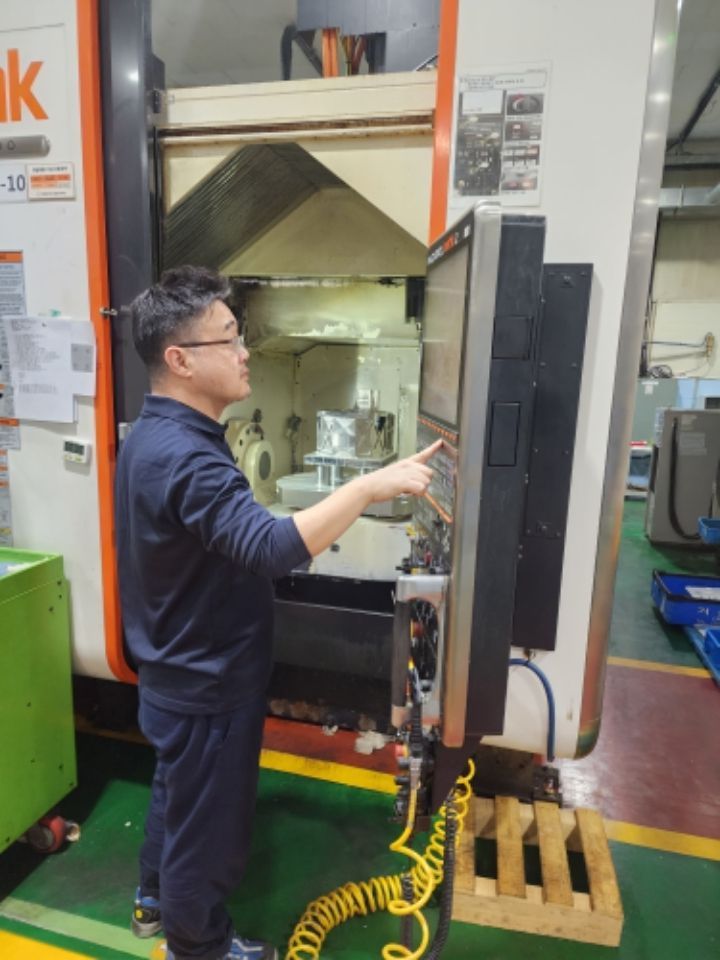 The exterior of the processing machine is quieter than expected, but inside, cutting fluid must be sprayed to control the temperature caused by friction during processing. (Photo by Volk)
Upon entering the industrial complex, factories were arranged in a grid pattern. It was clear that the industrial complex was planned and developed systematically. We visited VOLK, a machining specialist company (hereafter referred to as VOLK). Since it is a machining specialist, we expected loud machine noise. That was a misconception. It was quiet. VOLK, which started as Gwangseong Precision, has been increasing its defense sales ratio every year. Before 2018, defense sales accounted for only 34%, but since then, they have made up 65%. More than half of the annual 30 billion KRW sales come from defense sales. A company official said, “As advanced weapons evolve, precision machining work also advances,” adding, “As defense exports increase, the importance of domestic parts production grows, leading to increased sales.”
Precision Machining Required for Every New Weapon
Following the company official, we entered the first-floor machining site. Machining machines were lined up. Machining machines are divided into 3-axis and 5-axis machines. In the past, 3-axis (X, Y, Z) machining was the focus, but recently, the volume of 5-axis machining, which adds rotation and tilt, has increased. This means higher precision is required. Even the task of mounting tools before the machining process was complicated. Tools vary depending on the material. When mounting the selected tool on the machining machine, it must be inspected to ensure proper installation. Even a slight tilt during mounting leads to defective products.
Among the machining volume were parts for medium- and high-altitude reconnaissance unmanned aerial vehicles (MUAVs). MUAV is Korea’s first strategic-class unmanned aerial vehicle that conducts reconnaissance of ground targets from an altitude of 10 to 12 km. VOLK manufactured an assembly to mount the MUAV camera. They carved a 146 kg titanium block into a 7 kg assembly. The exterior of the 5-axis machining machine was quieter than expected. However, inside it was noisy. It continuously carved the material while spraying white cutting fluid. Temperature inside the machine during machining is also important. Heat is generated by friction, and if the temperature is not maintained, deformation occurs during the machining process, directly causing defects. It takes VOLK four months to produce one camera assembly because the machining process is not done all at once.
Various Durability Tests for Ship Cabinets
In the area where products were displayed, there were system cabinet (equipment storage) parts used in the Ulsan-class Batch-Ⅲ. The Ulsan-class Batch-Ⅲ is the Navy’s latest escort ship capable of simultaneously launching 8 to 10 anti-ship missiles. The server, the brain of the escort ship, is stored in the cabinet. VOLK produces this cabinet. The cabinet parts resembled small furniture components and looked simple. However, the procedures were complicated. All parts’ dimensions were critical. Produced parts were placed on inspection machines. The inspection machine’s needle measured the parts with a “beep” sound each time it touched them. Even small deviations from the design were not tolerated. Besides dimensions, durability was important. The parts must withstand vibrations, shocks, and electromagnetic interference (EMI) shielding tests while operating on a moving ship. Efficient use of internal space was also crucial. Due to the limited space on ships, all components must maximize space utilization. VOLK changed the cabinet repair method from one requiring removal of the entire server inside to a method allowing removal of only the server.
Jeong Su-je, the site manager, said, “Machining must be thoroughly verified down to 10 microns (0.001 mm),” adding, “The inspection machines are regularly calibrated and verified by accredited certification bodies.”
Efforts to Reduce Weight and Increase Strength
VOLK continued various attempts regarding parts used in ships. They introduced carbon composite materials. Compared to aluminum, weight was reduced by 50%, but strength increased by 6 to 7 times. It also withstands vibrations. VOLK also independently produced multifunction consoles (system control equipment) used by ship commanders. The console is a kind of desk that allows viewing the ship’s status and enemy movements at a glance. VOLK designed the console’s height and control layout tailored to the operator to reduce fatigue.
Kim Seong-gon, head of the business division, said, “Companies capable of turnkey delivery (where the producer delivers a product ready for immediate use by the buyer) must prioritize quality,” adding, “We will grow into a machining company that can grow alongside K-defense.”

© The Asia Business Daily(www.asiae.co.kr). All rights reserved.
![Clutching a Stolen Dior Bag, Saying "I Hate Being Poor but Real"... The Grotesque Con of a "Human Knockoff" [Slate]](https://cwcontent.asiae.co.kr/asiaresize/183/2026021902243444107_1771435474.jpg)
















