Controversy Over Claim:
"Successful Working Women Have Shorter Lifespans"
A professor in China made an absurd claim that successful working women generally have shorter lifespans, and women who have given birth to 10 children can live up to 100 years.
On the 12th, the Hong Kong South China Morning Post (SCMP) reported, citing local media, that a professor at a university in the Inner Mongolia Autonomous Region of China sparked controversy by stating, "Women who have given birth to 10 children can live up to 100 years."
During a lecture, the professor claimed, "When a woman gives birth, God bestows grace to let her live longer, and successful women generally have shorter lifespans," adding, "Rural grandmothers who have given birth to 8 to 10 children usually live to 90 or 100 years old, and their chances of getting sick are very low."
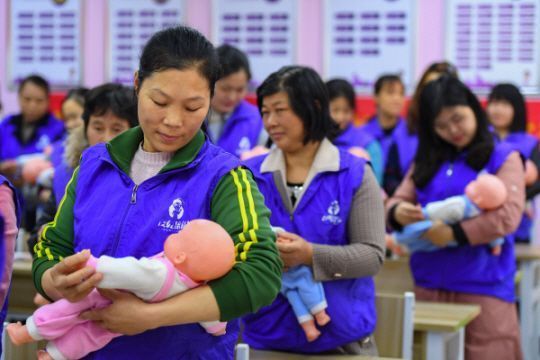 Trainees learning infant nursing skills at a vocational training school in Changsha County, Changsha City, Hunan Province, central China, on April 9 last year. Photo by Xinhua News Agency
The professor is also known to have worked as a doctor in a hospital and reportedly earns 300,000 yuan (about 60 million KRW) annually. However, the name of the university where he is employed has not been disclosed.
The video containing the professor’s remarks rapidly spread online locally. Netizens who saw it expressed anger with comments such as, "Is there any accurate scientific evidence?", "Are women who die during childbirth also blessed by God?", "Are they forcing us to have children? Raising children is too costly and educating them is a difficult task. No matter what experts or the government say, I will not have more children," "How can a professor be unaware of the risks of childbirth?", and "This is an excessively unrealistic claim."
Meanwhile, China has faced population decline and a drop in birth rates in recent years. In 2022, the population decreased for the first time in 60 years, and in 2023, the number of births was 9.02 million, falling below 10 million for the second consecutive year. The total fertility rate (the average number of children a woman is expected to have in her lifetime) in 2023 was 1.0, which is lower than the United States (1.62) but slightly higher than South Korea (0.72).
In response, Chinese authorities have implemented birth promotion policies, such as local governments calling married women in their 20s and 30s to inquire about pregnancy plans, providing cash support to parents, and encouraging families to have two or more children.
However, major foreign media, citing experts, pointed out, "Official policies alone to increase birth rates are unlikely to persuade the younger generation to start families. Especially with high unemployment and sluggish economic growth, young people are postponing marriage and childbirth." Wang Feng, a Chinese professor specializing in population statistics, also criticized, "The Chinese government’s birth promotion campaigns are not effective," adding, "Young women, in particular, face not only high living costs but also serious disadvantages if they quit their jobs to have children."
© The Asia Business Daily(www.asiae.co.kr). All rights reserved.
![Clutching a Stolen Dior Bag, Saying "I Hate Being Poor but Real"... The Grotesque Con of a "Human Knockoff" [Slate]](https://cwcontent.asiae.co.kr/asiaresize/183/2026021902243444107_1771435474.jpg)
















