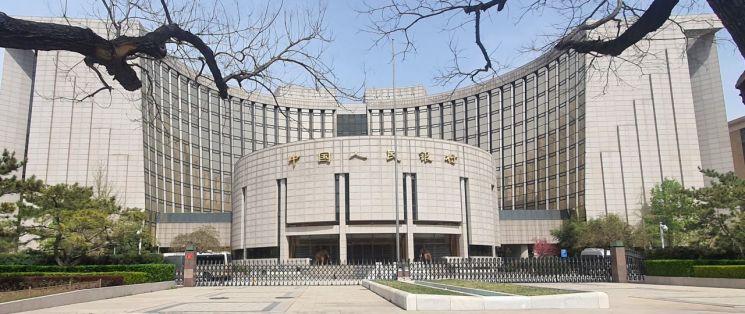
China's central bank, the People's Bank of China, has decided to temporarily suspend the purchase of government bonds through open market operations starting this month, according to a report by the state-run Xinhua News Agency on the 10th.
The People's Bank of China stated that this decision was made because demand in the government bond market recently exceeded supply, and that it plans to resume purchases at an appropriate time depending on market conditions.
Since last year, investors concerned about the continuous weakness of the Chinese economy have flocked to safe assets, causing Chinese bond yields (interest rates) to fall to record lows. A decline in bond yields means a rise in bond prices. Additionally, as bond interest rates fell, the value of the yuan also dropped to a record low.
Earlier this month, the 10-year Chinese government bond yield fell to a record low of 1.6%, pushing the yield gap between Chinese and U.S. government bonds to an unprecedented level of 300 basis points (1bp = 0.01 percentage points). The Wall Street Journal (WSJ) reported that this puts significant pressure on the yuan, which has been hit by tariff threats from the Trump administration and a strong dollar. Since early December last year, the yuan has depreciated by 1.3% against the dollar and remains at a 16-month low.
In response, the People's Bank of China announced the day before that it will issue central bank securities with a total value of 60 billion yuan and a maturity of six months in Hong Kong on the 15th to appreciate the yuan. Issuing central bank securities in Hong Kong can absorb local yuan liquidity and induce yuan appreciation in the offshore market.
Ken Cheng, Asia foreign exchange strategist at Mizuho Bank, explained, "The authorities have shown discomfort with the decline in government bond yields and the increasing downward pressure on the yuan's value," adding, "The downward pressure on the yuan will continue due to the strong dollar and U.S. tariff threats."
© The Asia Business Daily(www.asiae.co.kr). All rights reserved.
![Clutching a Stolen Dior Bag, Saying "I Hate Being Poor but Real"... The Grotesque Con of a "Human Knockoff" [Slate]](https://cwcontent.asiae.co.kr/asiaresize/183/2026021902243444107_1771435474.jpg)
















