Opposition Confident in Passage with 'Third-Party Recommendation, Veto Power Excluded'
Ruling Party Opposes, Citing Impact of Foreign Exchange Inducement Crime Through Presidential Election
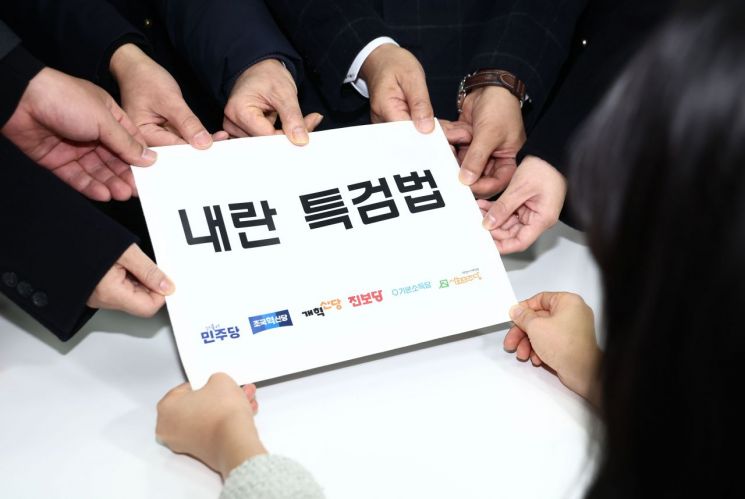
The six opposition parties, including the Democratic Party of Korea, have complicated the calculations between the ruling and opposition parties by reintroducing the special investigation law on treason, partially reflecting the ruling party's demands. The opposition is confident of passing the bill in the National Assembly as the ruling party's grounds for opposition have weakened, but the ruling party has announced plans to propose its own special investigation law, calling the current bill a 'hasty legislation.'
According to political circles on the 10th, the core of the special investigation law on treason reintroduced by the opposition the day before is that the authority to recommend special investigation candidates is given to a third party, the Chief Justice of the Supreme Court, rather than the opposition party. The opposition party's 'veto power' to reject the Chief Justice's recommended candidates if deemed inappropriate was also excluded. The number of dispatched prosecutors and public officials appointed as special investigation officers was reduced from the original 205 to 155, a cut of 50, and the investigation period was shortened by 20 days from 170 to 150 days.
The Democratic Party's significant acceptance of the ruling party's claims stems from the fact that the special investigation law on treason was narrowly rejected by just two votes in the National Assembly plenary session on the 8th. Kim Yong-min, the Democratic Party's deputy floor leader for policy, said, "We have resolved most of the issues raised by the government and the People Power Party in their opposition to the special investigation." From the Democratic Party's perspective, the reintroduced bill must be passed to quell criticism over delays in passing the special investigation law on treason. A first-term Democratic Party lawmaker explained in a phone interview, "Although there are some regrets, this reintroduced special investigation law is expected to pass as the ruling party no longer has grounds to oppose it."
A variable is President Yoon's foreign exchange inducement crime included in the special investigation law on treason. The foreign exchange inducement crime excludes the statute of limitations and carries severe penalties, including the death penalty or life imprisonment.
The People Power Party criticized the Democratic Party's revised and reintroduced special investigation law as a hasty bill made for public opinion manipulation. Within the People Power Party, attention is focused on the fact that the revised and reintroduced special investigation can investigate for up to 150 days. There are concerns that public opinion manipulation could continue through the foreign exchange inducement charges, treason incitement, related complaints and accusations, as well as the Constitutional Court's impeachment trial and acceptance of the impeachment motion leading up to the presidential election. Kwon Seong-dong, the People Power Party floor leader, claimed at a party strategy meeting held at the National Assembly that morning, "The special investigation law proposed by the Democratic Party opens the door to unlimited special investigations by allowing the scope of investigations to be infinitely expanded."
However, the People Power Party also finds it burdensome to maintain a political stance of rejecting the special investigation law without alternatives, so it is simultaneously moving to draft its own special investigation law. At the first vote on the special investigation on treason on December 12 last year, five lawmakers?Ahn Cheol-soo, Kim Ye-ji, Kim Yong-tae, Kim Jae-seop, and Han Ji-a?voted in favor, and in the re-vote the day before, six lawmakers voted in favor, increasing the number of dissenting votes by one.
Accordingly, the floor leadership has requested the legal advisory committee to prepare a draft of its own special investigation law. Floor leader Kwon told reporters, "We are preparing a bill that includes the supplementary and exceptional nature of the special investigation and removes unconstitutional elements," adding, "If it is prepared quickly, I think it can be discussed next week."
Meanwhile, it is noteworthy that Jeong Seong-ho, considered a leader of the pro-Lee Jae-myung faction within the Democratic Party, is calling for the restoration of political relations between the ruling and opposition parties. He emphasizes that the large opposition party, the Democratic Party, should resolve the special investigation issue through active dialogue with the ruling party.
Jeong told reporters ahead of a forum at the National Assembly Members' Office Building in Yeouido, Seoul, on the 10th, "The current relationship between the ruling and opposition parties is completely severed. Mutual criticism and ridicule have become routine, but that should not be the case," adding, "Democracy is about recognizing differences and striving to overcome them."
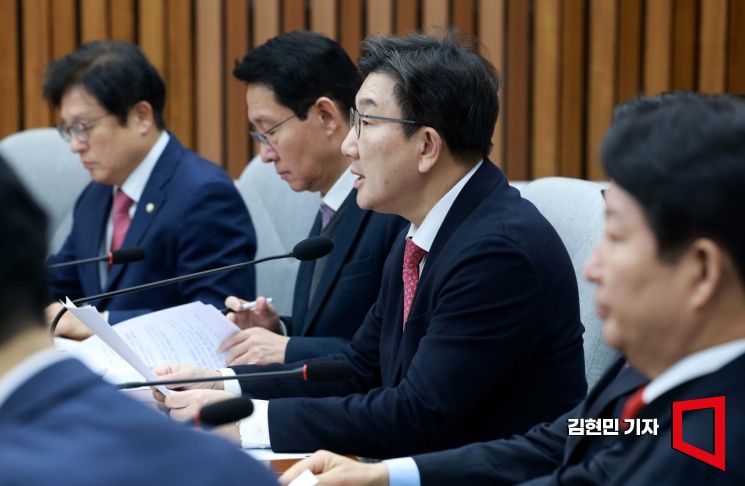 Kwon Seong-dong, floor leader of the People Power Party, is speaking at the party's strategy meeting held at the National Assembly on the 10th. Photo by Kim Hyun-min
© The Asia Business Daily(www.asiae.co.kr). All rights reserved.


















