"We don't know the scale of returning students... Currently evaluating existing quotas first"
"Return of medical students means significant changes even for schools without increased quotas"
The Korea Institute of Medical Education and Evaluation (KIMEE) is reportedly considering conducting a major change evaluation for medical schools located in Seoul, including Seoul National University, Yonsei University, and Korea University, in relation to the issue of medical school quotas. If this happens, next year's freshmen at these medical schools may not qualify to take the national medical licensing examination, resulting in a situation where they cannot practice as doctors even after graduation.
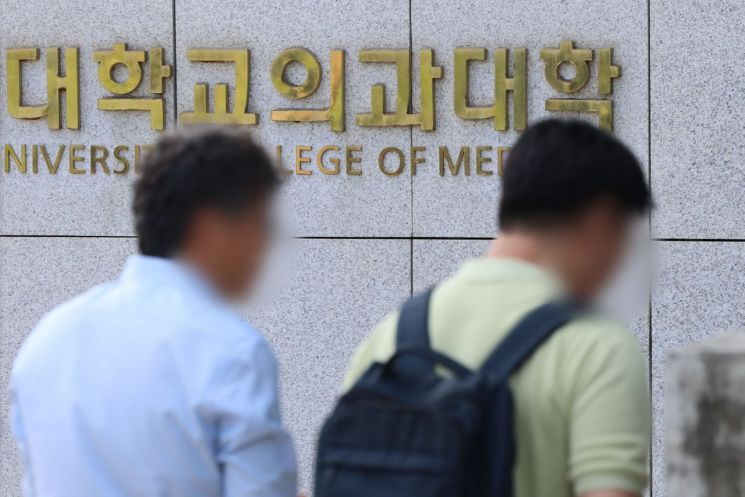
On the 10th, Andeokseon, president of KIMEE, told Asia Economy, "If medical students who took a leave of absence last year return to school, not only the 30 medical schools currently undergoing major change evaluations but also 10 medical schools in Seoul, including 8 that have not yet been evaluated, will experience significant changes in student numbers," adding, "This could also be considered an increase in quota that warrants a major change evaluation, so it is under discussion."
KIMEE is an institution designated by the Ministry of Education responsible for the evaluation and accreditation of medical schools. KIMEE's accreditation includes regular evaluations, interim evaluations, and major change evaluations. Major change evaluations are conducted when significant changes are expected in medical education, such as changes in affiliated hospitals, campus relocation or division, ownership changes, or changes in student numbers.
In the case of student numbers, if there is an increase of 10% or more compared to the total enrolled students, a major change evaluation can be conducted. Accordingly, 30 medical schools outside Seoul are currently undergoing major change evaluations, but KIMEE's position is that a "de facto increase due to returning students" could also be a reason to conduct such an evaluation. The 30 medical schools currently being evaluated may also need to undergo another evaluation depending on the return of students who took leaves of absence.
For example, Medical School A in Seoul with a quota of 100 students was not originally subject to a major change evaluation because there was no increase in quota, but if first-year students who took a leave of absence last year return, the school would have to educate about 200 students instead of 100.
All medical schools located in Seoul, including Seoul National University, Yonsei University, Korea University, Hanyang University, Kyung Hee University, Chung-Ang University, Catholic University, and Ewha Womans University, are expected to fall under such cases. The evaluation results are divided into accreditation and non-accreditation. A non-accreditation decision can be deferred for one year. According to the Medical Service Act, if a medical school was not accredited at the time of admission, graduates cannot take the national medical licensing examination.
This situation arose because medical students who took a leave of absence in February last year due to prolonged medical-government conflicts have not yet expressed their intention to return. As of last year, the existing quota for medical schools nationwide was 3,058 students. The government initially expected 4,567 newly admitted students to attend first-year classes, but if students on leave return, the number attending the same classes would reach about 7,500.
KIMEE also drew attention during the closure of Seonam University Medical School in 2018. Seonam University failed KIMEE's accreditation evaluation in 2013 and again failed an additional evaluation in 2016, which eventually led to students dispersing to other schools and the university closing down.
© The Asia Business Daily(www.asiae.co.kr). All rights reserved.
![Clutching a Stolen Dior Bag, Saying "I Hate Being Poor but Real"... The Grotesque Con of a "Human Knockoff" [Slate]](https://cwcontent.asiae.co.kr/asiaresize/183/2026021902243444107_1771435474.jpg)
















