Mawakana CEO Emphasizes Importance of Partnership with Hyundai Motor
Confident in Competitive Edge over Tesla's Vision-Based Lidar System
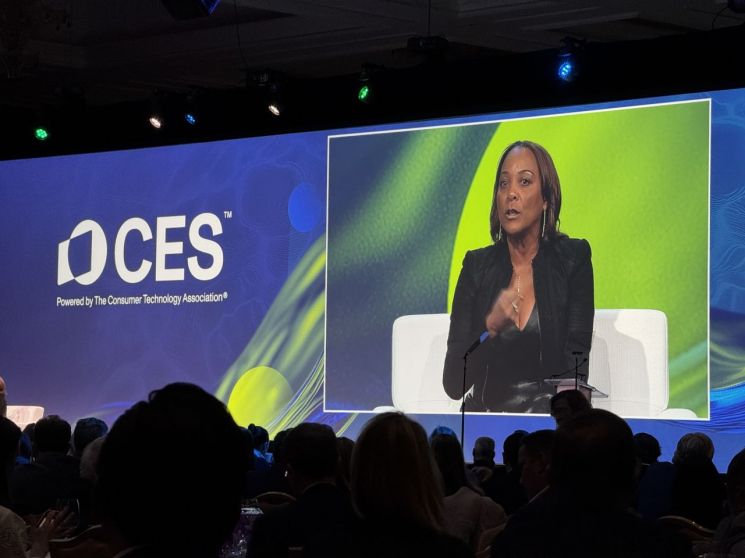 Tekedra Mawakana, Co-CEO of Waymo, explained the importance of collaboration with Hyundai Motor Company at a conversation event with CES tech leaders held on the evening of the 8th (local time) at the Wynn Hotel in Las Vegas. Photo by Baek Jongmin
Waymo, Google's autonomous driving robo-taxi division, has revealed ambitious plans to expand its autonomous taxi service using LiDAR technology in collaboration with Hyundai Motor Company. It also expressed the view that while the United States will lead the world in autonomous driving under President-elect Donald Trump, appropriate regulations are necessary.
Tekedra Mawakana, co-CEO of Waymo, focused on emphasizing the superiority of LiDAR-based systems during the 'Conversation with Tech Leaders' event at CES 2025, the world's largest electronics and IT exhibition, held on the evening of the 8th (local time) at the Wynn Hotel in Las Vegas, USA. She actively announced that Waymo is preparing a new autonomous robo-taxi service based on the Ioniq 5 in cooperation with Hyundai Motor Company.
CEO Mawakana stated, "Our collaboration with Hyundai is an important step toward expanding autonomous driving technology," adding, "The Waymo robo-taxi service will fully utilize the Ioniq 5 starting from the end of 2025."
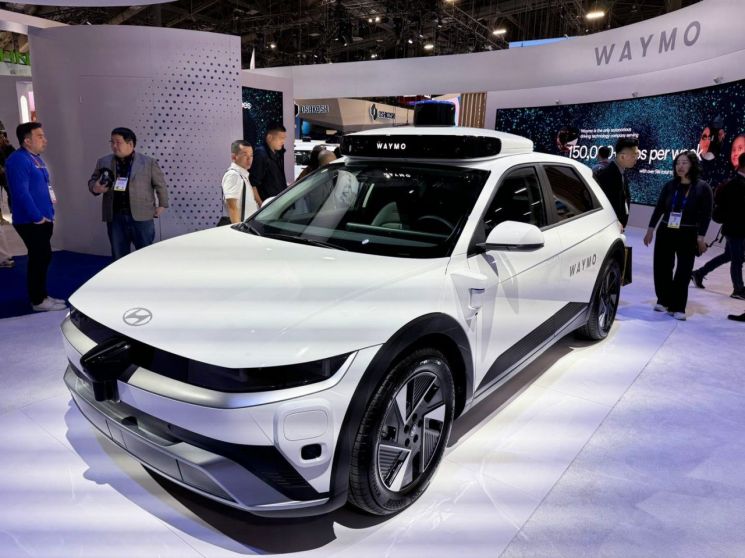 The world's largest home appliance and IT (Information Technology) exhibition, 'CES 2025,' features Waymo, a Google subsidiary's 6th generation robotaxi, the Hyundai Ioniq 5. Photo by Yonhap News
Waymo plans to introduce Hyundai's Ioniq 5 vehicles into its autonomous driving service through this partnership. The Ioniq 5 autonomous vehicle was also exhibited at this CES.
According to her, the Hyundai autonomous vehicles used by Waymo will be produced at Hyundai's factory in Georgia, USA. These vehicles will be equipped with Waymo's latest 6th-generation autonomous driving technology called the 'Waymo Driver.' Initially, driver controls such as a steering wheel and accelerator pedal will be installed in accordance with U.S. regulations.
CEO Mawakana's emphasis on LiDAR technology can be seen as highlighting the technological superiority over Tesla's vision system-based autonomous driving approach. The autonomous driving industry continues to debate between LiDAR and camera-based vision systems. Tesla switched from LiDAR to a camera-based vision system citing cost efficiency and mass production feasibility.
LiDAR uses wireless radar technology to measure distances accurately but the sensors themselves are expensive. Waymo claims to ensure safety and redundancy through a multi-sensor system combining LiDAR, radar, and cameras.
CEO Mawakana emphasized, "'Waymo Driver' adopts an integrated approach to enhance spatial understanding and reasoning capabilities," adding, "This is the result of 15 years of accumulated experience at Waymo."
Regarding Elon Musk, CEO of Tesla, who operates a competing company and has been appointed head of the Department of Government Efficiency (DOGE) in the upcoming Donald Trump administration, CEO Mawakana stressed, "Regulatory frameworks should be based on each company's safety record." She argued that the introduction of autonomous vehicles will be a critical turning point for public safety beyond mere innovation, requiring transparency and trust-building.
She forecasted, "The goal of autonomous driving technology is not perfection but to significantly improve existing traffic safety levels," adding, "Autonomous driving technology will revolutionize road safety, provide sustainable mobility, and have a positive impact on society as a whole."
© The Asia Business Daily(www.asiae.co.kr). All rights reserved.


















