ETFs Gaining Popularity Due to Lower Risk Compared to Direct Investments
#. Office worker Kim Ho-yeon (51) has set an investment plan to purchase exchange-traded funds (ETFs) such as 'SCHD' (Schwab US Dividend Equity ETF) through installment savings this year. Kim said, "U.S. stocks consistently trend upward, so I believe I can steadily grow my assets with stability," explaining the reason for his investment. SCHD is an ETF that tracks the Dow Jones U.S. Dividend 100 Index. It invests in 100 high-quality U.S. dividend stocks.
Recently, the number of individual investors seeking ETFs has increased. The Standard & Poor's (S&P) 500 Index, representing the U.S. stock market, recorded a rise of over 20% for two consecutive years, and as expectations for steady and stable returns grew, more people have been looking for ETFs that track the S&P 500 Index. In fact, as the ETF market has rapidly grown, the total net assets of domestic ETFs exceeded 176 trillion won this year. This is an increase of more than 45% compared to the previous year (about 121 trillion won). As of the end of November last year, the number of ETF listings reached 935.
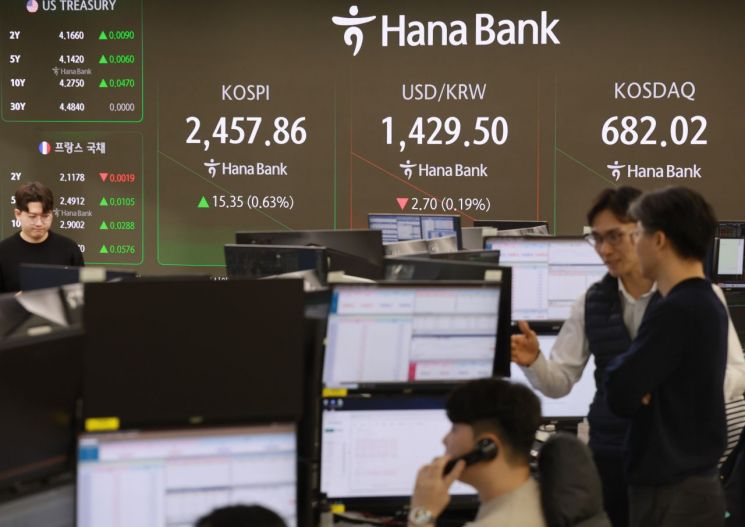 Various domestic and international indices are displayed on the electronic board in the dealing room of Hana Bank in Euljiro, Seoul. The photo is not related to the specific content of the article. Photo by Heo Young-han
ETFs are products created by listing index funds on the exchange that are designed to track the returns of market indices such as KOSPI 200 or S&P 500, allowing investors to trade them conveniently like stocks. For example, if the product overview specifies that the underlying index is the KOSPI 200 Index, it means the ETF follows the returns of the KOSPI 200 Index. If the KOSPI 200 generally shows strength, the ETF rises; if the opposite, it falls.
The advantage of ETFs is often described as 'low cost and high efficiency.' Direct investment in individual company stocks requires understanding and analysis of the company and industry. However, with ETFs, investors can diversify across multiple stocks with a small amount of money to trade one unit, reducing the risks associated with investing in individual stocks. In a situation where savings and deposit interest rates are unattractive, ETFs can be a good option. Currently, the fixed deposit interest rate at commercial banks is only in the 3% range annually, but the 'TIGER U.S. S&P 500 ETF,' which recorded the highest cumulative net purchase volume by individuals among domestic listed ETFs last year, posted a return of 43.94%.
Compared to general public funds, ETFs also offer greater convenience in trading. General funds require visiting financial institutions and completing paperwork, making subscription relatively complicated, but ETFs can be traded in real-time on the exchange like stocks. Management fees are also cheaper. General funds usually charge management fees of over 1%, but most ETFs have annual management fees below 0.1%.
If you are a beginner ETF investor... check 'this'
Since ETFs also carry the risk of principal loss, there are points to know before investing. First, it is necessary to check which stocks compose the ETF you want to invest in. Also, check management fees and tracking error to select an ETF that matches your investment goals and preferences. Tracking error refers to the difference between the market price at which the ETF is actually traded and the real-time estimated net asset value (iNAV).
You should also check for hedge, TR, and synthetic status by looking at the fund name. An ETF with '(H)' at the end means it is hedged, which eliminates the risk of exchange rate fluctuations and removes volatility in returns. 'TR' (Total Return) means that dividends from the stocks are not distributed to investors but reinvested. Since reinvestment is done before deducting dividend income tax, compound interest effects can be expected. An ETF labeled '(synthetic)' means that instead of the asset management company directly managing the ETF, it enters into a 'swap (over-the-counter derivative) contract' with a securities firm and indirectly manages the ETF by receiving the target index's returns from the securities firm.
If you invest in overseas-listed ETFs, you should also consider taxes. When investing in foreign stocks, capital gains tax of 22% is imposed on trading profits, but gains up to 2.5 million won are tax-exempt. In other words, capital gains within 2.5 million won per year are not taxed. For long-term investors who want to reduce taxes, a widely used method is to sell some holdings and then repurchase them.
© The Asia Business Daily(www.asiae.co.kr). All rights reserved.
!["The Woman Who Threw Herself into the Water Clutching a Stolen Dior Bag"...A Grotesque Success Story That Shakes the Korean Psyche [Slate]](https://cwcontent.asiae.co.kr/asiaresize/183/2026021902243444107_1771435474.jpg)
















