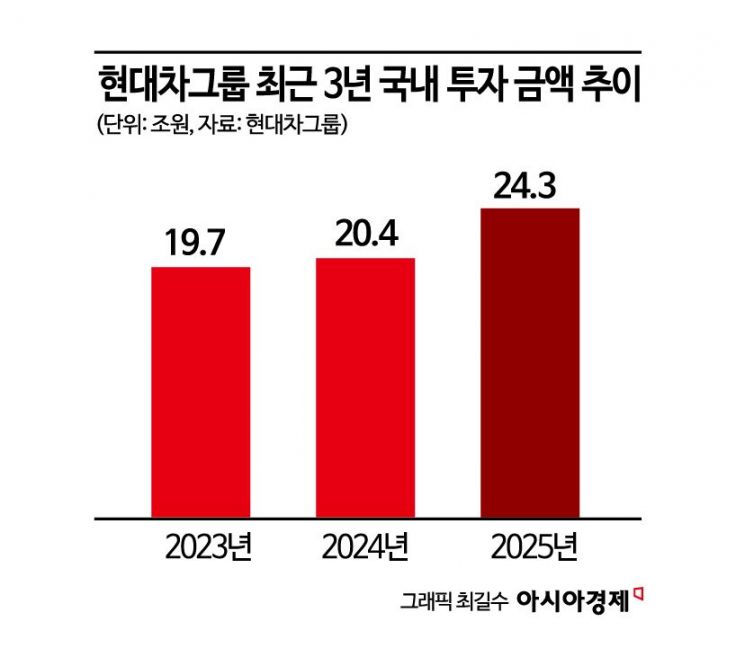
Record Domestic Investment of 24.3 Trillion Won This Year
"Promoting Activation and Advancement of Related Industry Ecosystems"
Expansion of Electric Vehicle Production Bases in Ulsan and Hwaseong
Increased R&D to Secure Core Future Car Technologies
Hyundai Motor Group decided to increase its domestic investment to an all-time high this year because it judged that it is necessary to actively secure future growth engines especially in times of crisis. Recently, Hyundai Motor Group Chairman Chung Euisun repeatedly emphasized at the group’s New Year meeting that opportunities must be found even amid crises where internal and external uncertainties are higher than ever before. The decision to make large-scale investments is also interpreted as being influenced by increased confidence backed by solid profitability, while many global automakers are struggling due to the paradigm shift surrounding the automotive industry.
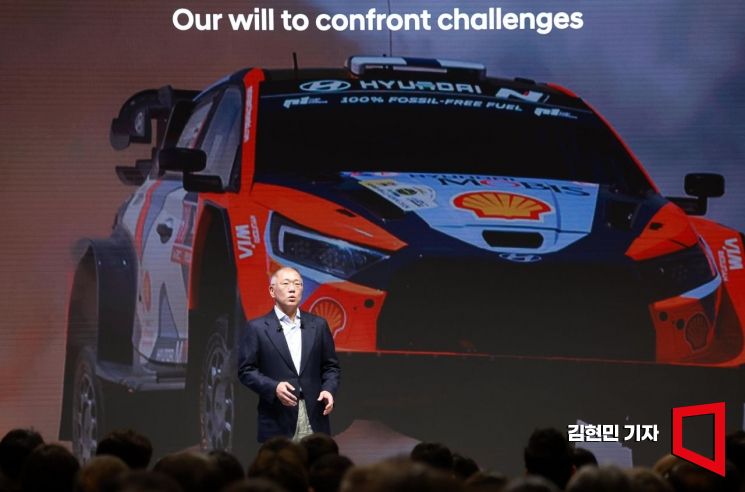 Hyundai Motor Group Chairman Chung Euisun is delivering a New Year's address at the '2025 Hyundai Motor Group New Year's Meeting' held on the 6th at Hyundai Motorstudio in Goyang, Gyeonggi Province. Photo by Kim Hyunmin
Increasing Domestic Investment Despite Internal and External Adversities
Jang Jae-hoon, Vice Chairman of Hyundai Motor Group, recently said at the New Year meeting, "This year is an important year that can determine the next several years." China’s automotive industry is already said to have entered the next stage beyond electrification, which is smartization. This is why it is no longer considered a follower but a leader in advanced fields.
In major overseas markets, the possibility of a merger between Honda and Nissan, the second and third largest automakers in Japan competing with Hyundai and Kia, has increased within this year. In the United States, Hyundai and Kia’s largest market, various policy changes are expected after the inauguration of the second Trump administration, including high tariffs and the abolition of electric vehicle tax credits. The domestic market, which has become the most difficult since the financial crisis with the lowest new car sales, is also a source of instability. In Europe, emission regulations will be strengthened starting this year, and if electric vehicle sales are sluggish, fines will have to be paid.
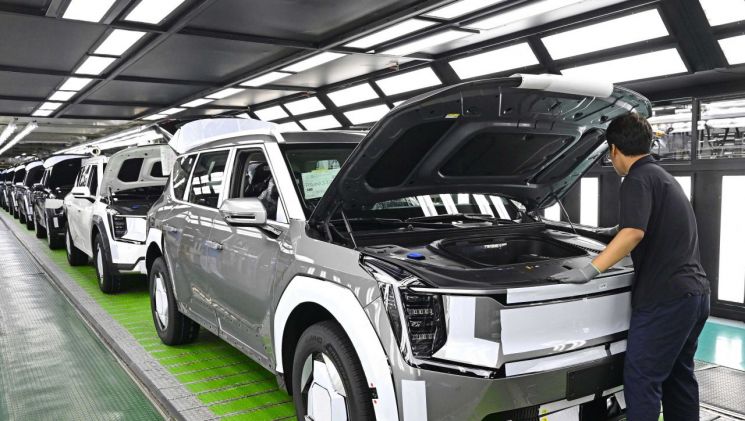
Although various adversities have piled up, the need for investment has increased. Most of the electric vehicle dedicated plants and production line renovations carried out over the past two to three years must be completed within this year. Investment in research and development (R&D) is also necessary to secure core technologies required in the process of realizing future mobility such as software-defined vehicles (SDV) and next-generation hydrogen fuel cell systems. Since the headquarters and key research and production facilities are located domestically, it was judged that domestic investment, regarded as an ‘innovation hub,’ is the top priority to overcome the crisis and sustain growth.
Future Vehicle Development R&D and Electrification Facility Expansion
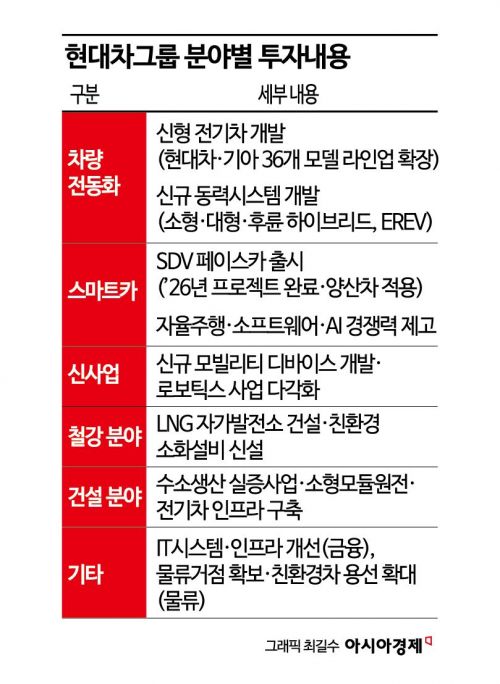
The largest portion of this year’s domestic investment is capital expenditure. It will be used to expand production facilities such as electric vehicle dedicated plants and to supplement infrastructure such as new manufacturing methods and customer experience bases. Following Kia’s Gwangmyeong electric vehicle dedicated plant, which began operations last year, the goal is to complete and operate a purpose-built vehicle (PBV) dedicated plant in Hwaseong in the second half of this year. PBVs are planned to expand demand not only in B2B (business-to-business) sectors such as cargo and passenger transportation but also in B2C sectors targeting general consumers.
The Hyundai Motor Ulsan electric vehicle dedicated plant, scheduled to begin operations in the first half of next year, will mass-produce various models starting with a large-sized sports utility vehicle (SUV). The Hyundai Ulsan plant will also have a hypercasting factory that stamps out vehicle bodies in one go. The representative customer experience base is the UX Studio Seoul, being built at the Gangnam-daero office building in Seoul.
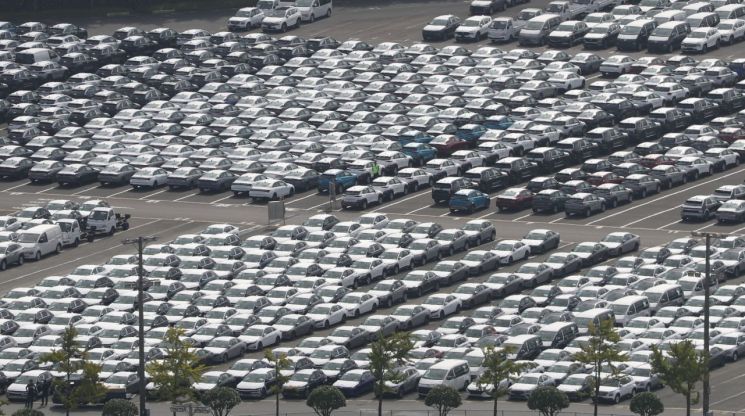 Finished vehicles waiting in the storage yard next to the export shipment dock at Hyundai Motor Company's Ulsan plant. Photo by Yonhap News
The R&D sector is related to next-generation powertrain systems applicable to various electrified vehicles. Hyundai Motor Group expects the electric vehicle chasm (temporary demand slowdown) to last about four to five years and believes that a system combining internal combustion engines is necessary to respond flexibly to market demand. The current main hybrid lineup will be expanded to include various types such as small engines around 1000cc, high-displacement hybrids around 3500cc, and rear-wheel hybrids.
Electric vehicles will also steadily expand new models, with Hyundai planning to have 21 models by 2030 and Kia 15 models by 2027. The SDV face car, which applies high-performance electric and electronic design, is under active development with the goal of completing the project next year and applying it to mass-produced vehicles. Beyond automakers, in the steel sector, new facilities such as liquefied natural gas (LNG) self-power plants and eco-friendly fire extinguishing equipment will be built to reduce electricity costs. Investments will also proceed as planned in other areas such as hydrogen production demonstration projects, small modular reactors, renewable energy, logistics hubs, and expansion of eco-friendly vehicle charters.
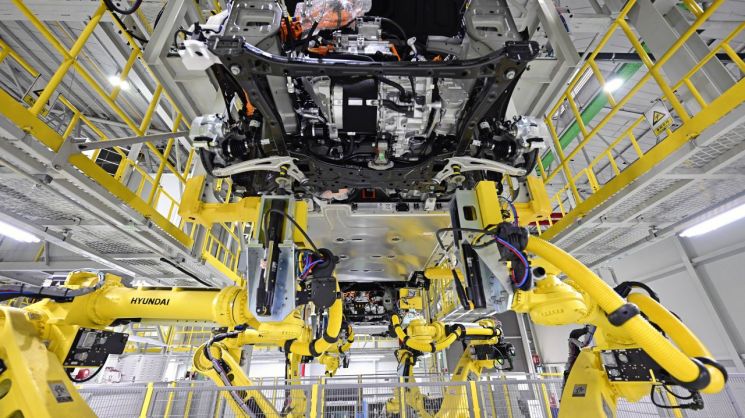 Kia Gwangmyeong Electric Vehicle Dedicated Plant (EVO Plant) Production Line. Provided by Hyundai Motor Group, Yonhap News Agency
This domestic investment plan announcement is also part of active communication with stakeholders in the market, including customers and shareholders. By informing the investment direction, it aims to enhance the value of major affiliates and help related industry partners plan their business. Amid a continued economic downturn with the government’s economic growth forecast lowered to the 1% range this year, it is also expected to play a catalytic role in revitalizing the domestic economy and promoting co-growth of upstream and downstream industries.
A group official said, "We will secure future growth engines through proactive investment, continuous structural improvement, change, and innovation without being shaken by internal and external management environments."
© The Asia Business Daily(www.asiae.co.kr). All rights reserved.



















