Changes in Both School Records and CSAT Starting from Current Prospective High School Freshmen
Introduction of 5-Grade School Record System and Integration of CSAT Subjects
Teachers Also Struggling with Subject and Grade-Level Instruction
Admissions Industry Says "Educational Policy Uncertainty Increasing"
Starting this year, the high school credit system will be fully implemented for first-year high school students, and the 2028 university entrance exam reform plan will be applied, bringing significant changes. Prospective first-year high school students, parents, teachers, and the admissions industry are all on edge.
What Are the High School Credit System and University Entrance Exam Reform Plan?
 On November 21 last year, parents and students attending the "2025 College Scholastic Ability Test Analysis and Regular Admission, Medical School Application Strategy Admission Briefing," co-hosted by the Korean Council for University Education and EBS at Samsung Hall, Ewha Womans University in Seoul, are listening attentively to the lecturer's explanation. Photo by Jo Yong-jun
According to the Ministry of Education on the 9th, the high school credit system will be fully introduced in schools starting this March. The high school credit system is a system where students select various subjects according to their career paths like university courses, and graduation is recognized when the accumulated credits reach the required completion criteria.
The subjects students take in high school are broadly divided into common subjects and elective subjects. In the first year, students mainly attend common subject classes, and when they advance to the second year, they take elective subjects. In particular, from prospective first-year students, in addition to general electives and career electives, integrated elective subjects will be added. The internal evaluation method will also change from the existing 9-grade system to a 5-grade system, and subject evaluation results will include both absolute evaluation (A~E) and relative evaluation (grades 1~5).
Furthermore, current prospective first-year students will be subject to the 2028 university entrance exam reform plan previously announced by the Ministry of Education. The 2028 College Scholastic Ability Test (CSAT) will eliminate the current subject-specific elective system and change to an integrated exam type. Korean and Mathematics will each be tested as common subjects, and the inquiry areas will be integrated into Integrated Social Studies, Integrated Science, and Successful Vocational Life.
Parents Say, "We Don't Know What to Do"
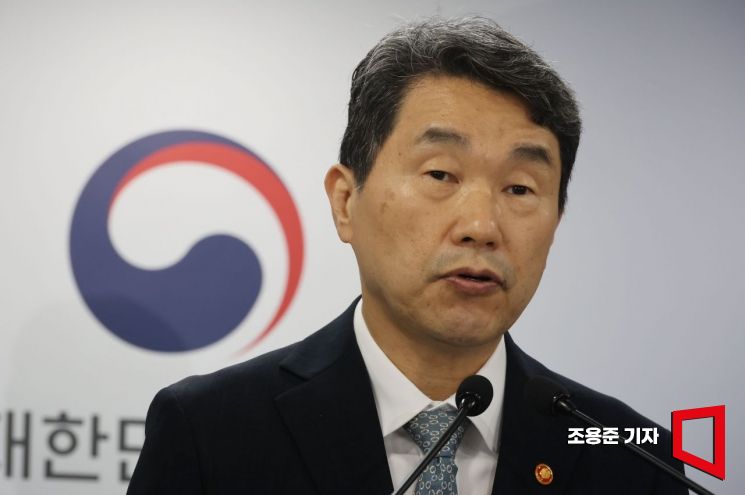 Lee Ju-ho, Deputy Prime Minister for Social Affairs and Minister of Education. Photo by Jo Yong-jun.
However, ahead of the first implementation of the policy, parents and teacher organizations are expressing confusion. Parents with prospective first-year high school children have voiced on online communities, "There are so many changes starting this year that we need to understand well to avoid getting lost, but we feel overwhelmed not knowing what to do," and "It seems we have to create a high school admission portfolio from middle school, which is very difficult and exhausting."
Concerns are also emerging in schools about increased workload for teachers. Teachers must prepare for the changing courses offered at each school. The Korean Teachers and Education Workers Union demanded the withdrawal of the high school credit system last November, stating, "In schools where there is a shortage of teachers, the expansion of elective subjects has made many teachers struggle to secure time for lesson research while managing multiple subjects and multiple grades."
The admissions industry also analyzes that parents are struggling to keep up with the changes in education policy. Woo Yeon-cheol, director of the Jinhaksa Admissions Strategy Research Institute, said, "Since the subjects offered vary by school, students will have significant concerns about which subjects to take," adding, "Now, it is necessary to carefully check when the desired subjects are offered and weigh the pros and cons." Lim Seong-ho, CEO of Jongro Academy, said, "Since the admissions system itself is generally in a state of confusion, it seems that policy uncertainty has increased from the parents' perspective," and added, "Immediate government-level information provision on the series of education policy changes appears necessary."
© The Asia Business Daily(www.asiae.co.kr). All rights reserved.