Claims in Chinese Financial Journal... "Let's Change Unemployment Rate Measurement"
"Current Method Fails to Reflect Workers' Real Income Levels"
"Separate Statistics Needed to Include Platform Workers"
Claims that the Chinese authorities' method of measuring unemployment rates does not accurately reflect reality have drawn attention. According to the Hong Kong South China Morning Post (SCMP) on the 7th, Zhu Changzheng, founder of the Changping Economic Forum in China, stated, "Employment and unemployment rates are as important as, or perhaps even more important than, Gross Domestic Product (GDP) in evaluating future government performance," and argued that "the current method of measuring unemployment in China is inadequate and requires reform and expansion." This claim was reportedly published in the New Year's issue of the influential Chinese financial magazine 'Caijing 2025.'
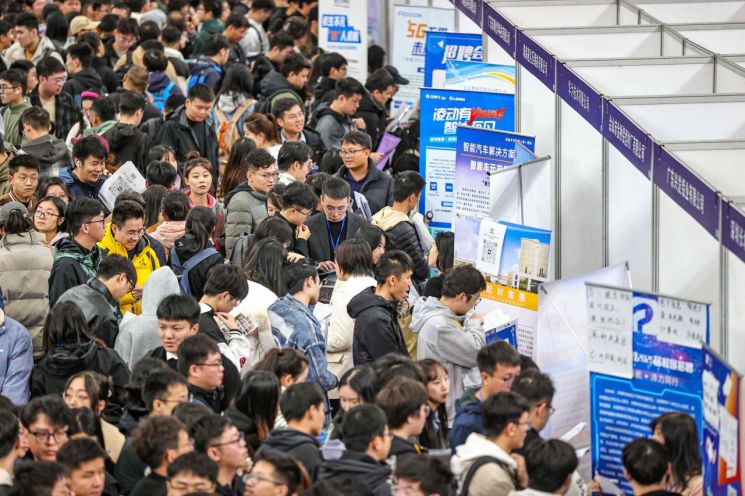 People crowding at a job fair held in Shenyang, Liaoning Province, China, last October. Photo by AFP
The National Bureau of Statistics of China classifies individuals aged 16 and over who work at least one hour per week for wages or business income as employed. Unemployed persons are those willing to work but unable to find a job. According to this definition, even working one hour a week as a delivery part-timer counts as employed, leading to criticism that such metrics cannot accurately reflect the economic situation.
Since the COVID-19 pandemic, the number of platform workers has surged dramatically, and as of 2021, it is estimated that 200 million workers in China work in flexible forms rather than fixed hours. Additionally, there has been an increase in university graduates delaying employment to secure better jobs.
Zhu pointed out, "Considering working one hour a week as employed aligns with the International Labour Organization (ILO) definition," but added, "Statistics measured in this way fail to reflect factors such as workers' income levels, especially whether earnings exceed the minimum cost of living or how they compare to regional minimum wages." He further argued, "Flexible forms of labor conceal low employment and hidden unemployment," and "counting all of these as employed is problematic."
He proposed the need to produce separate statistics to reflect the reality of these workers. In Hong Kong, individuals who involuntarily work less than 35 hours per week are classified as 'underemployed,' an intermediate category between employment and unemployment. The United States separately publishes the 'U6 unemployment rate,' which includes those who have given up job searching or work part-time because they cannot find full-time jobs, alongside the official unemployment rate.
According to the National Bureau of Statistics of China, the overall urban unemployment rate was 5% in November last year, and the youth (aged 16?24) unemployment rate fell by 1 percentage point from 17.1% the previous month to 16.1%. In June 2023, when youth unemployment soared to 21.3%, China suspended the publication of unemployment statistics for six months, citing a revamp of the measurement method. Since January last year, the unemployment rate has been calculated by excluding students enrolled in schools from the base population. However, voices within China are increasingly questioning the accuracy of the GDP and unemployment measurement methods published by the country.
© The Asia Business Daily(www.asiae.co.kr). All rights reserved.

















