Seoul City Signs Implementation Agreement with Uisinseol Urban Railway Co., Ltd.
Applying BTO-MCC... Responsible Operation Including Ancillary Businesses
Establishing Operating Rights with 280 Billion KRW Private Investment Financing
The Seoul Light Rail Uisinseol Line project, which faced bankruptcy due to increasing annual deficits, is taking its first step toward normalization. Starting from March, the operation by the new project operator is scheduled to begin, and a plan to raise private investment funds totaling 280 billion KRW will also be concretized.
On the afternoon of the 8th, Seoul City announced on the 9th that it signed the 'Uisinseol Urban Railway Private Investment Project (BTO-MCC) Implementation Agreement' with the new project operator, Uisinseol Urban Railway Co., Ltd., at Seoul City Hall. This followed the completion of the handover process between the existing and new operators. The new operator will manage the Uisinseol Line operation until 2047.
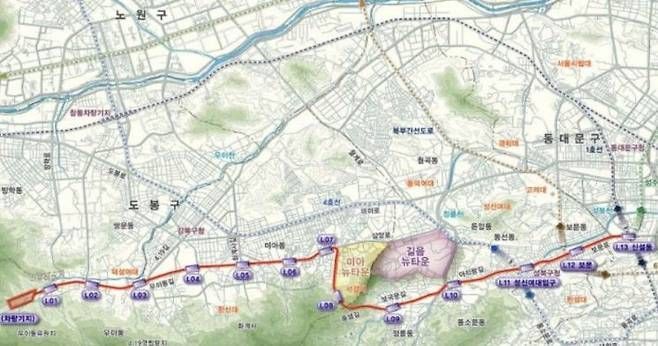 Route map of the Uisinseol Line connecting Bukhansan Ui Station and Sinseoldong Station. Provided by Seoul City
Opened in September 2017 and operated under the BTO (Build-Transfer-Operate) model, the Uisinseol Line has accumulated deficits since its launch. The biggest cause was the failure to predict ridership, which, combined with a high rate of fare evasion, led to unavoidable losses. The ridership of the Uisinseol Line in 2024 was about 75,000 daily passengers, approximately 58% of the predicted demand of 130,000, and the fare evasion rate was 36.2%, more than three times the predicted level of 11.6%.
To normalize the project, Seoul City changed the project model to BTO-MCC (Minimum Cost Compensation) and recruited a new operator. After designating 'Uisinseol Urban Railway Co., Ltd.' as the preferred negotiator with the highest evaluation score in April, the plan passed Seoul City's financial planning review and the Ministry of Strategy and Finance's private investment project review committee in December.
The agreement includes ▲financial support under the BTO-MCC model ▲raising and managing private investment funds totaling 280.5 billion KRW and establishing management and operation rights ▲setting an average annual total management and operation cost of 20.1 billion KRW over about 23 years ▲full responsibility for managing and operating all project facilities including ancillary projects ▲strengthening the supervisory authority of the competent authority ▲annual performance evaluations followed by adjustments to management and operation costs.
Seoul City places great significance on the change to the BTO-MCC model. Under this model, the competent authority supports the principal and interest of the total private investment and alternative investment costs, and covers any shortfall in management and operation costs not covered by the operator’s actual operating income. This is expected to have a considerable impact on other light rail projects as well. The BTO-MCC model has been applied to the restructuring of most private railroads such as Seoul Line 9, Uijeongbu Light Rail, and Yongin Light Rail, but some projects are still facing difficulties.
The Wirye-Sinsa Line light rail project, which failed to attract private operators despite two rounds of third-party proposal re-announcements, drifted for 16 years before being converted to a public project, but has faced strong opposition from residents. The Western Line connecting Eunpyeong-gu and Gwanak-gu still faces the challenge of securing new construction investors. Additionally, the Nangok Line, a 4.08 km underground light rail connecting Boramae Park Station (Sillim Line) and Nanhyang Elementary School, is struggling to improve its economic feasibility. The Gangbuk Transversal Line and Mokdong Line have been rejected in the Ministry of Strategy and Finance’s preliminary feasibility study.
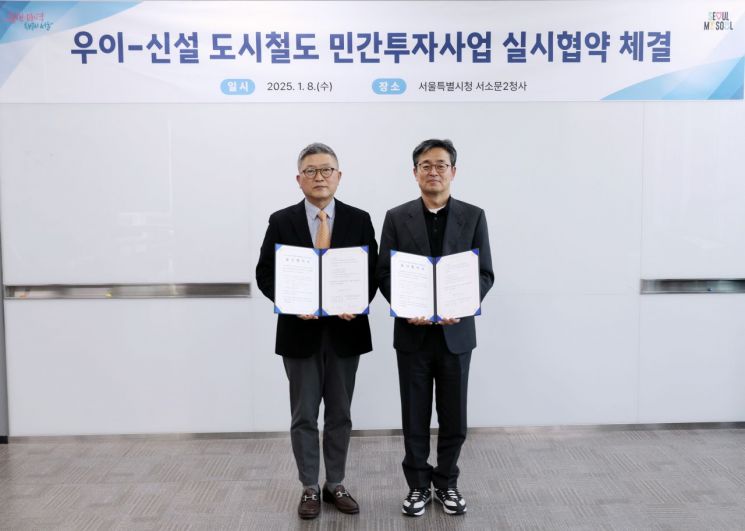 On the afternoon of the 8th, Ryu Chang-su, CEO of Uisinseol Line Urban Railway Co., Ltd. (left), and Yeo Jang-kwon, Director of Transportation of Seoul City, attended the implementation agreement ceremony for the Uisinseol Urban Railway Private Investment Project (BTO-MCC) held at Seoul City Hall. Photo by Seoul City
© The Asia Business Daily(www.asiae.co.kr). All rights reserved.


















