7 Core Strategies Announcement
Profitable Agricultural Transformation
On the 7th, Gyeongbuk Province announced the ‘2030 Agricultural Great Transformation 7 Core Strategies’ to proactively respond to internal and external changes such as the aging rural population, labor shortages, and abnormal climate, and to increase agricultural income and enhance agricultural competitiveness.
Until now, agriculture has often been regarded as hard and strenuous labor that people did not want to pass on to their children. Now, the status of agriculture is changing. Gyeongbuk Province plans to focus on innovation toward easier and more convenient agriculture through scaling up, mechanization, and advancement, and to concentrate on a great transformation of agriculture and rural areas filled with hope and new opportunities.
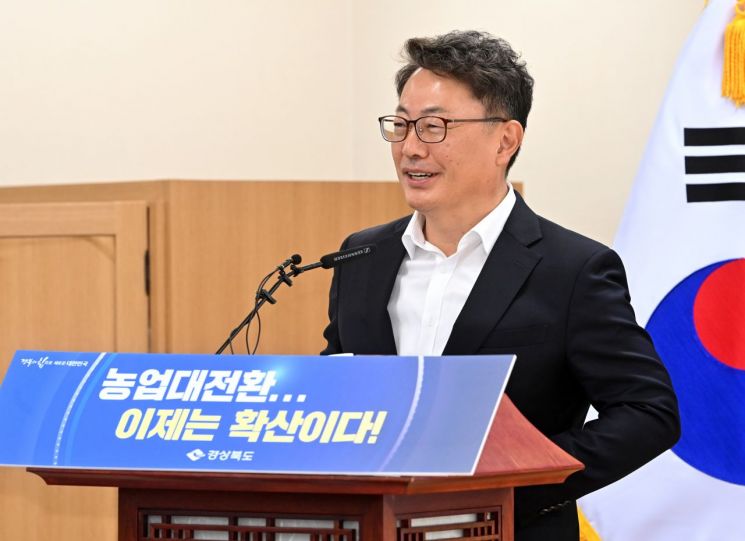 Kim Ju-ryeong, Director of the Agricultural and Fisheries Distribution Bureau of Gyeongbuk Province, is holding a press conference.
Under the slogan ‘Agricultural Great Transformation, Now It’s Time to Spread!’, Gyeongbuk Province aims to expand the agricultural great transformation across all sectors including production, processing, export, and distribution by setting and implementing seven core strategic tasks by 2030.
The seven core strategies are: solving aging, income, and rice oversupply issues through double cropping joint farming; transitioning to easy and convenient agriculture and livestock farming through advanced technology at production sites; competing globally with Gyeongbuk’s representative fruit, apples, through flat apple orchards; increasing agricultural product consumption, added value, and jobs through agro-food processing; opening the era of 2 trillion KRW in Gyeongbuk K-food exports; completing the agricultural great transformation that started with production through digital distribution; and proactively preparing for the future of Gyeongbuk agriculture by addressing aging and labor shortages.
By 2030, double cropping joint farming will be expanded to 9,000 hectares. The ‘shareholder-type joint farming income model,’ first introduced nationwide in Gyeongbuk, will be adopted as a government policy by the Ministry of Agriculture, Food and Rural Affairs starting in 2026. Building on this, the province plans to expand double cropping joint farming to 100 sites and 9,000 hectares by 2030, spreading it to all cities and counties. Consequently, rice cultivation area will be reduced by 10%, helping to solve the rice oversupply problem.
Double cropping joint farming allows elderly farmers to secure stable income by simply providing land, makes farming easier through mechanization enabling double cropping, and reduces production costs, thus improving both productivity and income.
Double cropping joint farming, proven by high results such as tripling agricultural production value and doubling farm income in the Yeongsun district of Mungyeong, is being promoted at 14 sites within the province including Gumi, Sangju, and Yeongdeok, and will be rapidly expanded throughout the province focusing on large-scale fields.
Next, by 2030, smart facilities will be supplied to 2,700 hectares, which is 30% of the province’s vinyl greenhouses, and smart livestock farming will be expanded to 1,400 farms, transforming agriculture and livestock farming into easy and convenient operations.
Existing vinyl greenhouses will be converted into automated smart facilities equipped with automatic irrigation and fertilization systems, automatic temperature and humidity control, nutrient supply devices, and mobile remote control, and the strategy is to expand smart facilities capable of automation to open-field crops such as fruit trees and vegetables.
Additionally, advanced smart farms, which require high initial facility investment, will be offered as rental types to provide opportunities to manage smart farms without burden, and long-term low-interest loans will support new smart farm construction. In livestock farming, automatic temperature and humidity control, ventilation, automatic feed and water supply devices will be introduced to transition to smart livestock farming.
Third, through a structural transformation of apple production, Gyeongbuk’s representative fruit, the province will transform the fruit industry into one that can confidently compete globally beyond South Korea.
Leading South Korea’s apple industry, Gyeongbuk apples innovated with the New Gyeongbuk-type apple orchard in 1996 and are now pursuing another innovation with flat apple orchards.
Flat apple orchards switch cultivation methods to ‘ultra-dense’ and ‘multi-axis’ types, minimizing tree spacing while maximizing light transmission, producing apples of twice the quality compared to traditional orchards. This also facilitates easier work, significantly reduces labor, and decreases pest and disease occurrence.
Gyeongbuk Province plans to convert 30%, or 6,000 hectares, of the province’s apple orchard area to flat apple orchards by 2030, greatly enhancing productivity and quality competitiveness.
Fourth, the province will accelerate the great transformation of the processing industry to promote consumption and increase added value of local agricultural products.
The food industry has a larger market size, growth potential, and job creation effect compared to other industries. Activating agro-food processing using local agricultural products is crucial to promote consumption and establish a virtuous cycle ecosystem where agricultural product supply continues steadily.
Accordingly, Gyeongbuk Province will nurture and support 1,000 agro-food companies by 2030 through investment attraction, new and expansion support, and startup activation, and will foster 200 excellent companies with sales exceeding 10 billion KRW.
Fifth, to achieve 2 trillion KRW in agro-food exports by 2030, the province will foster strategic items, enhance export competitiveness, and create market diversification and export infrastructure.
Following the popularity of K-pop, Korean dramas, and variety shows, the overseas news about people lining up to buy Korean gimbap since last year, expressed as ‘Kimbap’ rather than ‘Korean sushi,’ shows the growing interest and popularity of K-food.
Therefore, Gyeongbuk Province will expand cultivation of new varieties of fresh agricultural products such as grapes and strawberries, which are highly preferred overseas, and will focus on overseas markets with K-food tailored to local tastes such as gimbap, kimchi, and beverages.
Moreover, the province will actively pioneer emerging markets in Europe and Southeast Asia through various international food fair promotions, expansion of overseas permanent sales outlets, and discovery of new buyers, and will build an export comprehensive support center linked to the Daegu-Gyeongbuk Integrated New Airport scheduled to open in 2030, serving as a central hub for fresh agricultural product exports.
Sixth, to respond to the rapidly changing distribution environment and secure competitiveness, the province will promote digitalization of distribution.
Agricultural products have a complex distribution structure averaging 4 to 5 stages, with distribution costs approaching 50% of the price. To address this, the province will strengthen production area distribution organizations to expand direct transactions with large consumers and create a distribution system where farmers receive fair prices.
Existing production area distribution facilities (APCs) will be transformed into smart APCs by introducing automated systems for sorting, packaging, distribution, and sales, converting the entire distribution process into digital by 2030 with 25 facilities to be built.
Livestock auction markets will also be digitalized by 2026 with the establishment of an online platform providing fast and accurate information and fair transaction systems, ensuring farmers receive appropriate prices at all livestock markets in the province.
Finally, Gyeongbuk Province will proactively prepare for the future by addressing chronic rural problems such as aging and labor shortages through fostering successor young farmers and supplying labor during peak farming seasons.
Through support for startup costs and customized education from the farming preparation stage to stable settlement and professional farmer development, the province will nurture 8,000 young farmers as young and capable farm managers by 2030.
Additionally, the supply system for foreign seasonal workers, essential to Korean agriculture, will shift from farm-level direct assignment and management to public sector management and operation, supplying necessary labor to farms.
To this end, the current four public seasonal worker centers will be expanded to 50 by 2030, and dormitory facilities will be installed in all cities and counties to provide stable accommodation for seasonal workers.
Gyeongbuk Province will invest 82 billion KRW to expand double cropping joint farming, 298.2 billion KRW to transition to easy and convenient smart agriculture and livestock farming, and 320.8 billion KRW to establish Gyeongbuk-type flat apple orchards.
It will also invest 117.3 billion KRW to foster the agro-food processing industry, 92 billion KRW to expand Gyeongbuk K-food exports, 157.9 billion KRW to promote digital distribution strengthening production area distribution functions, 67.3 billion KRW to nurture successor young farmers preparing for the future of Gyeongbuk agriculture, and 30.2 billion KRW to support stable seasonal worker supply, totaling 1.1657 trillion KRW by 2030.
Lee Cheol-woo, Governor of Gyeongbuk Province, stated, “Since the start of the 8th elected term, we have been tirelessly working to change the framework of agriculture through the agricultural great transformation.” He added, “Challenges can be faced alone, but spreading success requires everyone’s participation. We will focus all administrative capabilities on opening the future of Korean agriculture through Gyeongbuk’s agricultural innovation, the ‘Agricultural Great Transformation.’”
© The Asia Business Daily(www.asiae.co.kr). All rights reserved.
![Clutching a Stolen Dior Bag, Saying "I Hate Being Poor but Real"... The Grotesque Con of a "Human Knockoff" [Slate]](https://cwcontent.asiae.co.kr/asiaresize/183/2026021902243444107_1771435474.jpg)
















