Rehabilitation Robot Startup 'Hurotics'
Double Winner of CES 2025 Innovation Awards
CEO Ki-wook Lee: "The Answer to Health is Wearable Robots"
Robots Worn Like Bags Stimulate the Gluteus Medius with Braces
"Rehabilitation Enhances Quality of Life... Robots Gradually Becoming Lighter"
On June 12, 2014, the opening match of the Brazil World Cup captured the attention of the world. Juliano Pinto, a 30-year-old Brazilian man with a lower-body disability, stepped onto the field. He was fully standing on the ground and kicked off with great force. It remains a legendary miraculous scene still talked about in the scientific community.
At that time, Pinto was wearing an exoskeleton robot. It was a robotic suit created by Professor Miguel Nicolelis of Duke University in the United States. The helmet he wore detected Pinto's brainwaves and recognized his commands. This message was transmitted to his legs as "move," enabling him to kick the ball.
 On the 8th (local time), a large crowd gathered at the Hurotics exhibition booth located on the 2nd floor of the Venetian Expo in Las Vegas, USA, watching the rehabilitation robot experience event. Photo by Hurotics official Instagram
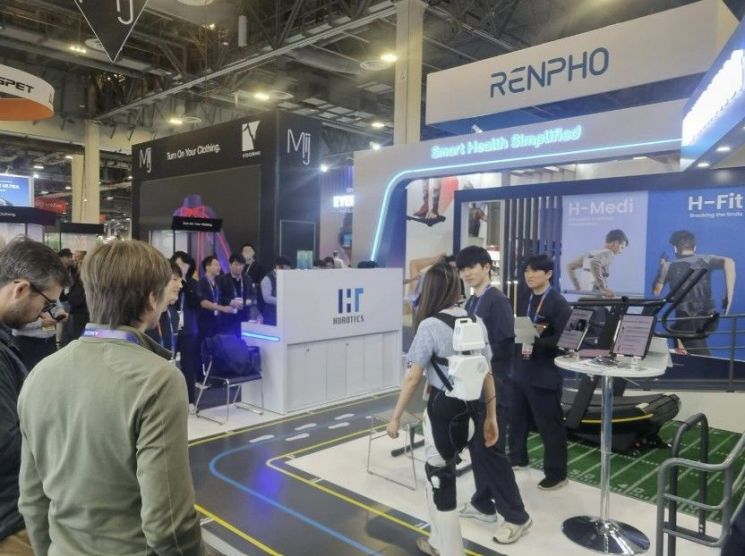 On the 8th (local time), a visitor is experiencing a rehabilitation robot firsthand at the Hurotics exhibition booth located on the 2nd floor of the Venetian Expo in Las Vegas, USA. Photo by Hurotics official Instagram
Our robot startup, Hurotics, is dedicating itself to research and development to create such miraculous dramas. Hurotics manufactures wearable robots that assist rehabilitation for the elderly, disabled, athletes, and others who have difficulty walking due to accidents or illnesses. At CES 2025, the world's largest electronics and information technology (IT) exhibition held at the Las Vegas Convention Center on the 7th (local time), Hurotics won two innovation awards in the categories of Aging & Accessibility and Robotics, earning a double crown and recognition for its technological prowess. This marks the second consecutive year of winning awards.
On the 8th, at the Hurotics exhibition booth in the Venetian Expo in Las Vegas, CEO Kiwook Lee told our publication, "A lot of research is being done so that robots can replace tasks humans have done, but ultimately, there are things robots can replace and things they cannot. What they cannot replace is health," adding, "If my leg hurts or doesn’t move, I don’t just amputate it and replace it with a robot. At such times, advanced devices that can help are needed, and wearable robots can be the answer."
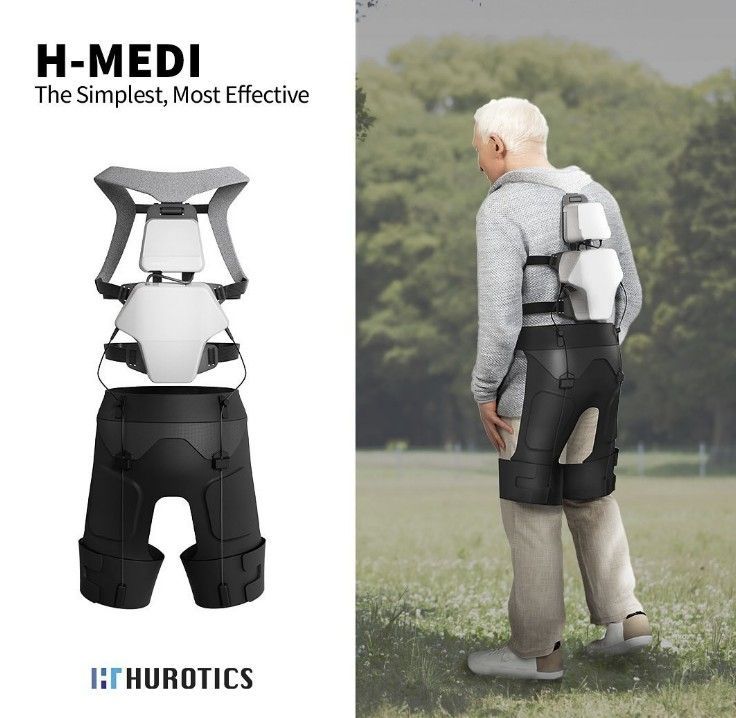 Rehabilitation robot H-Medi developed by Hurotics. It mainly assists the walking of elderly people, patients, and individuals with physical disabilities. Photo by Hurotics Official Instagram
Hurotics exhibited two robots at CES 2025. The 'H-Medi' is a robot used for rehabilitation treatment of hospital patients, and the 'H-Pit' is mainly used by athletes to treat injuries. Both robots function according to the treatment method required by the user but are similar in their overall framework. The robot is carried like a backpack on the user's back, and protective braces connected to the robot are worn on both knees. Then, the user wirelessly connects an electronic device that issues commands to the robot. The robot recognizes the user's movements in real time and assists muscle movement by pulling cables in sync with the timing. On-site, visitors were able to experience the robots, and those wearing them noticed their walking speed gradually increasing the more they walked.
CEO Lee said, "As our country becomes a super-aged society (where the population aged 65 and over exceeds 20% of the total population), there will be many mild patients who feel discomfort in walking," adding, "Our robots can be a solution for those people." In fact, as the population ages, the number of people suffering from degenerative diseases such as stroke, spinal cord injury, multiple sclerosis, or Parkinson’s disease is expected to increase, raising the importance of rehabilitation treatment. Market research firm Kings Research predicted that the global rehabilitation robot market, which was $239.1 million (about 348.9 billion KRW) in 2022, will grow to $1.026 billion (about 1.4974 trillion KRW) by 2030. Professor Shin Hyun-yi of Chung-Ang University’s Department of Rehabilitation Medicine, who participated in the development of Hurotics’ robots, said, "Not doing rehabilitation doesn’t affect life or death, but it can improve quality of life, so it is important," adding, "Previously, wearable robots were large and heavy like Iron Man suits, but recently they have become much lighter and more like clothing, making it possible to easily perform rehabilitation treatment at home, which is very meaningful."
© The Asia Business Daily(www.asiae.co.kr). All rights reserved.
![Clutching a Stolen Dior Bag, Saying "I Hate Being Poor but Real"... The Grotesque Con of a "Human Knockoff" [Slate]](https://cwcontent.asiae.co.kr/asiaresize/183/2026021902243444107_1771435474.jpg)













