Support for Kim Gun-hee Special Prosecutor Bill 196·Oppose 103 Rejected
The Double Special Prosecutor Act (Special Prosecutor Act on Treason and Kim Geon-hee) promoted by the Democratic Party of Korea failed to pass the plenary session of the National Assembly on the 8th and was discarded.
On the same day, the National Assembly announced that the Special Prosecutor Act on Treason, aimed at investigating President Yoon Seok-yeol's treason charges, was rejected with 300 members present, 198 in favor, 101 against, and 1 abstention. The Special Prosecutor Act on Kim Geon-hee was also rejected with 300 members present, 196 in favor, 103 against, and 1 invalid vote. Both special prosecutor bills required approval by two-thirds (200 seats) of the total members in a re-vote to pass, but were ultimately blocked by opposition from ruling party members and failed.
The Double Special Prosecutor Act had previously passed the plenary session on the 12th of last month but was vetoed and sent back for re-vote on the 31st of the same month by Choi Sang-mok, Acting Prime Minister and Minister of Economy and Finance. At that time, Acting Prime Minister Choi opposed it, stating, "Since the special prosecutors are to be recommended by the Democratic Party and a non-negotiating group respectively, it has greater unconstitutionality than previous special prosecutor laws where the Supreme Court recommended and the opposition party could veto."
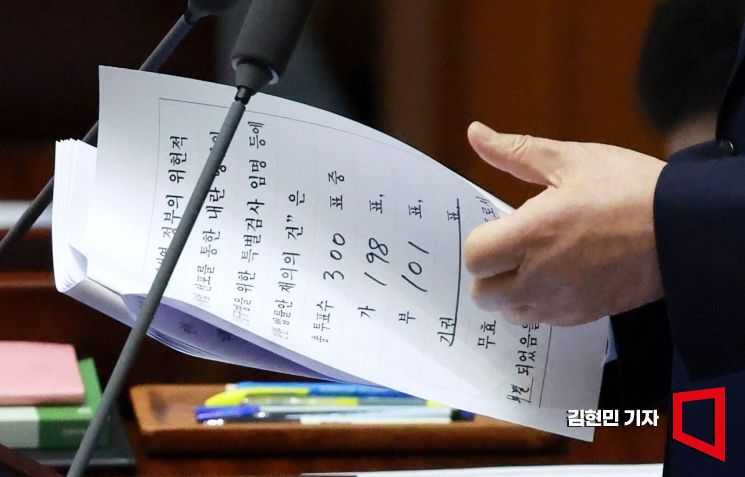 Speaker Woo Won-shik is declaring the rejection of the re-vote on the Special Investigation Act on Internal Insurrection at the plenary session held at the National Assembly on the 8th. Photo by Kim Hyun-min
The Democratic Party plans to immediately reintroduce the Double Special Prosecutor Act. Hwang Jeong-a, the Democratic Party floor spokesperson, said, "We plan to reintroduce the bill by including foreign exchange crimes in the special prosecutor's jurisdiction and expanding the scope of investigation," adding, "We aim to resubmit it for reapproval before the Lunar New Year."
Major contentious bills between the ruling and opposition parties, including the 'Agriculture Four Acts' (Amendments to the Grain Management Act, Agricultural and Fishery Products Price Stabilization Act, Agricultural and Fishery Disaster Countermeasures Act, and Agricultural and Fishery Disaster Insurance Act), as well as amendments to the National Assembly Act and the National Assembly Testimony and Inspection Act, were all rejected and discarded after re-votes. The Grain Management Act, led by the opposition, mandates the Minister of Agriculture, Food and Rural Affairs to compulsorily purchase surplus rice in the event of a sharp decline in rice prices. The government and ruling party have opposed the Grain Management Act citing concerns over excessive rice supply.
The amendment to the National Assembly Act, which would abolish the automatic referral system of the budget bill to the plenary session, was also discarded. Additionally, the National Assembly Testimony and Inspection Act (amendment concerning testimony and inspection in the National Assembly) failed to pass the National Assembly. This bill aimed to expand the scope of witnesses subject to summons from 'important agenda reviews and hearings' in addition to audits and investigations, and stipulated that requests for submission of materials or attendance by the National Assembly cannot be refused on grounds such as personal information protection or trade secret protection.
© The Asia Business Daily(www.asiae.co.kr). All rights reserved.
![Clutching a Stolen Dior Bag, Saying "I Hate Being Poor but Real"... The Grotesque Con of a "Human Knockoff" [Slate]](https://cwcontent.asiae.co.kr/asiaresize/183/2026021902243444107_1771435474.jpg)
















