Presentation of Five Key Priorities... Revitalizing Domestic Demand and Corporate Growth
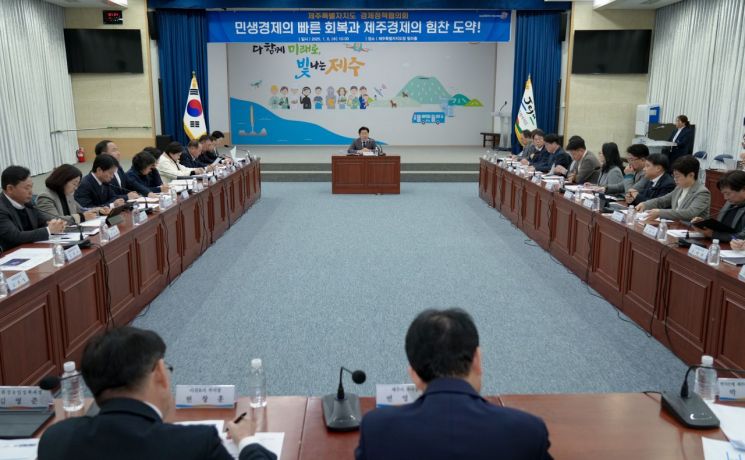 Jeju Province held the 1st meeting of the '2025 Economic Policy Council' on the morning of the 8th at Tamna Hall in the provincial government office, chaired by Governor Oh Younghoon, to discuss this year's economic policy implementation strategy. Photo by Jeju Province
Jeju Special Self-Governing Province will implement economic policies in 2025 aimed at revitalizing domestic demand and fostering corporate growth through coexistence and recovery.
On the morning of the 8th, Jeju Province held the first meeting of the ‘2025 Economic Policy Council’ in the Tamna Hall at the provincial government building, presided over by Governor Oh Younghun, to discuss this year’s economic policy strategies.
The Jeju branch of the Bank of Korea diagnosed that domestic political instability and a decline in tourism demand due to aircraft accidents are exerting downward pressure on Jeju’s economy. However, it projected that as political uncertainties are resolved and with active fiscal spending, the economy will gradually improve.
To restore vitality to the local economy, Jeju Province will pursue five major tasks: ▲supporting small business owners to overcome crises ▲tailored stabilization of livelihoods ▲corporate growth and talent development ▲innovative advancement and structural improvement ▲creating new growth engines for Jeju’s economy. In particular, the key measures include establishing a ‘coexistence-based domestic demand activation system’ where residents help each other, early execution of public finances, expanding local company contracts, financial support for small businesses, and revitalizing traditional markets and local commercial districts.
The first strategy for revitalizing domestic demand is to stimulate consumption among both residents and tourists. The province will integrate the Tamnaneujeon and Zero Pay payment systems to enhance convenience for tourists. From the 13th to the 31st, customers who spend over 50,000 won per day at Tamnaneujeon-affiliated stores in traditional markets and shopping districts will receive a 10,000 won refund. In addition, when using the delivery app ‘Meokgaebi,’ a delivery fee subsidy of 3,000 won per order will be provided so that both small business owners and consumers can benefit.
Support for revitalizing traditional markets and shopping districts will also be strengthened. Customized revitalization will be promoted by designating autonomous commercial districts tailored to each area’s characteristics, and more than 700 busking performances will be held annually throughout urban areas to expand cultural experiences for residents and tourists and boost local commercial districts. Furthermore, modernization of outdated facilities and management innovation in traditional markets and shopping districts will be supported to enhance competitiveness.
The core of the corporate growth policy is stable financial support for small and medium-sized enterprises (SMEs) and small business owners. The support period for SME management stabilization funds will be extended by an additional two years from the existing two years, and the scope for 10-year long-term installment repayment will be expanded. In addition, a newly introduced 30 billion won special guarantee for crisis recovery will be provided, forming a ‘three-part financial support package’ to actively help companies overcome funding difficulties.
From the 10th, a 30 billion won ‘Special Guarantee for Revitalizing Local Commercial Districts’ will be launched as emergency operating funds for self-employed business owners in local commercial districts. Small business owners operating retail or restaurant businesses in local commercial districts can borrow up to 50 million won at an annual interest rate of 4.5%. A comprehensive support system for small business owners, including the ‘One-stop Support for Small Business Owners’ consultation channel and support for maternity benefits and substitute personnel for sole proprietors, will also be implemented as part of a robust social safety net.
Debt adjustment and educational programs will be expanded to help small business owners who have closed their businesses make a comeback. For financially vulnerable groups, a Financial Welfare Counseling Center will be established to assist with debt adjustment such as credit recovery and personal rehabilitation, and the scope of interest subsidy support for policy-based microfinance will be expanded from youth to all residents.
A total of 122.5 billion won will be invested in job creation projects for seniors, people with disabilities, and women, creating more than 25,000 jobs for vulnerable groups.
Efforts will also be made to create an ecosystem for sustainable corporate growth. A program to foster promising SMEs will be operated, and Jeju-type startups will be discovered and nurtured. In particular, mentoring and commercialization support for young entrepreneurs will be strengthened to lay the foundation for new entrepreneurs to grow.
A cooperative system will also be established to enhance the effectiveness of these policies. In the public sector, opportunities for local companies to win public project contracts will be expanded, and the target for rapid fiscal execution in the first half of this year will be set at 60% so that public finances can serve as a catalyst for revitalizing the local economy.
Meanwhile, council members who attended the meeting presented specific measures to overcome the economic downturn and stimulate domestic demand.
Park Gudo, head of the Jeju branch of the Bank of Korea, predicted, "Private consumption in the Jeju region will gradually recover in the second half of the year," and suggested, "It is necessary to establish effective population policies in response to the declining birth rate."
Kang Donghun, president of the Jeju Tourism Association, expressed his commitment, saying, "We will actively attract domestic tourists by organizing school trips linked to the novels of Nobel Literature Prize-winning author Han Kang and conducting on-site promotional marketing."
Governor Oh Younghun emphasized, "If political instability continues, it could lead to a downturn in the tourism industry, so political uncertainty must be resolved as soon as possible," and added, "Until then, we must seek and implement various measures to overcome the crisis with our own internal strength."
To this end, Governor Oh stated, "We may consider an early supplementary budget." He also announced plans to expand the ‘Busking Day’ regular performances held during the year-end and New Year period, and urged each organization to actively promote local consumption campaigns such as the ‘Eat Dinner Out’ movement.
Meanwhile, the Economic Policy Council was established in accordance with the ‘Ordinance on the Economic Policy Council of the Province’ to discuss directions for local economic development and measures to revitalize the local economy, with participation from experts and organizations in various fields such as economic organizations, small businesses and corporations, tourism, primary industries, construction, consumers, local communities, tax, and academia.
© The Asia Business Daily(www.asiae.co.kr). All rights reserved.
![Clutching a Stolen Dior Bag, Saying "I Hate Being Poor but Real"... The Grotesque Con of a "Human Knockoff" [Slate]](https://cwcontent.asiae.co.kr/asiaresize/183/2026021902243444107_1771435474.jpg)











