Concerns Over Trump Tariffs Heighten Inflation Fears in the US
South Korea Also Affected, Potential Slowdown in Base Rate Cuts
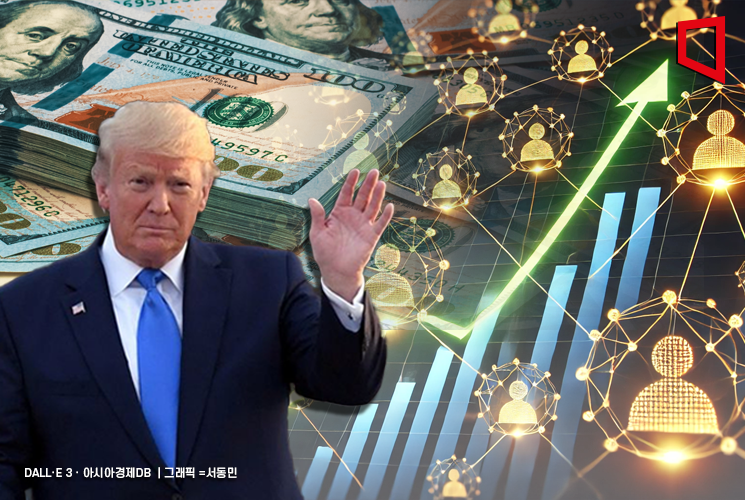
Concerns about inflation (rising prices) have increased following the inauguration of Donald Trump's second-term administration in the United States, leading to widespread expectations that the pace of interest rate cuts will be slower than anticipated. South Korea is also expected to experience increased price instability due to Trump's tariff policies, which may slow down the pace of future interest rate reductions.
Possibility of Slower Interest Rate Cuts Due to U.S. Price Instability Grows
According to the Chicago Mercantile Exchange (CME) FedWatch on the 9th, the probability of the U.S. Federal Reserve (Fed) maintaining the current benchmark interest rate this month reached 95%. The likelihood of the rate remaining unchanged until June is also 33%, with the probability of a rate hold steadily increasing.
This is because concerns about inflation are growing locally ahead of Donald Trump's presidential inauguration on the 20th. The U.S. Institute for Supply Management (ISM) reported that the December service sector Purchasing Managers' Index (PMI) last year was 54.1, exceeding the market expectation of 53.4. In particular, the service sector price index among the detailed items surged by 6.2 points from the previous month to 64.4, heightening inflation concerns. In surveys released alongside the ISM service index, respondents also expressed significant worries about price increases due to Trump's tariff policies.
The U.S. Department of Labor also revealed that the number of job openings in November last year reached 8.1 million, the highest in six months, causing the U.S. 10-year Treasury yield to surge to 4.7%, the highest in eight months. Considering that the upper limit of the current U.S. benchmark interest rate is 4.5%, this indicates that market expectations for interest rate cuts are low.
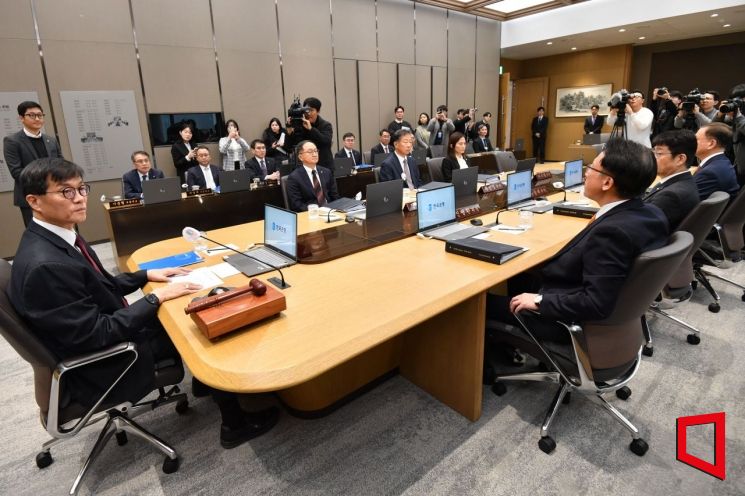 The Monetary Policy Committee meeting held at the Bank of Korea in Jung-gu, Seoul on November 28 last year. Photo by Joint Press Corps
Price Instability Concerns Growing in South Korea, Possible Adjustment in Rate Cut Pace
Concerns about inflation triggered by Trump are also rising in South Korea. Major global investment banks (IBs) have been consecutively raising their forecasts for South Korea's consumer price inflation rate this year.
JP Morgan recently raised its forecast for South Korea's consumer price inflation rate this year from 1.7% to 2.0%. HSBC also increased its forecast from 1.9% to 2.0%. These figures are higher than the Bank of Korea's inflation forecast of 1.9% for this year. They assessed that inflationary pressure in South Korea has intensified due to rising import prices caused by Trump's tariff concerns and a sharp rise in the won-dollar exchange rate amid domestic political instability.
Kim Woong, Deputy Governor of the Bank of Korea, also warned at a price situation review meeting held at the end of last month that the consumer price inflation rate in January could be somewhat higher due to the high exchange rate. The Bank of Korea viewed that the rise in the won-dollar exchange rate since mid-November last year increased the consumer price inflation rate last month by about 0.05 to 0.1 percentage points.
Concerns about inflation are a factor that lowers the possibility of the Bank of Korea cutting the benchmark interest rate in January. On the 2nd, Lee Soo-hyung, a member of the Bank of Korea's Monetary Policy Committee, cited inflation as the top priority of the Bank of Korea's monetary policy in an interview with foreign media. If inflation rises again, the likelihood that the Bank of Korea will halt interest rate cuts is expected to increase.
Im Jae-kyun, a researcher at KB Securities, explained, "Although the Bank of Korea may cut the benchmark interest rate in January due to economic concerns, expectations for additional rate cuts will be reduced because of inflation worries. Even if the Bank of Korea lowers the benchmark interest rate in January, if it makes conservative remarks about further cuts, the final interest rate level expected by the market could rise."
However, considering the economic situation, there is also an opinion that the pace of interest rate cuts in South Korea will be faster than in the United States. Ahn Jae-kyun, a researcher at Shinhan Investment Corp., predicted, "In the U.S., the need for rate cuts is diminishing due to solid growth and inflation exceeding 2%. Unlike the U.S., South Korea is likely to quickly lower the benchmark interest rate to around the neutral rate of 2% amid growing concerns about economic slowdown."
© The Asia Business Daily(www.asiae.co.kr). All rights reserved.