Ministry of Trade, Industry and Energy's 2025 Key Task Implementation Plan
Exports Expected to Show 'High in the First Half, Low in the Second Half' This Year
'Emergency Export Measures' to Be Announced Next Month
The government, anticipating difficult export conditions in the first half of this year, plans to support the largest-ever scale of trade insurance and prepare additional emergency export measures at the pan-government level next month to respond accordingly.
On the 8th, the Ministry of Trade, Industry and Energy reported the '2025 Major Work Promotion Plan,' which includes these points, to Choi Sang-mok, Acting Prime Minister and Minister of Economy and Finance.
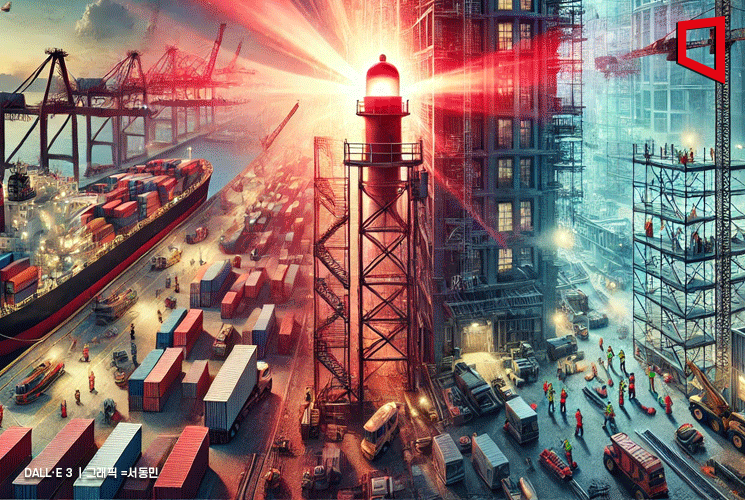
The Ministry expressed concern that the sense of crisis regarding the real economy is higher than ever. Park Seong-taek, the first vice minister of the Ministry, diagnosed, "Export conditions for key items such as semiconductors and automobiles are deteriorating, and market encroachment and technological pursuit by competitors including China are intensifying. With the domestic political situation and the inauguration of the new U.S. administration coinciding, the internal and external uncertainties that companies most fear have reached their peak."
◆ Concentrated deployment of available resources for exports in the first half = The Ministry plans to make every effort to maintain the upward trend in exports and foreign direct investment. The export outlook is not bright. Vice Minister Park explained, "Exports this year are expected to follow a 'low in the first half, high in the second half' trend. Since exports in the first half, when adverse factors are concentrated, may be very difficult, we plan to intensively deploy available policy resources in the first half."
First, the Ministry will support trade insurance at the largest scale ever, amounting to 252 trillion won. Through this, it will extend a 50% discount on short-term export insurance premiums for small and medium-sized enterprises (SMEs) and mid-sized companies, and expand export credit guarantees for production fund loans (from 4.5 trillion won to 5 trillion won). In response to recent exchange rate increases, import fund loan guarantees for raw materials and others will also be expanded from 2.8 trillion won to 3 trillion won, and the guarantee limit per individual company will be raised up to 150%. Additionally, the scale of foreign exchange fluctuation insurance support will be expanded (from 1.45 trillion won to 1.5 trillion won) with a 30% discount on premiums. Medium- to long-term insurance and guarantees to support overseas orders in sectors such as nuclear power, defense, and plants will also be expanded to 20 trillion won.
Furthermore, to resolve export difficulties faced by SMEs and mid-sized companies, a logistics-only voucher will be newly established, mutual recognition agreements for certification of new markets and promising items will be expanded (from 200 to 210 cases), and support for entry and sales on global online platforms for export-startup companies will be increased (from 1,000 to 1,500 companies), implementing a 'three-piece set' to alleviate export difficulties. Support for export marketing such as exhibitions, consultation meetings, and trade delegations will also be expanded, and export vouchers worth 61.6 billion won for SMEs and mid-sized companies will be intensively supported with more than 70% in the first half.
Along with this, the government plans to prepare and announce an additional 'Emergency Export Measures' at the pan-government level in February. Vice Minister Park said, "I believe additional measures are needed in trade finance to mitigate shocks in the short term. Once the additional measures are implemented, we will be able to establish a stable export foundation in the second half."
◆ Attracting foreign investment by expanding cash support and tariff exemption periods = Foreign direct investment aims for 35 billion dollars, with comprehensive attraction activities underway. To maintain external credibility, relay meetings with major foreign chambers of commerce and foreign-invested companies in countries such as Japan and China, which have been ongoing since December last year, will continue. In addition, investment explanation sessions (IR) targeting major countries including the U.S. will be actively conducted centered on the newly appointed International Investment Cooperation Ambassador.
Also, to attract companies related to materials, parts, and equipment linked to Korea’s advanced strategic industries such as semiconductors and bio, target countries by industry will be designated: the U.S. for semiconductors and artificial intelligence (AI), Europe for bio and chemicals, and Japan for advanced materials and parts. Intensive investment attraction activities will be conducted in the first half. Furthermore, foreign investment incentives will be significantly strengthened by temporarily raising the cash support limit up to 75% and extending the tariff exemption period from the basic 5 years to a maximum of 7 years to enhance investment attractiveness.
Vice Minister Park said, "The current situation of the Korean economy is extremely severe, and the role of the Ministry of Trade, Industry and Energy, which is responsible for the real economy, is more important than ever. We will make every effort to provide policy support so that the upward trend in exports and foreign direct investment, which reached record highs last year, continues."
© The Asia Business Daily(www.asiae.co.kr). All rights reserved.
![Clutching a Stolen Dior Bag, Saying "I Hate Being Poor but Real"... The Grotesque Con of a "Human Knockoff" [Slate]](https://cwcontent.asiae.co.kr/asiaresize/183/2026021902243444107_1771435474.jpg)
















