Current Account Surplus of $9.3 Billion in November Last Year
7 Consecutive Months of Surplus Since May Due to Semiconductor Export Improvement
2024 Surplus Expected to Exceed $90 Billion
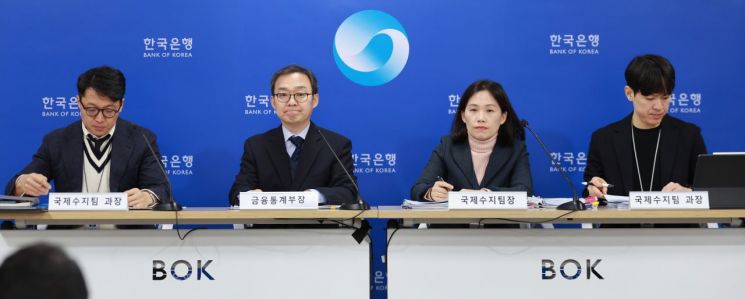 On the morning of the 8th, the 2024 November Balance of Payments (Preliminary) briefing was held at the Bank of Korea in Jung-gu, Seoul. From the left in the photo: Ahn Yong-bi, Manager of the International Balance of Payments Team at the Bank of Korea; Song Jae-chang, Head of the Financial Statistics Department at the Bank of Korea; Moon Hye-jung, Head of the International Balance of Payments Team at the Bank of Korea; Lee Young-woo, Manager of the International Balance of Payments Team at the Bank of Korea. Photo by Bank of Korea
The current account balance recorded a surplus for seven consecutive months as exports of semiconductors and information and communication devices continued to perform well. Due to the improvement in exports, the total current account surplus for 2024 is expected to exceed the previous forecast of $90 billion, marking the largest surplus in eight years.
Last Year's Current Account Surplus Expected to Exceed $90 Billion
According to the 'November Balance of Payments (Provisional)' released by the Bank of Korea on the 8th, South Korea's current account surplus in November last year was $9.3 billion. The current account has recorded a surplus for seven consecutive months since May last year.
The cumulative current account surplus from January to November last year was $83.54 billion, an increase of $55.47 billion compared to the same period the previous year ($28.07 billion). With the continued surplus in the current account, it is expected that the annual forecast surplus of $90 billion for 2024 will be fully achievable. Surpassing $90 billion in the annual current account surplus would be the first time in eight years since 2016.
Song Jae-chang, head of the Financial Statistics Department at the Bank of Korea, stated, "It has been confirmed that export improvements based on customs clearance continued in December last year," adding, "The annual current account surplus forecast of $90 billion by the Bank of Korea's Research Department is expected to be exceeded."
Looking at the components of the current account, the goods balance recorded a surplus of $9.75 billion as of November last year, supported by improved semiconductor exports. The surplus has been maintained for 20 consecutive months since April last year. The surplus amount also increased by more than $1.6 billion compared to October ($8.12 billion).
Exports in November last year were $57.1 billion, up 1.2% compared to the same month the previous year. Semiconductor exports increased by 29.8%, information and communication devices by 8.5%, and steel products by 0.8%. On the other hand, chemical products declined by 6.8%, machinery and precision instruments by 12.5%, passenger cars by 14.1%, and petroleum products by 18.6%. By region, exports increased to Southeast Asia (9.1%) and the European Union (EU, 0.9%) compared to the same month last year, while exports to China (-0.7%), Japan (-2.4%), and the United States (-5.2%) decreased.
Song said, "Exports remain solid, centered on high-spec semiconductors, and the export growth trend is expected to continue this year," but added, "However, uncertainties in the trade environment, such as the start of the Trump administration's second term and concerns over the expansion of US-China conflicts, may slow the export growth rate."
Imports in November last year were $47.35 billion, down 4.4% compared to the same month the previous year. Although capital goods such as semiconductor manufacturing equipment continued to increase, raw materials continued to decline, and consumer goods also turned to a decrease. Imports of raw materials such as petroleum products (-19.4%), chemical products (-17.2%), crude oil (-16.8%), and coal (-12.5%) decreased by 10.2% compared to the previous year. Consumer goods such as passenger cars (-30.9%) and grains (-10.2%) also decreased by 6.3%. On the other hand, imports of capital goods such as semiconductor manufacturing equipment (77.4%), semiconductors (24.5%), and precision instruments (0.6%) increased by 11.3%.
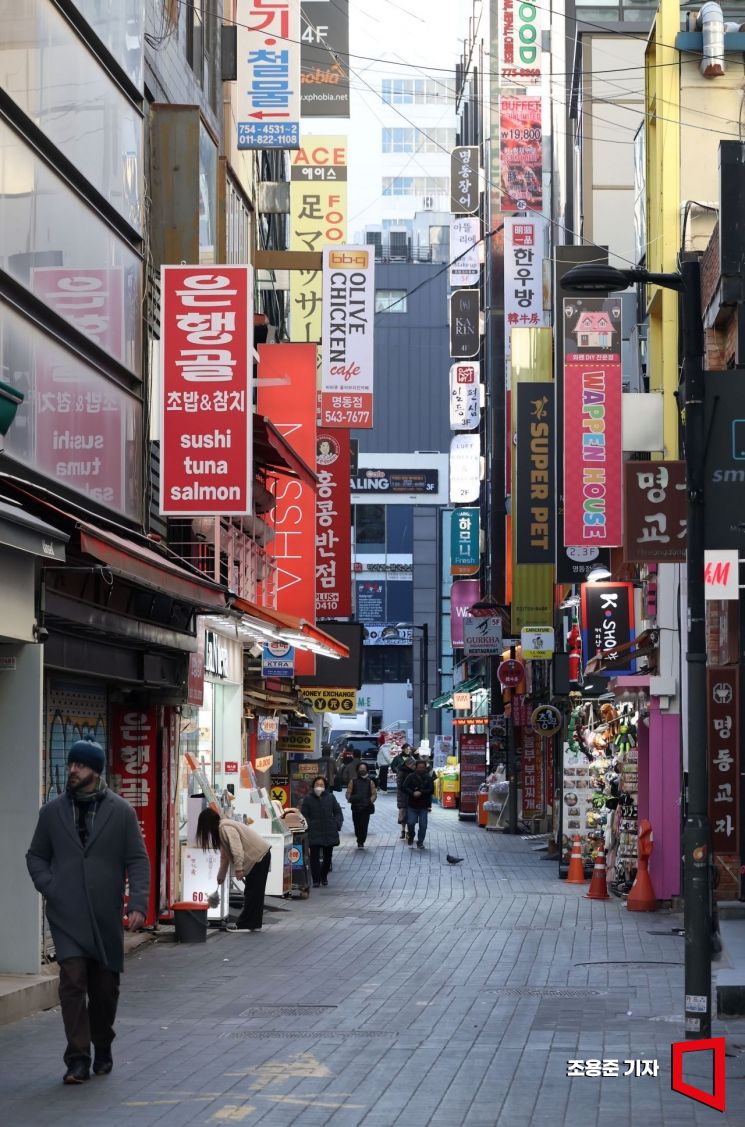 On the 31st of last month, the streets of Myeongdong in Jung-gu, Seoul, appeared quiet with fewer visitors. Photo by Jo Yong-jun
Service Account Deficit Continues as Foreign Tourists to Korea Decrease
The service account recorded a deficit of $2.09 billion, centered on processing services, travel, and other business services. The travel account showed a deficit of $760 million due to the disappearance of the effect of the Chinese National Day holiday in the previous month. The deficit widened compared to the previous month (-$480 million).
Song said, "With the end of the Chinese National Day holiday, the deficit in the service account increased in November last year due to a decrease in Chinese tourists," adding, "Due to the decrease in tourists visiting Korea caused by political instability and the increase in overseas travel by Koreans at the end of the year, the deficit is expected to continue in December as well."
Additionally, the primary income account recorded a surplus of $1.94 billion, mainly from interest income. The secondary income account recorded a deficit of $300 million.
The financial account, which shows capital inflows and outflows, increased net assets by $9.76 billion in November last year. The scale decreased compared to the previous month ($12.98 billion). Direct investment saw an increase of $2.84 billion in domestic investors' overseas investments and a decrease of $10 million in foreign investors' domestic investments. In securities investment, domestic investors' overseas investments increased by $390 million, mainly in bonds, but foreign investors' domestic investments decreased by $2.12 billion, mainly in stocks.
© The Asia Business Daily(www.asiae.co.kr). All rights reserved.
![Clutching a Stolen Dior Bag, Saying "I Hate Being Poor but Real"... The Grotesque Con of a "Human Knockoff" [Slate]](https://cwcontent.asiae.co.kr/asiaresize/183/2026021902243444107_1771435474.jpg)

















