12-Year Cycle Major Maintenance Conducted Overseas
Complete Disassembly and Inspection Including Engine Overhaul
Due to Aircraft Supply Delays and Increased Overseas Passenger Demand
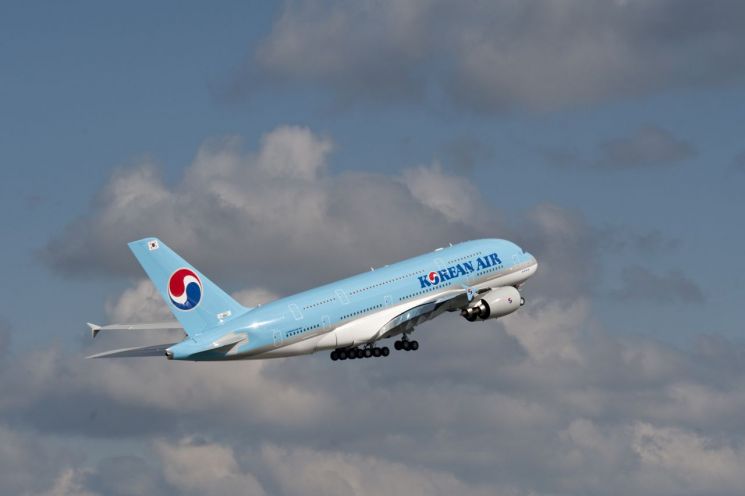
Korean Air is delaying the retirement of its A380 aircraft, known as the "hotel in the sky," and embarking on large-scale maintenance. As international flight demand increases and the introduction of next-generation aircraft is delayed, the airline has decided to utilize the A380 for a longer period than originally planned.
According to industry sources on the 9th, Korean Air recently sent its A380 HL7619 aircraft to the Lufthansa Technik Center in the Philippines at the end of last year. This was to carry out a major maintenance and performance improvement process called a D-check. The D-check is a large-scale maintenance operation conducted every 10 to 12 years. It involves engine overhaul (complete disassembly and reassembly), extensive dismantling and detailed inspection of various parts. The systems are also upgraded, followed by test flights to complete the maintenance and performance enhancement.
Originally, Korean Air planned to retire the A380 by 2026. The recent trend in aircraft is to operate with medium-sized planes fully occupied, but the A380, with four engines and a maximum seating capacity of 853 seats, is a super-large model that does not fit the current era. Korean Air Chairman Cho Won-tae also stated that the A380 would be retired by 2026, and Boeing 747 models, classified in the same category as the A380, would be retired by 2031. Other airlines such as Lufthansa, Qatar Airways, and Singapore Airlines were also postponing or canceling their A380 acquisitions.
However, Korean Air plans to extend the A380’s lifespan beyond 2030 through this D-check process. The demand for used A380s has declined, making disposal difficult, and delays in the aircraft manufacturers’ supply chain recovery have postponed the delivery of new aircraft. Korean Air’s next-generation Boeing 787-10 was also introduced in August last year, about three years later than originally scheduled. Airbus lowered its aircraft production target from 800 to 770 units last year due to supply chain issues.
The recovery in long-haul demand also influenced the decision. Korean Air’s cumulative sales for the third quarter of last year reached 13.369 trillion won, and operating profit was 1.6461 trillion won, increasing by 14.1% and 9.3% respectively compared to the same period the previous year. Analysts attribute this to focusing on more profitable long-haul routes rather than competing with low-cost carriers (LCCs) on short-haul routes. Regarding this, a Korean Air official said, "We will strive in various ways to provide better service until the A380 is retired."
© The Asia Business Daily(www.asiae.co.kr). All rights reserved.

















