"Not a Violation of Localizer Regulations" Position Reconfirmed
"However, Acknowledges Insufficient Safety Review Apart from Regulations"
"Will Seek Safety Improvement Measures"
Cause of Accident Likely to Take Several Months to Determine
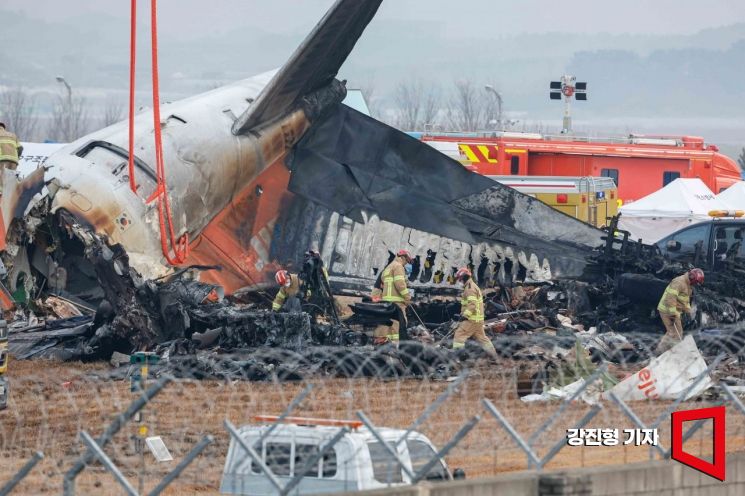 Firefighters are searching for fuel items at the site of the Jeju Air passenger plane collision and explosion accident that occurred at Muan International Airport, Jeonnam, on the 30th. Photo by Kang Jin-hyung
The Ministry of Land, Infrastructure and Transport claimed that the localizer (azimuth facility) at Muan International Airport in Jeollanam-do was installed in accordance with regulations. They maintained their previous stance regarding the controversy over violations related to the localizer's location and the concrete structure of the facility. However, they acknowledged that the safety review of the localizer was insufficient regardless of the regulations and stated they would seek improvement measures.
Joo Jong-wan, Director of the Aviation Policy Office at the Ministry, stated at a briefing on the Muan Airport passenger plane crash held at the Government Sejong Complex on the afternoon of the 7th, "The localizer at Muan Airport was constructed according to regulations."
The localizer is an antenna that assists passenger planes in landing. During the Jeju Air passenger plane accident on December 29 last year, the plane successfully performed a belly landing but collided with a 2-meter-high localizer mound. It was revealed that this mound was constructed with concrete, which was criticized for exacerbating the damage.
The Ministry took the position that the localizer's location outside the longitudinal safety zone was not a violation of regulations. Director Joo said, "According to domestic and international regulations, the longitudinal safety zone at Muan Airport is 199 meters, which exceeds the mandatory 90 meters to the localizer, thus complying with regulations."
They also drew a line regarding the possibility of illegality concerning the concrete material and mound shape. According to the Ministry, there are no regulations on the material and shape of facilities located outside the longitudinal safety zone. However, Director Joo stated, "Regardless of whether it violates regulations, the point that safety should have been reviewed to be ensured was insufficient," and added, "We will seek improvement measures."
Korea Airports Corporation promoted the localizer facility upgrade project at Muan Airport in 2020 and installed a concrete slab measuring 30 cm thick, 42 m wide, and 3.4 m long on the mound through the upgrade project last year.
The Ministry initially stated on December 30 last year that the localizer mound was installed according to regulations, but as criticisms arose that it did not align with other domestic regulatory guidelines, they withheld this position the following day. The Ministry explained that according to the 'Detailed Guidelines for Managing Aviation Obstacles under the Aviation Facilities Act,' obstacles on airport grounds must be made of breakable materials only if they are within the longitudinal safety zone. However, another guideline, the 'Detailed Design Guidelines for Airport and Airfield Facilities,' states that the longitudinal safety zone should extend to where obstacles such as localizers are located, which sparked controversy.
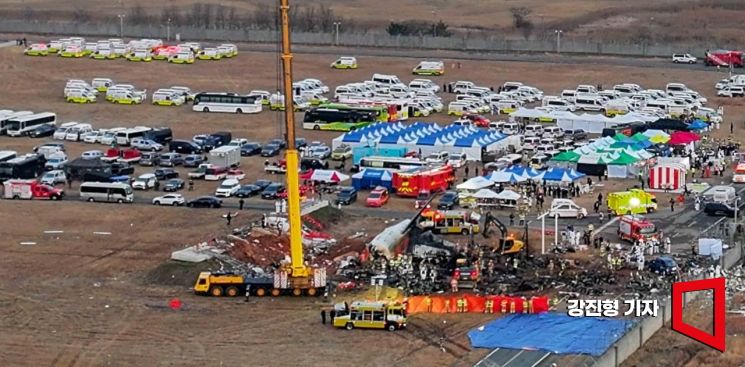 On the 29th, a Jeju Air passenger plane carrying 181 passengers collided with the outer wall of the runway while landing at Muan International Airport, causing a fire that resulted in a major disaster with most passengers dying. The wreckage of the accident aircraft is placed on the runway at Muan International Airport, Jeonnam. Photo by Kang Jin-hyung
On the same day, the Ministry also announced that it would consistently revise the regulations of the 'Standards for Installation of Airport, Airfield Facilities, and Runways' and the 'Airport Safety Operation Standards.' The installation standards do not restrict the material of facilities outside the longitudinal safety zone, but the operation standards include the requirement that they be installed to be 'easily breakable.'
Director Joo said, "The operation standards were applied starting in 2010, so they did not apply to the construction of Muan Airport. However, regarding the criticism that airport facilities should have been improved to meet the standards as much as possible during the operation and management of the airport afterward, we will reflect this in safety inspections and countermeasure establishment to ensure safety."
The Ministry will prepare safety line securing measures for airports with facility structures similar to Muan Airport, such as Yeosu International Airport and Pohang International Airport. However, no specific measures such as facility removal have been proposed yet, and discussions with experts about options including reconstruction are ongoing.
Meanwhile, Lee Seung-yeol, head of the Aviation and Railway Accident Investigation Committee's accident investigation team, said at the briefing that "it was confirmed that a bird strike occurred at the time of the accident," and explained, "One engine definitely experienced a bird strike, but whether it occurred in both engines simultaneously requires further investigation."
Lee added, "Feathers were found during the process of removing soil from the engine, and we plan to investigate what species the bird was through internal engine inspection."
He also stated regarding the flight data recorder (FDR) being analyzed in the United States, "It takes about three days to extract the data and one or two days to verify the basic data. However, it may take several months to analyze it in sync with the cockpit voice recorder (CVR) and other data."
© The Asia Business Daily(www.asiae.co.kr). All rights reserved.
![Clutching a Stolen Dior Bag, Saying "I Hate Being Poor but Real"... The Grotesque Con of a "Human Knockoff" [Slate]](https://cwcontent.asiae.co.kr/asiaresize/183/2026021902243444107_1771435474.jpg)

















