Baek Hyeryun "Sufficient judgment without examining the crime of rebellion in the constitution"
Park Juntae "Intention to end impeachment before Lee Jae-myung's trial"
Disagreement over witness adoption... Ruling party "Too many"
On the 7th, the ruling and opposition parties clashed over the withdrawal of the charge of rebellion and the number of witness requests at the Special Committee for the National Investigation into the Truth of the Rebellion Charges through the declaration of martial law by the Yoon Seok-yeol administration. The People Power Party argued that since the charge of rebellion was removed from the grounds for impeachment, a re-deliberation process must be undertaken, while the Democratic Party of Korea maintained that the removal of the rebellion charge was not a deletion but a constitutional clarification.
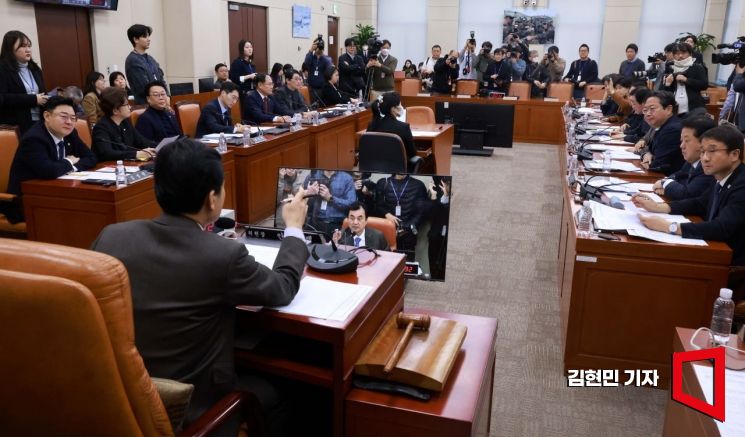 On the 7th, the Special Committee for the National Investigation into the Alleged Insurrection Charges through the Declaration of Martial Law by the Yoon Seok-yeol Administration is being held at the National Assembly. Photo by Kim Hyun-min
Baek Hye-ryun, a member of the Democratic Party's special committee, said at the plenary meeting that day, "The Constitutional Court claims to have removed the charge of rebellion, but it did not remove the charge; it only constitutionally clarified the act of rebellion." She added, "Constitutional trials and criminal trials are distinctly different," explaining, "A constitutional trial can be seen as a kind of disciplinary procedure, so it can make judgments without necessarily considering whether the charge of rebellion constitutionally applies."
Park Jun-tae, a member of the ruling party's special committee from the People Power Party, said, "Reconstructing the act of rebellion constitutionally to make a judgment is close to wordplay and means they do not intend to proceed," and added, "Because the constitution is abstractly developed, to determine unconstitutionality, one must comprehensively judge the illegality according to detailed laws and regulations."
He further pointed out, "The National Assembly passed the impeachment motion against President Yoon Seok-yeol with the charge of rebellion as the most significant content," and said, "But the Constitutional Court's refusal to judge it either admits that the charge of rebellion does not hold or intends to hastily conclude the impeachment trial." He added, "In the first trial of Representative Lee Jae-myung, a sentence invalidating his election was issued; if the intention is not to end the impeachment trial before the appeal and final trial of this case are over, then why are they doing this?"
Joo Jin-woo, a member of the same party, emphasized, "The impeachment defense team said that they removed the charge of rebellion from the impeachment document following the court's recommendation," and added, "That means there was some tacit understanding between the court, which should fairly handle the trial, and Chairman Jeong Cheong-rae, who acted as the prosecutor for the impeachment."
Additionally, Representative Joo said, "During the impeachment process, we reviewed and voted on the entire impeachment resolution," and asked, "Who authorized Chairman Jeong Cheong-rae to arbitrarily amend the text?" He continued, "The arbitrary amendment itself raises questions about the legality and legitimacy of the impeachment document," and stated, "I believe re-deliberation is inevitable."
The ruling and opposition parties also sharpened their positions over the number of witnesses. Kim Seong-won, the ruling party's special committee secretary, said, "During the Yongsan Itaewon disaster investigation, there were 103 witnesses, and during the Choi Soon-sil case, there were 70, but this time, 187 witnesses were requested over two days," and added, "We cannot agree on the witnesses together; if the Democratic Party deems it necessary, it should be done through a vote with the Democratic Party." In response, Ahn Kyu-baek, the special committee chairman, drew a line, saying, "The hearing on the charge of rebellion involves complex interrelations within the military's various organic systems, making it quite difficult to interpret it on the same level as other hearings."
The special committee plans to start institutional reports targeting the Ministry of National Defense and others on the 14th, followed by 2 to 3 rounds each of on-site investigations and hearings.
© The Asia Business Daily(www.asiae.co.kr). All rights reserved.
![User Who Sold Erroneously Deposited Bitcoins to Repay Debt and Fund Entertainment... What Did the Supreme Court Decide in 2021? [Legal Issue Check]](https://cwcontent.asiae.co.kr/asiaresize/183/2026020910431234020_1770601391.png)