Daesang, Mayonnaise Prices Increase by an Average of 19.1%
"High Exchange Rates and Climate Inflation Drive Up Costs"
Fresh Food Prices Also Soar, Raising Concerns Over Meal Expenses
Food prices have been fluctuating since the beginning of the new year. As global economic uncertainties expand, soaring exchange rates and rising raw material costs have led major domestic food companies to consecutively raise prices. Agricultural product prices are also skyrocketing ahead of the Lunar New Year holiday, the biggest traditional festival. The political vacuum caused by the internal conflict at the end of last year appears to be increasing the burden on household expenses.
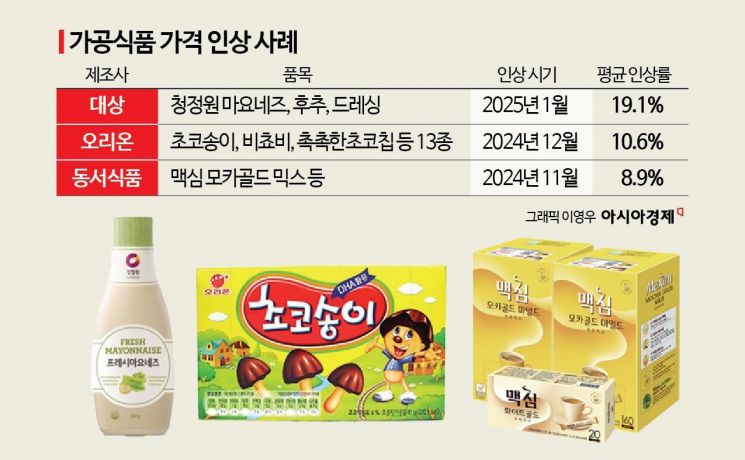
According to the food industry on the 8th, Daesang will raise the prices of Cheongjeongwon mayonnaise, pepper, and dressings by an average of 19.1% starting from the 16th. The price of pure pepper (50g) at large supermarkets will increase by 19.0%, from 3,680 won to 4,380 won. The price of Fresh Mayonnaise (300g) will rise by 9.0%, from 3,100 won to 3,380 won. In addition, dressing prices will increase by an average of 23.4%.
A Daesang representative said, "Due to the continuous rise in domestic and international raw material prices and manufacturing costs, we have inevitably adjusted prices."
Price Increases from Essential Cooking Ingredient Pepper to Snacks, Jam, and Chicken
The price hike relay among food companies has been ongoing since the end of last year. The high exchange rate continued, and import raw material prices surged significantly due to climate inflation, spreading a sentiment that they can no longer endure the costs. Moreover, the impeachment political crisis triggered by the December 3 internal conflict led to a government vacuum, leaving the administration helpless. Last year, the government called in CEOs of major food companies to request restraint on price hikes and poured subsidies into major distribution companies, making every effort to stabilize prices.
Accordingly, Orion, which had refrained from raising prices, increased the prices of 13 products including chocolate snacks by an average of 10.6% early last month. As a result, the price of 'Choco Song-i' rose by 600 won from 2,800 won to 3,400 won, and 'Talk Ping Almond & Granola' and 'Talk Ping Hazelnut & Granola' increased by 100 won from 1,500 won to 1,600 won.
Dongseo Foods followed suit. As international coffee bean prices soared, they raised the shipment prices of instant coffee, coffee mixes, and coffee beverages by an average of 8.9% in November. Consequently, the price of Maxim Mocha Gold Mix (180 sticks, 2.16kg) increased by 9.5%, from 23,700 won to 25,950 won.
Additionally, Dong-A Otsuka raised prices of major products by 100 won. Accordingly, OranC Pine Vitamin C and Narangd Cider sold at convenience stores rose from 1,400 won to 1,500 won each. The prices of Pocari Sweat cans (240ml) and Demi Soda (250ml) also increased by 100 won, from 1,600 won to 1,700 won. Ottogi raised the price of commercial strawberry jam by up to 10%.
Prices of chicken, a representative dining-out menu, have also increased. Puradak Chicken raised prices of 10 chicken menu items, excluding Basil Pesto, General Hot Chicken, and Pablo Chicken, by up to 1,000 won on December 30 last year. A representative from Eiders F&B, which operates Puradak Chicken, said, "Continuous price increases in the dining industry are ongoing due to raw material costs, rent, and delivery app fees," adding, "This is an unavoidable measure to improve franchise profitability."
Cabbage and Radish Prices Surge 60% Compared to Average Year... Fruit Prices Also Rise Ahead of Lunar New Year
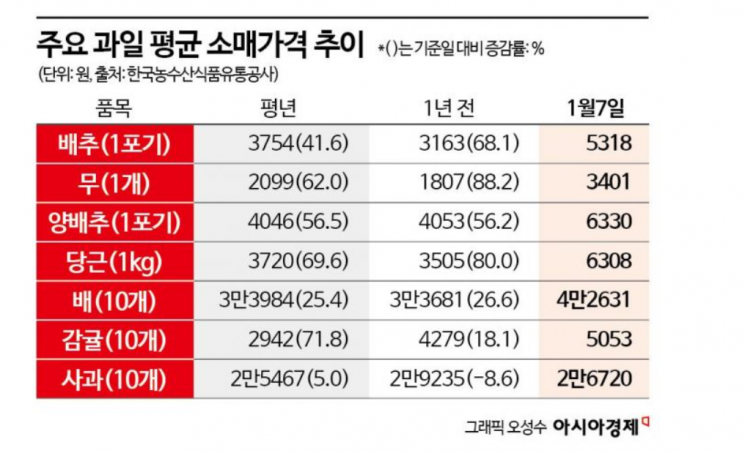
Major agricultural products are also facing emergencies in grocery prices ahead of the Lunar New Year. According to the Korea Agro-Fisheries & Food Trade Corporation (aT) Agricultural and Fishery Products Distribution Information (KAMIS), the retail price of one head of cabbage was 5,318 won as of the previous day, up 68.1% from the same period last year (3,163 won). Compared to the average year (3,754 won), the price rose by 41.6%. The average year price is the three-year average excluding the highest and lowest prices from 2020 to last year.
The price increase of radish is even steeper. Radish costs 3,401 won per piece, up 88.2% from the same period last year (1,807 won), and 62.0% higher than the average year (2,099 won). Additionally, carrot prices rose to 6,308 won per kilogram, up 80.0% from the previous year (3,505 won), and cabbage prices increased by 56.2% to 6,330 won per head during the same period, with vegetable prices rising across the board.
The rise in cabbage and radish prices appears to be due to the impact of climate change. Last summer's heatwave and the prolonged late heat after Chuseok led to poor growth of agricultural products. Frequent rain in Jeju, the main winter radish production area, also affected radish production volume. Furthermore, early shipment of cabbage and radish to stabilize prices during last year's kimchi-making season is considered one of the recent price increase factors.
Fruit prices are also strong ahead of the Lunar New Year at the end of this month. The average retail price of pears (Shingo variety) is 42,631 won for 10 pieces, up 26.6% from the same period last year (33,681 won) and 25.4% higher than the average year (33,984 won). Tangerine prices also rose by 18.1% to 5,053 won for 10 pieces compared to one year ago (4,279 won), and are 71.8% more expensive than the average year (2,942 won). However, the average retail price of apples (Fuji variety) is 26,720 won for 10 pieces, 5.0% higher than the average year (25,467 won) but 8.6% lower than last year (29,235 won).
The price increase of pears was greatly influenced by a decrease in supply. Due to high temperatures and heavy rainfall in September last year, damage increased, and harvest volume decreased after Chuseok, resulting in a 3.0% reduction in production compared to the average year. Heat damage also increased the proportion of discarded produce after harvest, reducing storage volume. The increase in long-term storage volume to meet demand during the Lunar New Year peak season also affected price rises. Tangerines suffered significant heat damage (cracking) during the summer heatwave, and poor growth reduced shipment volume.
However, livestock product prices are relatively stable compared to agricultural products. According to the Livestock Products Quality Evaluation Service's Livestock Distribution Information on the 7th, Korean beef short ribs cost 6,993 won per 100g, down 10.0% from the same period last year (7,770 won), while pork ribs rose 4.9% to 1,444 won per 100g from 1,376 won a year ago. During the same period, retail chicken prices fell 0.4% to 5,754 won per kilogram, and eggs (30 special eggs) dropped 2.9% to 6,809 won.
As grocery prices soar, the government plans to announce price management measures as early as this week. It is expected to increase the supply of major seasonal products to the highest level ever and support discount events on a maximum scale. In particular, to stabilize cabbage prices, the government is considering releasing all available quantities to the market and temporarily suspending purchases. They are also contemplating importing cabbage in case the situation worsens. Previously, when cabbage supply decreased and prices surged last summer, the government imported fresh cabbage from China.
© The Asia Business Daily(www.asiae.co.kr). All rights reserved.


















