Introduction of Earmarked Taxes and Expansion of Credits... Sustainability Discussions
"Improving Enrollment Period More Important Than Raising Income Replacement Rate"
The Democratic Party of Korea's 'Forum on Livelihood Economy and Innovative Growth (Livelihood Forum, Chair Park Jumin)' held a seminar on pension reform at the National Assembly on the 7th. The proposed reform of the National Pension discussed at the seminar focused on increasing public trust in the pension system, assuming government budget input.
At the 'Challenges of National Pension Reform' seminar hosted by the office of Rep. Kim Namhee, a member of the Livelihood Forum, at 7:30 a.m. that day, Professor Kim Taeil of Korea University's Department of Public Administration delivered the keynote presentation. Discussant Won Jonghyun, a full-time expert member of the National Pension Fund Management Committee, participated, along with 11 Democratic Party lawmakers and Rep. Baek Seonhee of the Innovation Party.
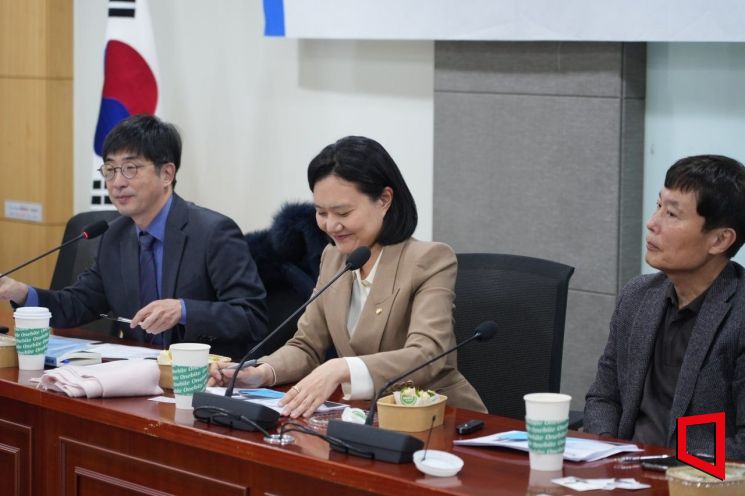 Won Jong-hyun, full-time expert member of the National Pension Fund Management Committee (from left), Kim Nam-hee, member of the Democratic Party of Korea, and Kim Tae-il, professor of Public Administration at Korea University, are attending the seminar "Challenges of National Pension Reform" held at the National Assembly Members' Office Building on the morning of the 7th. Photo by Kim Nam-hee, Office of the National Assembly Member
Professor Kim explained that for the National Pension to be sustainable above a certain level, the contribution rate should be 15%. Currently, the National Pension contribution rate is 9%. During the 21st National Assembly and other pension reform discussions, the consensus between ruling and opposition parties was around 13%. Considering this, Professor Kim emphasized the need for an additional levy in the form of a dedicated tax. A 'dedicated tax' refers to a tax collected for a specific expenditure purpose. He suggested that a value-added tax (VAT) applied to all items could be levied to secure funds for the National Pension.
The government and ruling and opposition parties have been engaged in a tug-of-war over how to adjust the current contribution rate of 9% and the income replacement rate of 40%. Regarding this, Professor Kim expressed a negative view on 'raising the income replacement rate.' The income replacement rate refers to the ratio of pension benefits received in retirement compared to the average lifetime income, based on a 40-year National Pension subscription period. Since the average subscription period in Korea is less than 20 years, he argued that finding ways to increase the subscription period would provide more practical benefits to the public.
Democratic Party lawmakers attending the seminar generally agreed with Professor Kim's views but stated that the first step in pension reform should be to prioritize 'parameter reform' by adjusting the contribution rate and income replacement rate. Rep. Kim Namgeun said, "I thought that raising the income replacement rate to some extent would build trust in the pension, but after today's discussion, it seems possible by increasing the subscription period," adding, "Since it is difficult to reach social consensus, I think we should quickly establish the foundation and then make improvements."
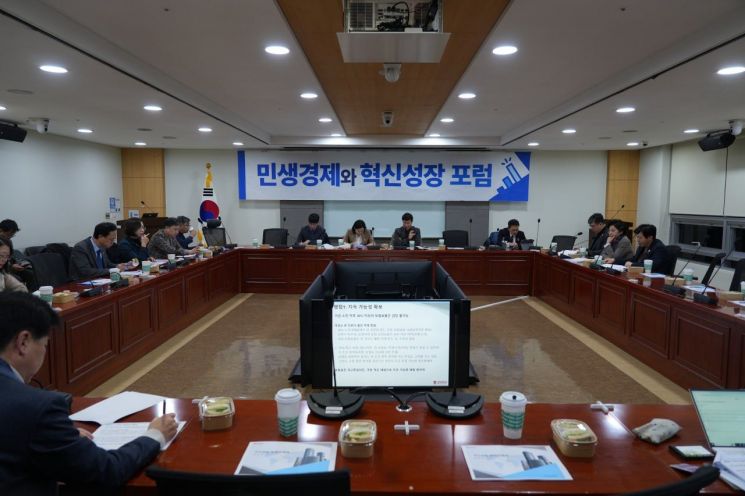 On the morning of the 7th, more than 10 members of the Democratic Party attended the seminar "Challenges of National Pension Reform" held at the National Assembly Members' Office Building. Photo by Namhee Kim, National Assembly Office
Rep. Kim Youngbae also said that day, "The fundamental issue is that stable jobs sufficient to subscribe to the National Pension must be provided to ensure its sustainability," adding, "We need to find a good way to raise contributions, split half by companies and half by individuals." Rep. Kim Sunghwan said, "It seems that the majority view is the 'two-step theory,' where parameter reform to raise contribution and income replacement rates is done first, followed by fundamental structural reform," adding, "Structural reform should also be divided into two steps to narrow blind spots."
© The Asia Business Daily(www.asiae.co.kr). All rights reserved.


















