Utilization of mountainous areas in regions with declining populations is expected to become easier.
On the 7th, the Korea Forest Service announced that it has amended the Enforcement Decree of the Mountainous Area Management Act to allow local governments to relax the standards for mountain land conversion permits by up to 20% through ordinances.
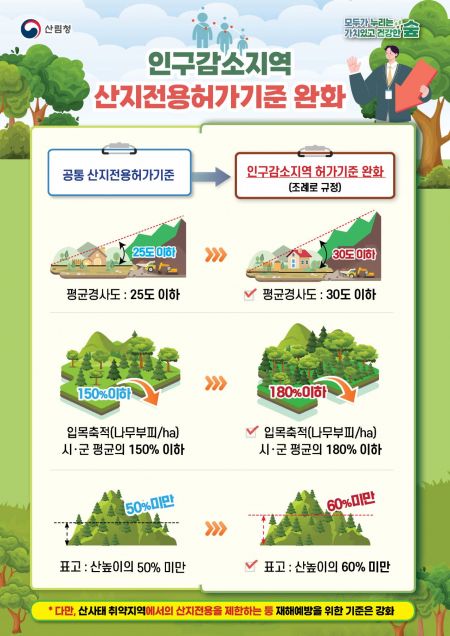
With the amendment of the Enforcement Decree, the criteria for mountain land conversion will be eased as follows: the average slope angle limit will increase from less than 25 degrees to up to 30 degrees, the volume of standing timber (the volume of trees within the forest) will increase from 150% of the city/county average to up to 180%, and the elevation limit will be relaxed from less than 50% to less than 60%.
The Korea Forest Service expects that the relaxation of mountain land conversion permit standards through the amendment will facilitate the use of mountainous areas in regions with declining populations, thereby promoting the attraction of facilities and fostering industries within those areas. The amendment was made with the purpose of addressing social and economic issues caused by population decline.
However, for areas vulnerable to landslides, the Enforcement Decree will be further amended to allow mountain land conversion only when disaster prevention facilities are installed to prevent forest disasters. The evaluation of disaster risk and other standards for planned mountain land conversion sites will continue to be operated as before.
Im Sang-seop, Administrator of the Korea Forest Service, stated, “We will continue to revise laws and regulations to make forests a key resource for regional development, resolve issues in regions with declining populations, and contribute to balanced national development.”
© The Asia Business Daily(www.asiae.co.kr). All rights reserved.

















