The Korea Eximbank, a state-run bank, is set to issue its first overseas bonds amid the impeachment turmoil. This marks the first attempt at overseas fundraising by the government, public institutions, and domestic companies since the December 3 emergency martial law incident. While the stock and foreign exchange markets experienced immediate shocks with large-scale foreign investor withdrawals due to the political upheaval, the bond market has remained relatively cautious. The results of the Eximbank’s overseas bond issuance, breaking a one-month hiatus in the Korean foreign currency bond market, are expected to serve as a barometer of global market perceptions of the Korean economy and its sovereign creditworthiness.
According to related ministries and agencies on the 7th, the Eximbank plans to issue dollar-denominated bonds worth $2 billion this week, mixing maturities of 3 to 10 years. These bonds will be issued to overseas investors in major financial markets worldwide, including the U.S., Europe, the Middle East, and Asia. Eight lead managers have been selected, including seven foreign institutions such as JP Morgan and domestic NH Investment & Securities. The funds raised through this bond issuance will be used to repay bonds maturing this year and for operational capital.
 On the 6th, members of conservative groups gathered near the presidential residence in Yongsan-gu, Seoul, urging opposition to the arrest of President Yoon Seok-yeol, following the High-ranking Officials' Crime Investigation Agency's official letter stating that the execution of the arrest warrant for President Yoon would be entrusted to the police. Photo by Kang Jin-hyung
The Eximbank’s overseas bond issuance is the first public offering by the government, domestic financial institutions, and public agencies since President Yoon Seok-yeol’s emergency martial law incident. This issuance is seen as a barometer to gauge overseas investors’ perceptions of the Korean economy following the martial law incident. Kim Yoon-kyung, head of the Capital Markets Department at the International Finance Center, said, “If the issuance yield is significantly higher than expected or the order volume falls short of market expectations, it could be interpreted as a lack of confidence in the Korean economy.” However, she added, “Political events mainly affect emerging or developing countries, so the fundamental impact on the overseas fundraising market is expected to be minimal.”
The industry also expects strong investor demand given the Eximbank’s solid fundamentals, making a reduced issuance below the target amount of $2 billion unlikely. The Eximbank’s credit rating is ‘Aa2’ (Moody’s), the third highest among ten investment grades, the same as the Korean government. Kim Sang-man, executive director at Hana Securities, said, “The scale of the Eximbank’s overseas bond issuance is similar to that of early last year, and since the bonds have long maturities, they are not expected to react sensitively to political situations.”
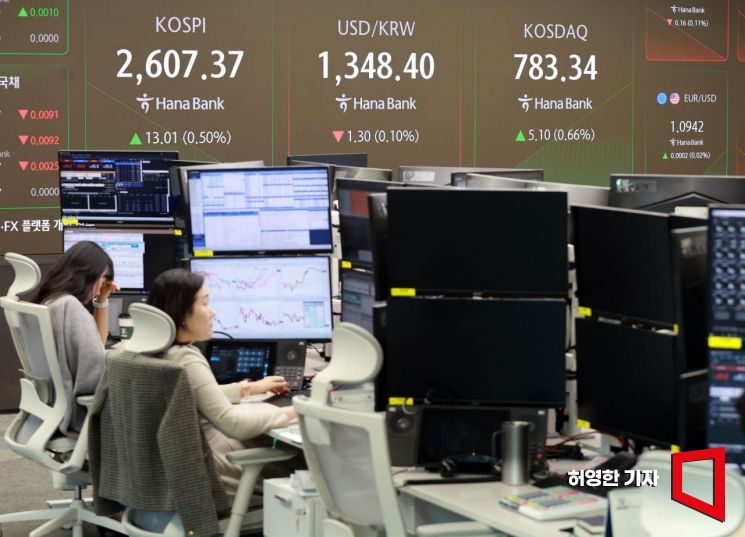 On the 10th, the first trading day after the inclusion of Korean government bonds in the World Government Bond Index (WGBI) was decided on the 9th, the KOSPI opened slightly higher in the 2610-point range, and the KOSDAQ also rose slightly. Employees are working in the dealing room of Hana Bank in Euljiro, Seoul, while stock prices, exchange rates, and other indices are displayed on the electronic board. Photo by Heo Younghan younghan@
The Eximbank’s Treasury Market Division is sparing no effort to ensure the success of the overseas bond issuance by continuously engaging with foreign institutional investors. Cha Beom-seok, head of the Treasury Market Division, and others sent letters under the name of President Yoon Hee-sung to global investment institutions last month and held non-face-to-face investor relations (IR) meetings, meeting foreign investors tirelessly. Cha said, “The more foreign investors we meet, the more favorable it is for the overseas bond issuance,” adding, “Despite recent political situations, Korea’s democracy has strong resilience, and the country’s credit rating remains stable.”
Unlike the stock and foreign exchange markets, which experienced large-scale foreign investor withdrawals and volatility after the incident, foreign trends in the bond market have been relatively stable. Ki Tae-ui, a researcher at Shin Young Securities, said, “Although there was seasonal selling pressure on 3-year government bond futures last month due to year-end maturity repayments, buying resumed at the beginning of the year, continuing a net buying streak,” and added, “While the martial law incident has been a critical bearish factor in the foreign exchange market, the bond market has remained relatively stable.”
Global credit rating agencies such as S&P, Moody’s, and Fitch also assess that political uncertainty does not have a substantial impact on the country’s credit rating. The credit default swap (CDS) premium for Korea’s sovereign risk (based on the 5-year Foreign Exchange Stabilization Fund bond) fluctuated only 2 to 3 basis points (1 bp = 0.01 percentage points) after the martial law incident occurred (34.41 bp on the 3rd). In fact, the CDS premium showed more sensitivity to the Federal Reserve’s interest rate cut news than to the martial law and impeachment issues.
Kim Myung-sil, a researcher at iM Securities, said, “There are no signs yet of changes in the country’s credit rating, and the fundraising market is not reflecting political risks,” diagnosing, “While the martial law and impeachment issues are clearly negative for investor sentiment, political uncertainty is unlikely to translate into sovereign risk.” However, she added, “If political uncertainty prolongs into the second half of this year, overseas credit rating agencies may reconsider their evaluations of Korea’s sovereign credit.”
The government bond market is also closely watching the results of the Eximbank’s issuance. As of the 3rd, foreign investors hold about 21% of the outstanding government bonds, indicating a significant foreign presence in the market. The government plans to issue a record-high KRW 197.6 trillion in government bonds this year, starting with KRW 13.7 trillion this month. Including the expected supplementary budget for the first quarter and Foreign Exchange Stabilization Fund bonds, the total issuance volume will reach the mid-200 trillion KRW range. Compared to the average of the previous four years (around 160 trillion KRW), this is a massive increase, posing a significant burden on fiscal and financial markets. A Ministry of Economy and Finance official said, “The results of the Eximbank’s issuance are expected to have some influence on the issuance of foreign currency-denominated bonds by the government and domestic companies.”
© The Asia Business Daily(www.asiae.co.kr). All rights reserved.


















