North Korea Demonstrates Strike Capability on Guam, Where US Forces Are Deployed
Kim Jong Un: "No One Can Respond... Deterring Nuclear War"
Daughter Ju Ae Also Appears, Observing via Video Surveillance System
North Korea claimed to have successfully test-fired a new type of hypersonic intermediate-range ballistic missile (IRBM). Kim Jong-un, Chairman of the State Affairs Commission of North Korea, observed the launch and expressed confidence that it would serve to check the "Pacific adversaries." This is interpreted as implying that the missile can strike as far as Guam, where U.S. reinforcement forces would be deployed in an emergency.
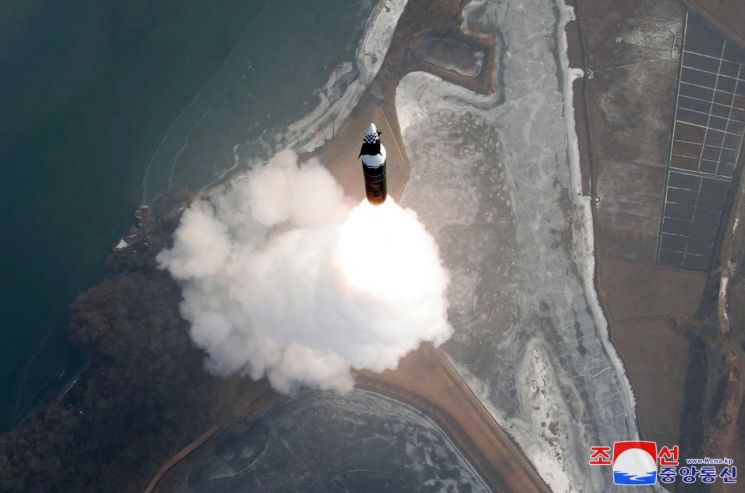 The North Korean Missile General Bureau announced on the 6th that it conducted a test launch of a new hypersonic medium-to-long-range ballistic missile (IRBM) at a launch site in Pyongyang. Yonhap News
On the 7th, the Korean Central News Agency reported that under the guidance of Jang Chang-ha, director of the Missile General Bureau, the new IRBM test launch was conducted the previous day. Chairman Kim observed the test launch via a video surveillance system, and his daughter Kim Ju-ae also watched the scene together. The agency stated, "At the launch site on the outskirts of Pyongyang, the missile's hypersonic glide vehicle, launched in a northeast direction, reached a speed of 12 times the speed of sound." The glide vehicle refers to the warhead.
North Korea claimed that the missile's first peak altitude was 99.8 km, and the second peak altitude was 42.5 km, and that it accurately struck a target in international waters along the 1500 km line. It added, "New carbon fiber composite materials were used in the production of the propulsion maneuvering body of the new hypersonic missile," and "a new comprehensive and effective method based on already accumulated technologies was introduced in the flight and guidance control system."
Chairman Kim evaluated, "At this time, we have undoubtedly proven that we are continuously renewing powerful new weapon systems such as the hypersonic IRBM in response to various security threats posed to the country by hostile forces." He further stated that the purpose of missile development is "to establish weapon systems that no one can counter as the core axis of strategic deterrence and to continuously enhance the country's nuclear war deterrence capability," claiming that only a few countries in the world possess such weapon systems.
He particularly mentioned the Pacific region, hinting at the capability to strike U.S. military forces. Chairman Kim said, "No dense defensive barrier can effectively block it, and it can inflict severe military damage on the opponent," adding, "It will reliably check any adversaries in the Pacific region that could affect the nation's security." This is interpreted to mean that the missile can strike as far as U.S. territory Guam, where U.S. reinforcement forces would be dispatched in an emergency, and that it also possesses the ability to evade interception.
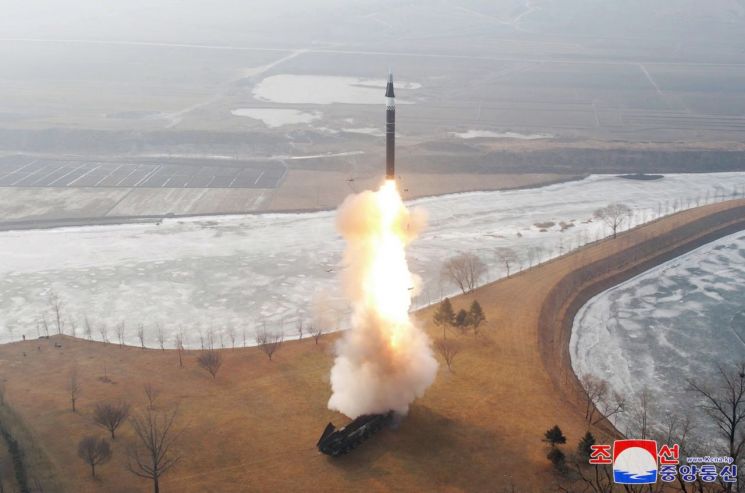 The North Korean Missile General Bureau announced on the 6th that it conducted a test launch of a new hypersonic medium-to-long-range ballistic missile (IRBM) at a launch site in Pyongyang. Yonhap News
According to the Joint Chiefs of Staff, the IRBM launched around noon the previous day was initially assessed to be equipped with a mid-range engine with a range of 3,000 to 5,500 km, but in reality, it flew 1,100 km and landed in the East Sea. While demonstrating the capability to strike Guam, it appears that North Korea deliberately reduced the range to moderate the level of provocation.
North Korea carried out a missile provocation in November last year, 6 to 7 hours before the start of voting in the U.S. presidential election. Since then, it had been quiet until the first provocation of the year occurred the previous day. This came about fifteen days before the inauguration of President-elect Donald Trump on the 20th and while the South Korean and U.S. foreign ministers were holding talks.
Chairman Kim insisted, "This is not an aggressive plan or action but clearly a plan and effort for self-defense," arguing that the missile provocation did not have any negative impact on the safety of neighboring countries.
Meanwhile, U.S. Secretary of State Tony Blinken stated at a press conference after the South Korea-U.S. foreign ministers' meeting the previous day, "There is credible information that Moscow intends to share advanced space and satellite technology with North Korea."
© The Asia Business Daily(www.asiae.co.kr). All rights reserved.
![Clutching a Stolen Dior Bag, Saying "I Hate Being Poor but Real"... The Grotesque Con of a "Human Knockoff" [Slate]](https://cwcontent.asiae.co.kr/asiaresize/183/2026021902243444107_1771435474.jpg)

















