"Post-COVID-19 Mechanic Shortage Crisis"
"Ignoring Staffing and Treatment Issues"
"Management Dismissing Mechanic Demands as Complaints"
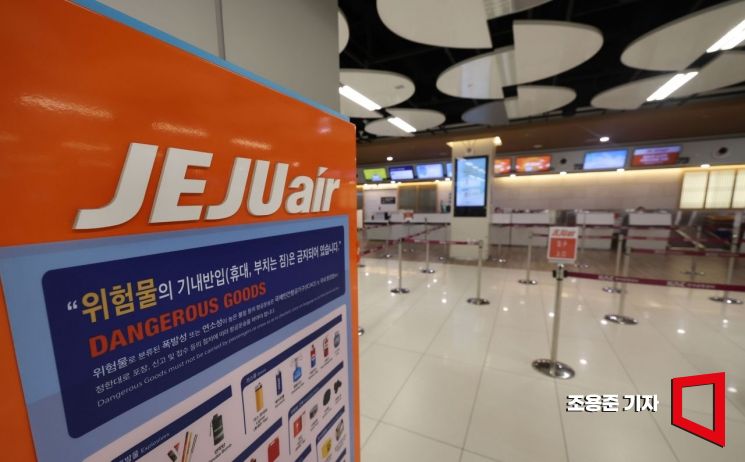 A day after the Jeju Air passenger plane disaster at Jeonnam Muan International Airport, on the 30th of last month, the Jeju Air counter at Seoul Gimpo International Airport showed a quiet scene. That morning, Jeju Air flight 7C101 to Jeju, the same model as the Muan accident plane, experienced a landing gear malfunction shortly after takeoff and returned to the airport. Photo by Jo Yong-jun
In the wake of the Jeju Air passenger plane disaster at Jeonnam Muan International Airport that resulted in 179 deaths, internal whistleblowers have revealed that Jeju Air maintenance technicians worked under poor conditions.
On the 5th, a post titled "I was a Jeju Air maintenance technician" was uploaded on the employee community Blind. The author, identified as A, who claimed to have worked as an aircraft maintenance technician at Jeju Air for a long time, opened by saying, "I wrote this post hoping the aircraft maintenance industry will develop in a better direction."
He stated, "I pray for the souls of those who died in the accident. Thinking of the colleagues who did their best until the end makes me indescribably sad," and added, "The treatment of Jeju Air's aircraft maintenance technicians is very poor." He continued, "After COVID-19, experienced maintenance technicians left the company, leading to a shortage of technicians, and voices demanding improvements in safety and treatment of maintenance staff grew louder. There is a severe shortage of skilled technicians qualified for the B737. Jeju Air posted job openings for experienced hires, but there are no technicians in the market, and even intern technicians left the company due to excessive workloads," he exposed.
Additionally, A said, "Jeju Air was known as a company that operated and maintained aircraft day and night at Incheon and Gimpo," and claimed, "For the sake of reducing maintenance costs, (technicians) performed heavy equipment work on the ramp without properly equipped facilities. They were assigned excessive work for 13 to 14 hours without meals or breaks." Furthermore, he added, "Costly personnel reinforcements and treatment issues were still ignored. The CEO, HR team, and maintenance headquarters dismissed the technicians' demands as complaints."
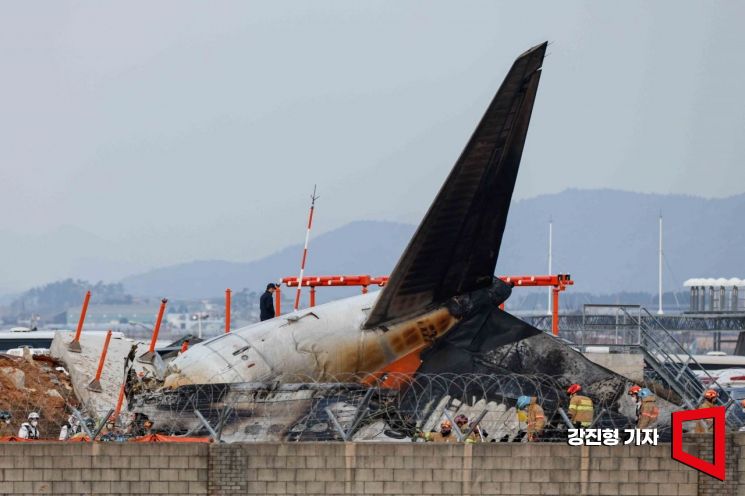 On the 29th of last month, a Jeju Air passenger plane carrying 181 passengers collided with the outer wall of the runway while landing at Muan International Airport, causing a fire that resulted in the deaths of most passengers. The wreckage of the accident aircraft is placed on the runway of Muan International Airport in Jeollanam-do. Photo by Kang Jin-hyung
Meanwhile, on the 29th of last month, Jeju Air flight 7C2216, departing from Thailand's Suvarnabhumi Airport, attempted a belly landing (landing with the aircraft body sliding on the runway without the landing gear deployed) on the runway at Muan Airport with the landing gear not extended. However, within about 10 seconds, the aircraft veered approximately 300 meters off the runway and collided with a concrete outer wall, causing a loud crash and the aircraft to break apart, with most of the fuselage engulfed in flames. The passenger plane carried a total of 181 people, including 175 passengers and 6 crew members. According to the Fire Agency's tally, all onboard perished except for two rescued crew members. As a result, the Jeju Air passenger plane disaster remains the deadliest aviation accident in South Korea.
© The Asia Business Daily(www.asiae.co.kr). All rights reserved.


















