Low Exposure of Creditor Banks
Most PF Projects Jointly Implemented
70% of Partner Companies Have Small Receivables Under 100 Million KRW
Authorities' Liquidity Support Program Available
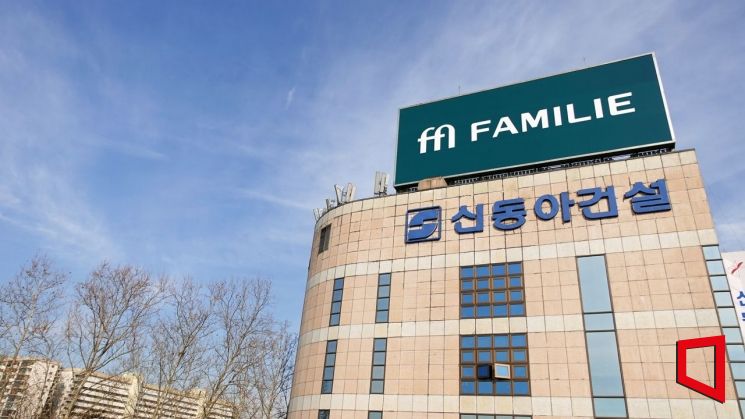
Mid-sized construction company Shindongah Construction's filing for corporate rehabilitation (court receivership) is heightening tension in the construction industry. Concerns over project financing (PF) defaults, which were triggered by last year's Taeyoung Construction workout crisis, have resurfaced, raising the possibility of a widespread crisis across the industry. However, financial authorities judge that this case differs from the Taeyoung Construction incident and expect the market impact to be limited.
According to financial authorities on the 7th, the Financial Services Commission and the Financial Supervisory Service have been monitoring Shindongah Construction since the end of last year when workout (corporate improvement process) crisis rumors circulated. However, in the current situation where court receivership has been filed, they believe that intervention at the government level, as was necessary during the Taeyoung Construction crisis, is not required. The Taeyoung Construction case involved a major construction company applying for workout due to liquidity issues last year, sparking fears of a chain of defaults throughout the construction industry, prompting large-scale government responses. Nevertheless, financial authorities operate financial support programs to help alleviate liquidity problems for Shindongah Construction’s partner companies and plan to consider additional measures depending on the situation.
Shindongah Construction is a mid-sized construction company ranked 58th in construction capability evaluation and is well known for its housing brand 'Familie.' However, due to a combination of factors such as the recent construction market downturn, increased unsold units, and rising construction costs, financial difficulties have intensified, leading to the court receivership filing. In particular, large-scale unsold units in major projects such as the high-rise residential-commercial complex projects near Jinju, Gyeongnam, and Uijeongbu Station, as well as the failure to convert the townhouse development project into the main PF, have reportedly increased financial pressure. Shindongah Construction’s debt stood at approximately 798 billion KRW as of the end of last year, an increase of over 150 billion KRW compared to the previous year (645.4 billion KRW).
Financial authorities are closely watching the Shindongah Construction situation but emphasize that it is fundamentally different from the Taeyoung Construction case. During Taeyoung Construction’s workout, there was a risk of default related to PF contingent liabilities spreading across the financial sector, posing a direct threat to financial system stability, which necessitated government intervention. However, this case is not of that magnitude and is considered an issue limited to an individual company.
A senior official from the financial authorities stated, "Shindongah Construction is not as large a construction company as Taeyoung Construction, is unlisted, and the exposure of creditor financial institutions is not significant." Furthermore, most of the PF projects are conducted jointly, reducing the possibility of a chain default. According to financial authorities, out of 13 PF projects by Shindongah Construction, only one is conducted solely by them. The rest involve other construction companies or financial institutions participating together to diversify risk. Even if problems arise in a specific project, other participants can compensate. In contrast, about half of Taeyoung Construction’s 60 PF projects were self-executed.
The official also added, "Most buyers have guarantees from the Housing & Urban Guarantee Corporation (HUG), so buyer-related issues are expected to be minimal." Thanks to HUG’s guarantees during Shindongah Construction’s court receivership, buyers who have already paid deposits are likely to have their payments refunded by HUG or have the project taken over and completed, minimizing the risk of financial losses for buyers.
Another government official also noted, "The scale of the projects is not large compared to the Taeyoung Construction case," and added, "Since Shindongah Construction has not executed any borrowings for financing since graduating from workout in 2019, the likelihood of the current situation spreading across the industry is low." As over 70% of Shindongah Construction’s partner companies are small-scale firms with outstanding receivables under 100 million KRW, financial authorities plan to keep liquidity supply channels open through rapid financial support programs for these companies.
© The Asia Business Daily(www.asiae.co.kr). All rights reserved.

















