Government's YouTube Ad Spending of 19.5 Billion KRW from January to August Last Year
Google's Corporate Tax Payment Issues... Fines Imposed
Creator Protection Act Underway... Improving Distribution Environment
As YouTube's influence grows, local governments are increasingly allocating separate budgets for promotion. This appears to be driven by the judgment that promotional effects are high even with a small budget, but concerns have also been raised about whether it is appropriate to use taxpayers' money for foreign companies.

According to Hwaseong City in Gyeonggi Province on the 8th, Hwaseong City Hall has allocated about 300 million KRW this year for planning and producing promotional video content through its own YouTube channel. A Hwaseong City official explained, "We judged that YouTube channels, which have high public attention due to the increase in video platform users, are an appropriate means of promotion." He added, "We plan to deliver fun and empathy through short-form content, which has recently become a mainstream media trend, focusing on city administration promotion and lifestyle information."
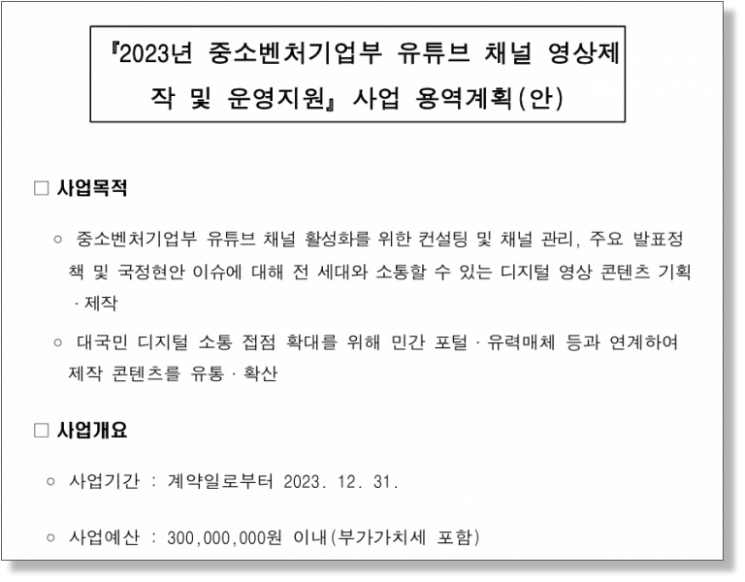
Hongcheon County in Gangwon Province spent 13 million KRW last December to air a 6-second promotional ad for the Hongcheon Railway on YouTube for one month. The Ministry of SMEs and Startups also allocated a budget of 300 million KRW in 2023 for producing and operating a YouTube channel for public communication.
The reason government ministries and local governments have concentrated their advertising on Google and YouTube is due to the large media influence and cost-effectiveness. According to a survey by the Korea Communications Commission, YouTube recorded a usage rate of 72.7% last year among online video services (OTT), ranking first. It has a significant gap compared to Netflix (36%), domestic OTT services Tving (14.8%), and Wavve (6.9%), which ranked second, third, and fourth respectively. The number of respondents watching terrestrial and paid broadcasting through TV is decreasing every year. Accordingly, Kim Tae-gyu, acting chairman of the Korea Communications Commission, recently said at the New Year's ceremony, "The weight of content is shifting more quickly to OTT and YouTube."
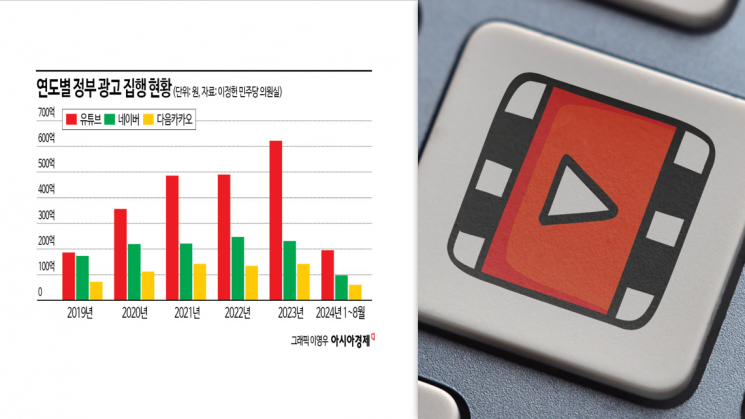
Government Budget Spent on YouTube Advertising... 19.5 Billion KRW from January to August Last Year
As the influence of YouTube, which attracts the public's eyes and ears, increases, there is also a concentration of taxpayers' money. According to the office of Lee Jeong-heon of the Democratic Party of Korea, the government paid 19.5 billion KRW in advertising fees to YouTube from January to August last year. This amount surpasses the combined advertising fees of domestic native platforms Naver (9.7 billion KRW) and Daum Kakao (6 billion KRW).
However, concerns have been raised about the concentration of government promotional budgets. Google, which owns YouTube, does not properly pay corporate taxes in Korea. The Korean Association of Financial Management claimed that Google's sales in Korea in 2023 could reach up to 12.135 trillion KRW, and it should have paid more than 500 billion KRW in corporate taxes. However, Google Korea disclosed sales of 365.3 billion KRW that year and paid 15.5 billion KRW in corporate taxes to the government. Lee Jeong-heon pointed out that it is not reasonable to spend hundreds of millions of government advertising funds on companies that reduce their sales scale and do not properly pay corporate taxes.
In addition to tax issues, Google was fined 867 million KRW by the Korea Communications Commission in 2020 for restricting mid-term cancellations of YouTube Premium services and violating important notification obligations. The Korea Communications Commission is currently investigating whether YouTube violated the Telecommunications Business Act by suddenly raising the Premium price from 10,450 KRW to 14,900 KRW per month by 43% in December 2023. The Telecommunications Business Act prohibits acts that △ harm users' interests or △ fail to explain or notify important matters such as usage fees and contract terms. A Korea Communications Commission official said, "The investigation is currently in the final stage," adding, "Results are expected by late this month at the earliest."
It was also revealed that Google has not launched the ‘family plan’ service, which is available in more than 40 countries worldwide, in Korea, resulting in higher subscription fees compared to other countries.
Legislation Proposed to Protect Domestic Creators
The government plans to continue supporting the creator industry, which forms the digital media ecosystem centered on YouTube and is continuously growing. The media creator industry was worth 5.3159 trillion KRW in 2023, growing 28.9% compared to the previous year. Choi Jun-ho, Director of Broadcasting Promotion Policy at the Ministry of Science and ICT, said, "The digital creator media industry has established itself as a core axis of media, creating new business models and employment."
In this regard, Lee Hae-min of the Innovation Party of Korea proposed the ‘Act on Fostering and Supporting Digital Creators’ as the main sponsor in August last year. This bill stipulates the preparation of standard contracts between businesses and creators and matters related to win-win cooperation to ensure fair contracts and a healthy distribution environment for creators. It also aims to create new jobs by establishing a support system for fostering creators. Problems such as creators' YouTube accounts being suddenly terminated overnight, the blackmail incident involving YouTuber ‘Tzuyang,’ and influencer impersonation advertisements have been pointed out as side effects where creators suffer damage within big tech platforms.
An official from the Ministry of Science and ICT said, "Most creators are young people or small businesses, so there are issues with not properly guaranteeing rights such as property rights infringement," adding, "We plan to gather stakeholders' opinions through a public hearing early this year."
© The Asia Business Daily(www.asiae.co.kr). All rights reserved.



















