A study has found that policy responses have changed as the central bank's monetary policy operation method, including the inflation stabilization target criteria, has been altered when deciding the base interest rate.
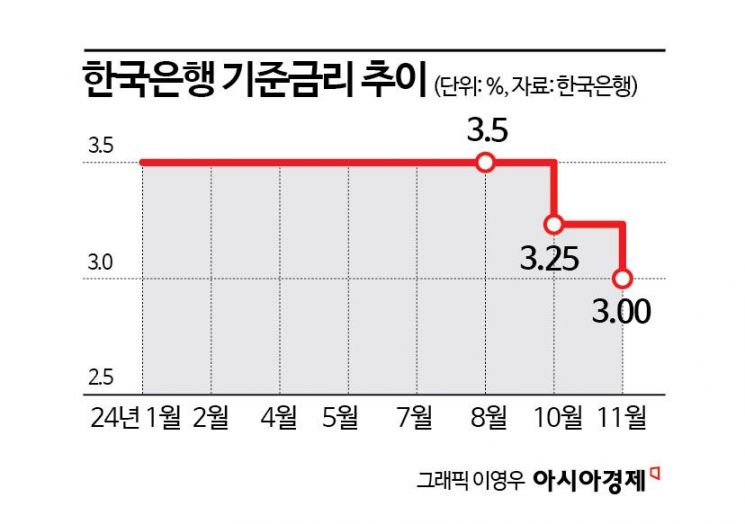
According to "Estimating the Taylor Rule Using Sectoral Inflation," published on the 6th by Joo Hyun-do, Deputy Director of the Fiscal and Industrial Team at the Research Department of the Bank of Korea, in the Korean Economic Association's Economic Research journal, the central bank's policy responses have varied depending on the monetary policy operation method.
According to the Taylor Rule, which is used as the basic model for monetary policy in major countries such as the United States, the base interest rate is primarily determined by economic growth rate and inflation rate. When deciding the interest rate, the central bank adjusts it by weighting the GDP gap (actual economic growth rate minus potential economic growth rate) and the inflation gap (actual inflation rate minus target inflation rate), which are the main considerations.
The Bank of Korea has set different weights on these figures depending on the period when deciding the interest rate. From 2004 to 2006 (early period), the inflation target indicator was the core price index. Since core inflation excludes prices of agricultural products and petroleum, the central bank actively responded to the GDP gap at that time. This is interpreted as a more active response to economic stabilization than to the inflation gap.
On the other hand, during 2007 to 2015 (mid period), when the target indicator was changed to the Consumer Price Index (CPI), the responsiveness to the inflation gap increased compared to the early period. By sector, it was found that the central bank paid relatively more attention to inflation in the service sector, which has high price rigidity, during this period.
From 2016 to April last year (late period), when the inflation target was set as a baseline (2%) rather than a range, the central bank responded more actively to the inflation gap. This is interpreted as a result of the central bank's active response to the globally high inflation trend around 2022. During this period, sectoral inflation was evenly reflected, and monetary policy was estimated to have been operated accordingly.
Monetary policy responses were found to be asymmetric depending on inflationary pressures. Since 2016, when inflationary pressure was negative (inflation below 2%), the central bank actively responded to the GDP gap, and when positive (inflation above 2%), it strongly responded to the inflation gap.

Deputy Director Joo said, "Although the central bank reviews sectoral inflation movements and makes comprehensive judgments when deciding monetary policy, until now, the use of the Taylor Rule to estimate monetary policy responses has not fully reflected this behavior of the central bank," adding, "Estimating the Taylor Rule using sectoral inflation will greatly help in understanding the central bank's monetary policy."
© The Asia Business Daily(www.asiae.co.kr). All rights reserved.
![Clutching a Stolen Dior Bag, Saying "I Hate Being Poor but Real"... The Grotesque Con of a "Human Knockoff" [Slate]](https://cwcontent.asiae.co.kr/asiaresize/183/2026021902243444107_1771435474.jpg)

















