"Refusal to Execute a Warrant? That Itself Is Treason"
Cheon Ha-ram, floor leader of the Reform New Party, opposed the arrest warrant for President Yoon Seok-yeol and directed his remarks at the People Power Party lawmakers gathered in front of the presidential residence, saying, "They should be arrested first," and claimed that they are "caught in the act of obstructing official duties by interfering with the lawful execution of the warrant."
On the 6th, Cheon, on CBS Radio's 'Kim Hyun-jung's News Show,' emphasized, "Members of the National Assembly have immunity from arrest, but this does not apply to those caught in the act," and added, "If they actually obstruct the execution of the warrant at the residence, the law must be actively enforced."
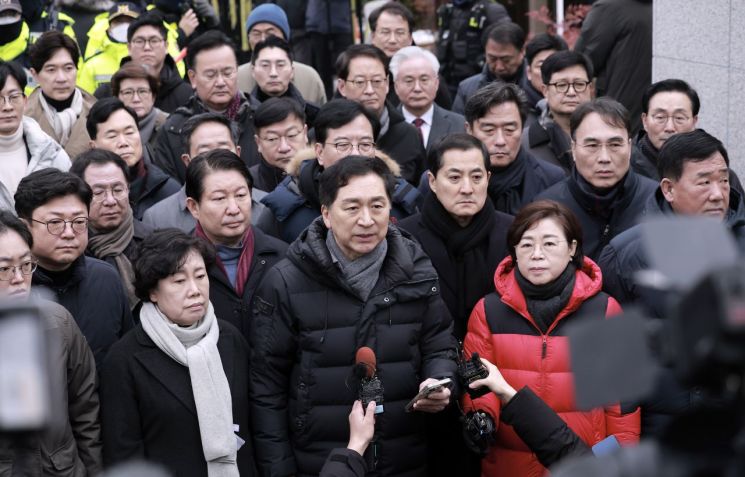 Members of the People Power Party, including Representative Kim Ki-hyun, are addressing the press gathered in front of the Presidential Residence in Yongsan-gu, Seoul on the 6th. Photo by Yonhap News
That morning, about 30 People Power Party lawmakers, including Kim Ki-hyun, gathered in front of the Hannam-dong presidential residence to block the execution of the warrant. This came amid expectations that the arrest warrant would be re-executed on the day the deadline for executing President Yoon's arrest warrant expired. On the 3rd, the Corruption Investigation Office for High-ranking Officials attempted to execute the arrest warrant at the residence, but the Presidential Security Service established a blockade and prevented entry, halting the execution of the warrant.
Cheon stated, "Refusing to execute a court warrant literally means creating a private army and stepping outside the rule of law of the nation," and defined it as "a declaration of 'I am the king' and, in itself, an act of rebellion." He criticized, "In this act of rebellion, the Presidential Security Service, a national public agency, is complicit, and lawmakers, constitutional institutions, are colluding. They all must be arrested."
Regarding the Presidential Security Service blocking the execution of the warrant, he pointed out, "Is the South Korean court a security risk?" and said, "Protecting the president to the extent of undermining the functions of constitutional institutions is a private army."
Cheon added, "If there are risks in the presidential detention area or threats from other detainees, consultation is naturally necessary," but "being detained in a safe space under the lawful execution of the warrant does not cause any harm to the president's body." He also criticized, "The duty of the Presidential Security Service is not to protect the president's mood but to protect the president's body," and said, "They are currently mistaken."
© The Asia Business Daily(www.asiae.co.kr). All rights reserved.

















