Official Schedule Kickoff Through Unveiled Event
Home Appliance Introduction Event Transforms into a Showcase of Advanced Future Technologies like AI and Quantum
Intercountry Advanced Technology War... Korea Also Needs National-Level Corporate Support
The world's largest electronics and IT exhibition, CES 2025, has finally opened its curtain. Although CES officially opens on the 7th (local time), the intense technological competition was already heating up through the media day event on the 5th and the 'Unveiled' event showcasing the winners of the Best Innovation Awards.
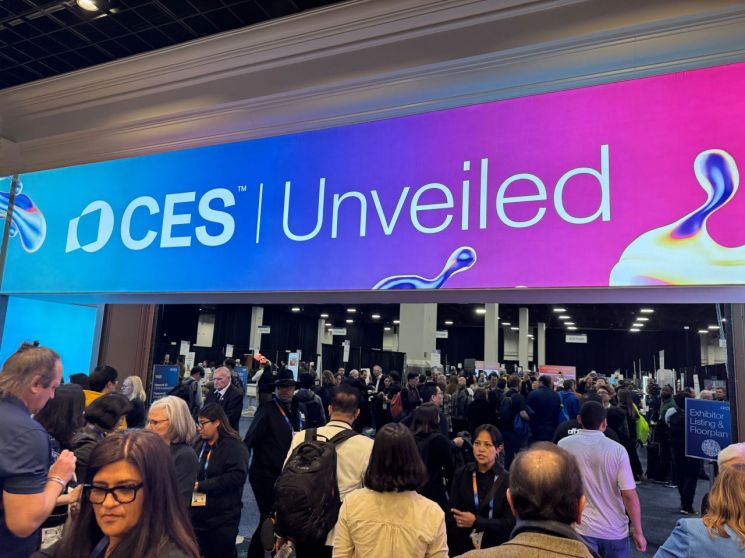 On the 5th (local time), reporters are entering the 'CES Unveiled event' held at the Mandalay Bay Hotel in Las Vegas. This event marked the official start of CES 2005. The exhibition will be held from the 7th to the 10th.
CES stands for Consumer Electronics Show. This event, which started in the United States, began as a showcase for home appliances such as TVs, refrigerators, and audio equipment. The current status of CES is completely different. Held every early January, this event is a 'feast' of cutting-edge technology not only for the year but also for the future. There are events like the Mobile World Congress (MWC) and the Internationale Funkausstellung (IFA) held in Europe, but since they focus mainly on mobile communications and home appliances, they have limitations. Another constraint is that these events are held in Europe, where the emergence of advanced technology has been delayed.
On the other hand, CES has continuously evolved. The CES of 2007, when the reporter first attended, is completely different from that of 2025. Technologies that were once considered possible only in imagination 17 years ago are now right before our eyes. This is the power of advanced big tech companies. Whereas CES was once led by Microsoft (MS) and Intel, it is now spearheaded by Nvidia. Remarkably, even though Apple has never participated in this event, progress continues unabated.
In recent years, electric vehicles and automobiles have surged, but now no one denies that artificial intelligence (AI) is the dominant trend. Especially this year, quantum technology, a future technology that has been operating beneath the surface, seems poised to explode.
The reporter is not the only one thinking this way. Dana Olmstead of Bloomberg News candidly revealed how CES has changed compared to 2017. He recalled that the buzzword at CES 2017 was Wi-Fi. Most exhibits focused on incorporating wireless connectivity features like Wi-Fi. Now, most home appliances include smart functions.
Jensen Huang, CEO of Nvidia, is expected to deliver a keynote speech that will signal CES as a stage forecasting the future of AI. While Huang is anticipated to unveil the latest gaming graphics processing unit (GPU), public expectations go beyond that. Attention is focused on whether there will be another message that could change humanity's future, such as the combination of AI and robotics or AI supporting the emergence of quantum computers. Intel, AMD, Qualcomm, Google, and others are expected to consecutively introduce new semiconductors, services, and extended reality (XR) devices.
Domestic companies such as Samsung Electronics, SK Hynix, and LG Electronics are also planning to counterattack. The competition is fierce. In Korea, there was the Mu-an Airport Jeju Air passenger plane crash accident, but the American representative airline Delta plans to showcase the future aviation era at 'The Sphere,' a new landmark in Las Vegas and a high-tech display-based performance venue.
Competition between countries cannot be ignored either. News that the U.S. rejected visas for Chinese attendees at this event suggests that the technological hegemony competition will accelerate further ahead of President-elect Trump's inauguration. Nevertheless, although the number has decreased compared to before COVID-19, more than 1,000 Chinese companies still attend CES. Many Chinese companies also emphasize AI as their main focus, meaning they are confronting the U.S. with advanced technology.
The problem lies with us. Although AI semiconductors, advanced bio, and quantum are being fostered as the three major game-changing technologies, it is insufficient to perceive that Korean companies are leading these fields at this CES.
A representative example is quantum. Google's quantum chip 'Willow,' announced last December, suggests that the advent of quantum computers is imminent, but it is difficult to find companies attending in this field domestically. Moreover, the 'Quantum Square' event hosted by the Ministry of Science and ICT during CES is expected to lose significance as the launch of the Quantum Strategy Committee has been delayed due to the presidential impeachment crisis. In contrast, CES is holding the 'Quantum World Congress' on the same day as Quantum Square, drawing attention to the quantum field.
The situation with AI is no different. The GPU that Jensen Huang ambitiously announces is hard to find in Korea. While major big tech companies competitively purchase hundreds of thousands of GPUs, it is known that Korea holds fewer than 3,000 units of the soon-to-be outdated H100 GPU.
It is not easy to overcome this with corporate efforts alone. China is already fervently developing technology to compete with the U.S. through full-scale support. While government-level support is necessary, political turmoil is acting as an additional negative factor for us.
Among the 19 CES 2025 Best Innovation Awards revealed at the Unveiled event that day, seven were Korean products. It is not the time to be complacent just because Korean companies took the majority of the Best Innovation Awards.
© The Asia Business Daily(www.asiae.co.kr). All rights reserved.
![Clutching a Stolen Dior Bag, Saying "I Hate Being Poor but Real"... The Grotesque Con of a "Human Knockoff" [Slate]](https://cwcontent.asiae.co.kr/asiaresize/183/2026021902243444107_1771435474.jpg)
















