Fed Hawks Also Warn of Inflation Risk After Trump Takes Office
As the inauguration of Donald Trump, the President-elect of the United States, approaches, dovish members (those favoring monetary easing) within the U.S. central bank, the Federal Reserve (Fed), have warned that the fight against inflation is not yet over.
According to major foreign media including Bloomberg on the 4th (local time), Mary Daly, President of the Federal Reserve Bank of San Francisco, stated this at the annual meeting of the American Economic Association (AEA) held in San Francisco that day. She evaluated that although inflation has significantly eased over the past two years, it still remains "uncomfortably" above the Fed's target of 2%. She added that so far, the process of calming prices has not caused significant damage to the labor market, but the trade-off between the two is expected to increase soon, urging careful efforts to ease inflation to support the goal of full employment.
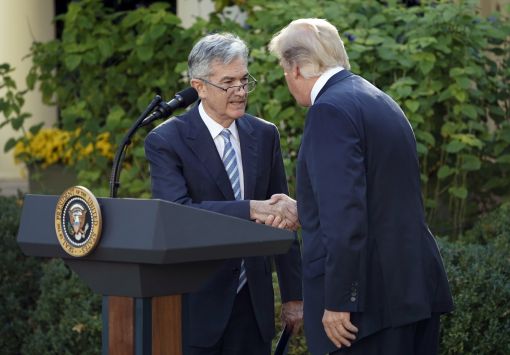 [Image source=Yonhap News] Jerome Powell, the nominee for the next Federal Reserve (Fed) Chair, and U.S. President Donald Trump
Adriana Kugler, a Fed Board member, also said at the same event, "Clearly, our duty is not over," adding, "We have not yet reached 2%, and we are definitely still aiming for it." She said, "No one is popping champagne (to celebrate victory)," while also stating, "At the same time, we want the unemployment rate to remain at the current level of 4.2% without a sharp rise."
In a CNBC interview the previous day, Kugler described the current inflation as "bumpy," similar to the first quarter of last year, and said she wants to confirm whether this phenomenon is temporary. Thomas Barkin, President of the Richmond Fed, known as a hawk (favoring monetary tightening) within the Fed, also said the day before that monetary policy should be kept at a restrictive level until there is greater confidence that inflation has returned to the 2% target. Barkin explained, "I think the upside risks to inflation are greater than the downside risks," because the U.S. economy continues to show strength and there is potential upward pressure on wages and prices.
The Fed cut its benchmark interest rate by a total of 1 percentage point in three rounds last year, bringing it to 4.25?4.5%. In particular, last month, while lowering the benchmark rate by 0.25 percentage points, the Fed conducted a "hawkish cut" by reducing the forecast for this year's rate cuts from 1 percentage point to 0.5 percentage points. The personal consumption expenditures (PCE) price index, which the Fed monitors, rose from 2.1% in September last year to 2.3% in October and 2.4% in November (year-over-year). Moreover, the market expects that if tariff pledges are realized after Trump’s inauguration on the 20th, inflation could be stimulated, making it difficult to lower interest rates as much as initially expected. Accordingly, according to the Chicago Mercantile Exchange (CME) FedWatch, the interest rate futures market sees an 89.3% chance of the benchmark rate remaining unchanged this month.
© The Asia Business Daily(www.asiae.co.kr). All rights reserved.
















