Expert: "Hundreds of Thousands of Birds Confirmed Near Airport"
"To Prevent Accidents, Precise Monitoring of Migratory Bird Habitats Is Necessary"
As bird strikes are identified as a major cause of the Jeju Air passenger plane accident, a wild bird expert has analyzed that the collision likely occurred at least 5 km before the plane arrived at Muan International Airport.
Jeju Air flight 2216, which departed from Bangkok, Thailand, attempted a belly landing after the pilot issued a Mayday (emergency distress signal) communication due to a bird strike on the morning of December 29 last year. However, at around 9:03 a.m., the plane collided with the concrete embankment of the localizer at Muan International Airport and exploded. Of the 181 people on board (6 crew members and 175 passengers), 179 died in the accident.
On the 5th, Newsis reported the words of Jo Gi-seok, head of the Muan branch of the Korea Endangered Wild Fauna and Flora Protection Association, who said, “After the Jeju Air disaster, we observed wild birds near Muan International Airport and confirmed that hundreds of thousands of birds, including Baikal teal, inhabit the area.”
Jo said, “Considering the flight speed and other factors from footage of the plane at the time of the accident, it is possible that both engines ingested birds at least 5 km before arriving at the airport.”
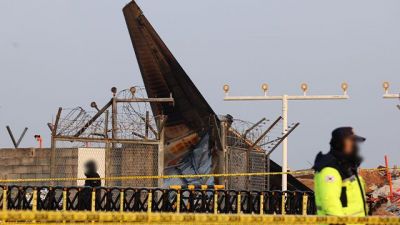 Wreckage of the passenger plane that crashed on the morning of the 29th at Muan Airport, Muan-gun, Jeollanam-do Photo by Yonhap News
He added, “Residents of Dongam-ri, Unnam-myeon, Muan-gun, which is on the flight path and a migration route for Baikal teal, also heard an explosion from the plane,” and “Upon confirming the movement of Baikal teal along the flight path, we found that around 1,000 Baikal teal were migrating at a similar location at the same time as the accident at 9:03 a.m.”
Earlier, on the morning of the 29th last year, a witness who was fishing near Muan Airport told KBC Gwangju Broadcasting, “The aircraft was flying low to land and collided with a flock of ducks.” He added, “The ducks scattered in panic, and it looked like the plane was on fire,” and “Then, shortly after, there was a loud bang and a huge plume of smoke rose into the sky.” The witness emphasized that the accident occurred less than five minutes after that.
Jo explained, “On the route to Muan International Airport, there are Haenam Geumho Embankment and Gocheonam Lake, where we confirmed that about 150,000 Baikal teal currently inhabit the Geumho Embankment,” and “Baikal teal are nocturnal and begin feeding at dusk, then migrate again in the morning, which coincides with the time of the passenger plane accident.”
During the day, 1,000 to 2,000 birds including common ducks and about 60 hooded cranes have also been observed at Changpo Lake in Piseo-ri, Mangun-myeon, where Muan International Airport is located.
Jo advised, “Since most airports nationwide are near migratory bird habitats, to prevent accidents like this, it is necessary to closely monitor the habitats of migratory birds,” and “Real-time monitoring of migratory bird movement times should also be strengthened.”
© The Asia Business Daily(www.asiae.co.kr). All rights reserved.
![Clutching a Stolen Dior Bag, Saying "I Hate Being Poor but Real"... The Grotesque Con of a "Human Knockoff" [Slate]](https://cwcontent.asiae.co.kr/asiaresize/183/2026021902243444107_1771435474.jpg)
















