Geonsanyeon, 7 Major Construction Industry Issues in 2025
Interest Rate Cuts vs. Regulation Conflicts, Housing Market Improvement Needs Time
Delayed Domestic Demand Recovery and Decreased Construction Investment... Construction Cost Increase Remains an Issue
Supply Shortage and Loan Regulation Enforcement Increase Real Estate Market Instability
Amid increasing uncertainty in domestic and international economic conditions, construction investment is expected to decline this year, and the prolonged stagnation of the real estate market is likely to further expand the financial risks faced by construction companies. It is analyzed that the instability of the real estate market will continue due to the worsening shortage of housing supply, conflicting factors between interest rate cuts and loan regulations, among others.
On the 4th, the Construction Industry Research Institute stated in a trend briefing report titled "7 Major Issues in the Construction Industry in 2025" that "the environment surrounding the construction industry in 2025 is unlikely to improve significantly considering recent domestic and international economic conditions, the construction and real estate markets, and business environments."
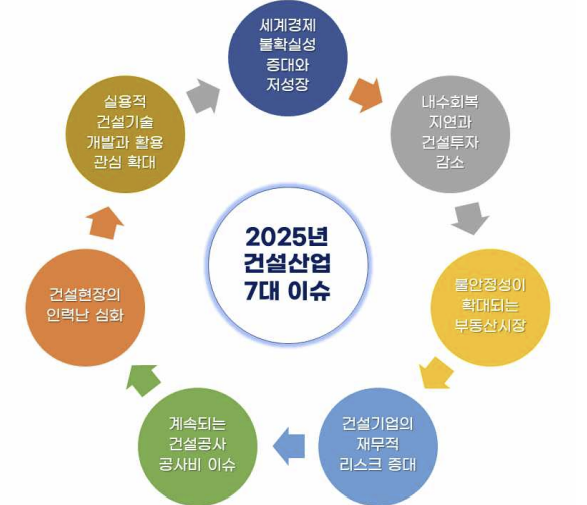
The institute identified the seven major issues for the construction industry in 2025 as △ increased uncertainty and low growth in the global economy △ delayed domestic demand recovery and decreased construction investment △ expanding instability in the real estate market △ increased financial risks for construction companies △ ongoing construction cost issues △ worsening labor shortages at construction sites △ growing interest in the development and utilization of practical construction technologies.
The institute explained, "The possibility of a sharp interest rate cut is low, and regulations remain, so improvement in the housing market will require time. Construction costs, which have been continuously rising over the past three years, are expected to persist for the time being, so the business conditions of construction companies will not improve rapidly."
Construction Investment Shrinks Amid Domestic and International Instability
With the inauguration of the Trump administration, trade pressure on allied countries is expected to intensify, and if tariffs increase, it could negatively impact the Korean economy, which heavily depends on exports to the U.S. Exports to China are expected to decline, severely affecting major export items such as semiconductors and automobiles. The institute stated, "Due to the reorganization of global supply chains, instability in supply chains will increase, inevitably affecting raw material supply instability and rising production costs," adding, "The Trump administration's tough stance on the Middle East raises concerns about a decrease in order volumes."
In a situation where short-term domestic demand recovery is difficult due to household debt, worsening external economic conditions are expected to further dampen consumer sentiment. Although expansion of fiscal policy to stimulate domestic demand is inevitable, consistent policy implementation is challenging amid political instability following the impeachment. The institute said, "Construction investment, the biggest factor affecting domestic demand sluggishness, will continue to decline for the time being due to decreases in construction orders and building permits since 2023," and added, "It is difficult to expect an increase in private companies' facility investments, so short- and medium-term expansion of construction investment is unlikely."
A slump in public construction volume is also inevitable. The 2025 SOC (Social Overhead Capital) budget has been set at 25.5 trillion won, a 3.6% decrease from the previous year. The institute expects that fiscal spending expansion will be difficult as financial market instability intensifies. Although growth in overseas construction markets with increasing global infrastructure investment is anticipated, competition is becoming fiercer, and challenges such as pioneering new markets and improving overseas business profitability remain.
Instability in Real Estate Market and Expansion of Financial Risks for Construction Companies Inevitable
The instability of the real estate market, including worsening supply shortages, is expected to deepen more than ever. Since 2022, housing starts have continuously decreased, and the sharp drop in completions this year is expected to exacerbate supply shortages. The institute explained, "Due to the decline in economic growth and worsening corporate performance, real estate investment capacity is limited, and with loan regulations and supply shortages mixed amid interest rate cuts, setting a direction for responding to the real estate market will be difficult."
The institute expects some regulatory easing focused on expanding housing supply and targeting young people and actual demanders, but believes it will be difficult to significantly contribute to market recovery due to conflicts with loan regulations and consumer sentiment. It stated, "If the liquidation of insolvent PF (Project Financing) sites continues in 2025, it will somewhat help stabilize the real estate market," but also pointed out, "Easing private market regulations is difficult considering the current instability of the real estate market, and rather, the full implementation of measures to strengthen loan regulations is scheduled, limiting practical market stabilization."
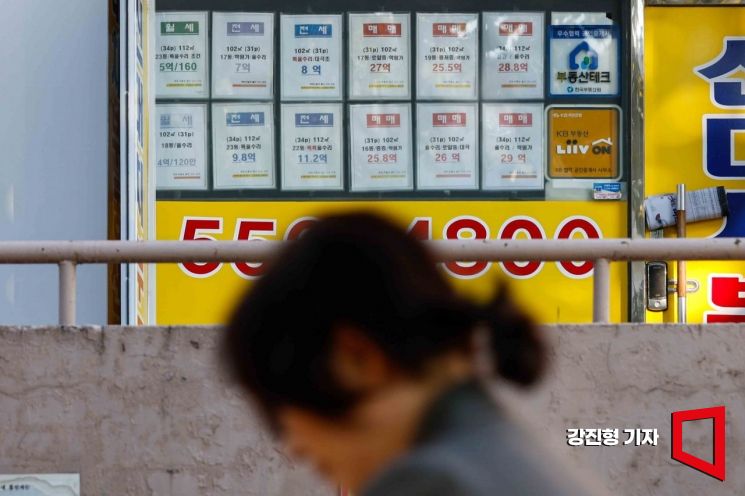 On the 24th, as apartment transactions shrink due to loan regulations and other factors, listings continue to accumulate. A real estate agency in Gangnam, Seoul, has flyers for sale and jeonse listings posted. Photo by Kang Jin-hyung
With decreases in construction orders, prolonged market stagnation, and rising construction costs, profitability is declining, making deterioration of financial soundness for construction companies inevitable. According to the construction industry, the average cost ratio of major construction companies stood at about 93.0% as of the third quarter, with worsening cost ratios and significant decreases in operating profits. Rising construction costs have reduced housing supply volumes, and increasing borrowings have decreased financial profits, creating a vicious cycle. Especially, due to the worsening local real estate market, regional small and medium construction companies face bankruptcy and closure risks. From January to November last year, 27 construction companies went bankrupt, the highest since 2019.
The institute explained, "As the financial soundness of construction companies deteriorates, difficulties in credit management and fundraising are intensifying, increasing the possibility of liquidity crises," adding, "With construction cost increases since 2022 being fully reflected in financial statements from the fourth quarter of 2024, there are concerns about a significant decline in business performance, which will increase difficulties in credit management and fundraising for construction companies."
Construction Cost Increase Factors Persist, Labor Shortages at Construction Sites Worsen
Despite the government's 'Construction Cost Stabilization Measures,' discussions on the realization of construction costs are expected to continue expanding. Persistent failures in major public construction bids and the decrease in public housing supply have increased the need for policies to realize construction costs. Considering external conditions, there is a high possibility of raw material price increases and supply instability due to global supply chain difficulties. The institute stated, "The impact of construction cost increases felt on-site by the construction industry is significant, and demands for construction cost realization will continue," emphasizing, "Timely and effective policies to stabilize construction costs are more necessary than ever."
The institute forecasts that difficulties in labor supply at construction sites will persist. According to employment insurance subscriber data in the construction industry, the number has decreased for 16 consecutive months as of November last year. The government plans to increase the quota for foreign workers (E-9) and introduce the use of skilled foreign workers, so the influx of foreign workers is expected to rise. However, the institute anticipates that the on-site impact will not be significant due to language communication issues, safety training, instability in long-term employment, and wage levels not differing greatly from domestic workers. It analyzed, "Considering the chronic labor shortage at construction sites and increased employment costs for foreign workers, labor shortages at construction sites will continue."
Senior Researcher Kim Young-deok of the Construction Industry Research Institute said, "With increasing uncertainty in the global economy, low growth in the domestic economy is inevitable, and due to increased instability in the real estate market, overall construction investment is expected to decline," adding, "Construction companies need to strengthen internal management systems, including active responses to financial risks amid the construction downturn, and simultaneously make efforts to secure and stabilize core management resources such as technology, labor, and finance."
© The Asia Business Daily(www.asiae.co.kr). All rights reserved.



















