[Hyundai Motor, Over the Mobility](1)
The Changing Status of Hyundai Motor in the Global Market
Collaboration Requests from US and Japanese Automakers as well as US Big Tech
Rising Rapidly as a 'K-Mobility Star'
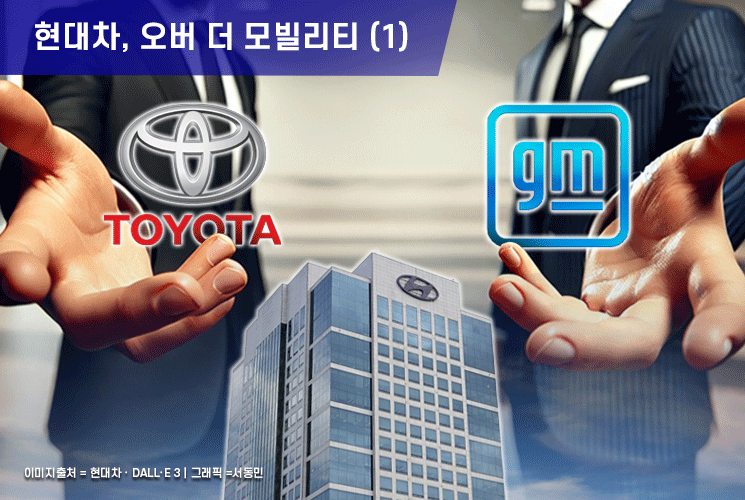
"It is never an opponent that can be easily defeated."
At the Toyota Stadium in Japan in November 2024, Akio Toyoda, Chairman of Toyota Motor Corporation Group, evaluated Hyundai Motor Group in this way. Although he said this ahead of the Korea-Japan motorsports competition, it sounded like a strangely ambiguous expression when compared to the current global automotive market situation. Until last year, Toyota, which has maintained the global sales number one position for four consecutive years, has no doubt that its strongest competitor is Hyundai Motor Group.
In the past, Hyundai Motor was just a bothersome 'fast follower' to Toyota. But now, it has become a strategic partner with whom they must join hands. Its status has changed from a competitor standing shoulder to shoulder to a 'K-Mobility Star' who must first extend a hand and make them an ally.
Let's look at automotive news on portals. Incredible news related to Hyundai Motor is pouring out. Last year, Hyundai Motor co-hosted a motorsports event with Toyota, the world's number one automaker, signed a comprehensive business cooperation agreement with GM, the largest automaker in the United States, and was entrusted with the production of autonomous vehicles by Waymo, Google's autonomous driving subsidiary.
If such news had been reported just five years ago, it would have been laughed off as fake news. It's like how initially it was hard to believe that BTS was nominated for the Grammy Awards and BLACKPINK 'owned' the stage at Coachella, the largest music festival in the United States.
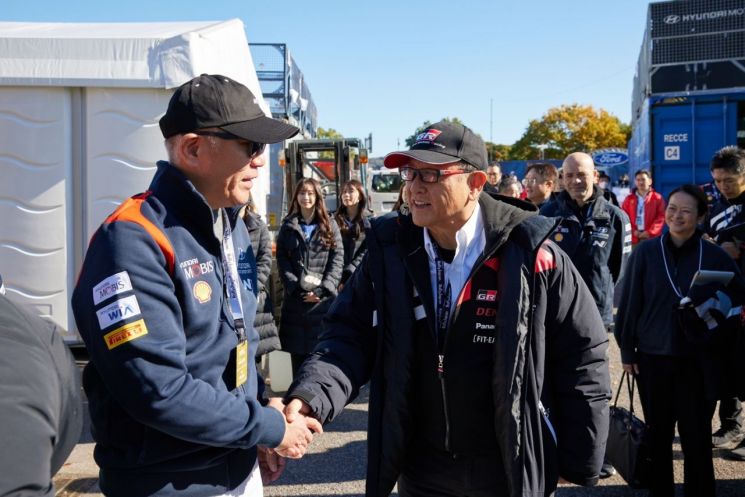 In November last year, at the World Rally Championship (WRC) held in Toyota City, Aichi Prefecture, Japan, Chung Eui-sun, Chairman of Hyundai Motor Group (left in the photo), and Akio Toyoda, Chairman of Toyota Motor Corporation Group, are shaking hands. Photo by Hyundai Motor Company
What Does Toyota Mean to Hyundai Motor?
For decades, Toyota has been a role model and benchmark for Hyundai Motor. In the 1980s, Toyota put its life on the line for the initial quality survey (IQS) by JD Power, a U.S. automotive market research firm, to gain recognition in the U.S. market. At that time, Toyota was strongly perceived as a 'fuel-efficient low-cost car' in the U.S. In the 1980s, Toyota's technology and durability gained a positive image by ranking high in various new car quality evaluations, including J.D. Power. Recognized for its technology, Toyota launched the premium brand Lexus in 1989 to enhance brand power.
Hyundai Motor's strategy toward the U.S. was quite similar to Toyota's. Hyundai vertically integrated its parts supply chain and worked hard to improve quality and gain recognition for its products and technology until the 2000s. In 2016, it launched Genesis in the U.S. and focused on image improvement efforts to enhance brand power.
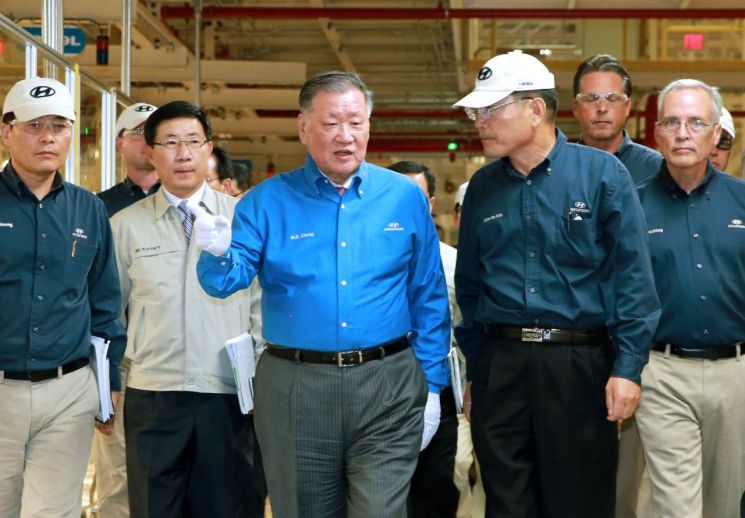 In 2014, Chung Mong-koo, Honorary Chairman of Hyundai Motor Group (center in the photo), is seen inspecting the status of Hyundai Motor's Alabama plant in the United States. Photo by Hyundai Motor.
The driving force behind Hyundai Motor's initial quality management was Chung Mong-koo, Honorary Chairman of Hyundai Motor Group. The bold warranty policy of '10 years/100,000 miles' in the U.S. was possible because of the owner's (Honorary Chairman Chung's) strong will for quality management. Chairman Chung, who ordered rigorous quality improvements, always had the phrase 'We must catch up with Toyota' on his lips. Until the 2000s, Toyota was always the target Hyundai Motor had to surpass.
In 2004, Hyundai Motor's Sonata overtook Toyota's Camry for the first time in the JD Power evaluation, ranking first in the mid-size car segment. At that time, Kim Dong-jin, Vice Chairman of Hyundai Motor, publicly mentioned the competitor, saying, "We have advanced our mid- to long-term goal of securing Toyota-level quality by three years," and "This is the happiest day in Hyundai Motor's history." Hyundai Motor's quality management will be covered in detail in future installments.
Hyundai Motor's Changed Status to Toyota
Toyota executives met recently in Nagoya, Japan, spoke with amazement about Hyundai Motor's changed status and the relationship between the two companies. In October last year, Hyundai Motor and Toyota co-hosted the motorsports event 'Hyundai N x Toyota Gazoo Racing Festival' at Yongin Speedway in Korea. The front pages of major newspapers the next day were adorned with images of the heads of the Korean and Japanese automotive industries embracing. A month later, the two company heads met again in Nagoya for the World Rally Championship (WRC) held in Japan. After the race, Toyota ran a Korean-language advertisement in about ten major Japanese newspapers congratulating Hyundai Motor's driver division victory and encouraging friendly competition.
An executive who worked at Toyota for over 20 years exclaimed, "I never dreamed that Toyota would hold a joint event with Hyundai Motor, and that too in Korea!" A foreign journalist attending the event said, "It feels like watching the heyday of France's Renault and Peugeot," and evaluated, "Toyota and Hyundai Motor are moving to bring the leadership of the global automotive industry to East Asia."
 Hyundai's 'i20 N Rally 1 Hybrid' (right in the photo) and Toyota's 'GR Yaris Rally 1 Hybrid' competing in the WRC. Provided by Hyundai.
In the past, the relationship between the two companies was closer to words like competition, check, and war rather than harmony, friendship, and cooperation. Around 2008, Toyota requested to tour Hyundai Motor's India plant but was flatly rejected. India was the only emerging market where Toyota, which was leading with durability, could not assert itself (excluding China). Hyundai Motor entered India a year earlier (1996) and was increasing its market share through thorough localization. Generally, in the automotive industry, unless it is a highly secret project, even competitors can easily request to tour production lines. However, Hyundai Motor firmly rejected Toyota's request at that time. The competitive spirit not to lose the only market where it was beating its direct competitor Toyota, mixed with inferiority complex toward Toyota, might have led to this complex decision.
Toyota was also constantly aware of Hyundai Motor. Although it always looked down on Hyundai Motor as a step below, it was undoubtedly the most concerning competitor. Hideo Kobayashi, Professor of Asia-Pacific Studies at Waseda Graduate School, predicted in his 2011 book titled
Mary Barra, GM Chairwoman, Makes a Surprise Appearance at Genesis House
Hyundai Motor's brand status is not only surprising to Toyota. GM, one of the Big Three automakers in the U.S., is also bewildered by Hyundai Motor's changes. The comprehensive business agreement signed between Hyundai Motor and GM in September last year is undeniable evidence within GM that Hyundai Motor's status has changed.
To Americans, GM symbolizes and is a source of pride for American manufacturing. As the name 'General Motors' suggests, GM is synonymous with automobiles in the U.S. GM reigned over the global automotive industry for 77 years until it handed over the crown of global sales number one to Toyota in 2008. However, even the vast GM empire fell into a state of receiving government aid after filing for bankruptcy protection in 2008.
The savior who stepped up to rescue GM was Mary Barra, GM Chairwoman. An engineer by training, Barra became the first female CEO in the global automotive industry in 2014. She rebuilt the collapsing GM by practicing transparent communication, setting sustainable goals, and demonstrating inclusiveness within the organization. Because of this history, she is called 'GM's Joan of Arc' in the industry.
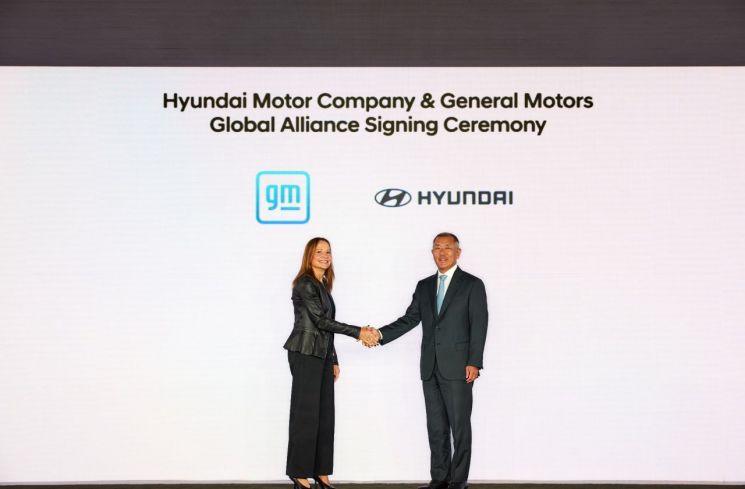 Last September at the Genesis New York House, Mary Barra, GM Chairwoman (left in the photo), and Chung Eui-sun, Hyundai Motor Group Chairman, signed an MOU for comprehensive cooperation between the two companies and are seen shaking hands. Provided by Hyundai Motor Company
News that Chairwoman Barra personally visited the Genesis House in New York last September shocked the global automotive industry again. At this event, GM and Hyundai Motor Group signed a memorandum of understanding (MOU) for comprehensive cooperation. GM's decision seems to have been influenced by the trauma of 2008, fearing that clinging to pride without quickly adapting to changing environments could lead to obsolescence.
GM was one of the global automakers with the most aggressive electric vehicle transition plans. However, as penetration of Chinese local brands increased in its main market, China, GM's profitability turned red. Outside China, consumer acceptance of electric vehicles was slower than expected. It became necessary to handle (i.e., efficiently allocate) already ordered batteries and various parts. Someone was needed to share the astronomical costs required for future new car development.
Why Hyundai Motor Joined Hands with GM
From Hyundai Motor's perspective, this is not a bad choice. Joint development and rebadging with each brand's mark can reduce development costs. Also, Hyundai Motor is recognized for its advanced technology in eco-friendly vehicles such as electric and hybrid cars and is receiving a good response in the U.S. market. Partnering with one of the Big Three U.S. automakers to enter the U.S. market is also advantageous for Hyundai Motor. There is also an expectation that GM, one of the Big Three, will voice industry opinions on behalf of the industry regarding changing eco-friendly vehicle policies under the second Trump administration.
In the U.S. electric vehicle market, Tesla holds an overwhelming market share of around 50%, while Hyundai Motor and GM compete for second place. According to Kelley Blue Book, as of the third quarter of 2024, Hyundai Motor Group's cumulative U.S. electric vehicle market share is 9.5%, and GM's is 7.3%. The fact that Hyundai Motor holds a status to compete with domestic brand GM in the U.S. electric vehicle market itself is encouraging. Through this partnership, Hyundai Motor can also consider production plans utilizing GM's idle plants in the U.S.
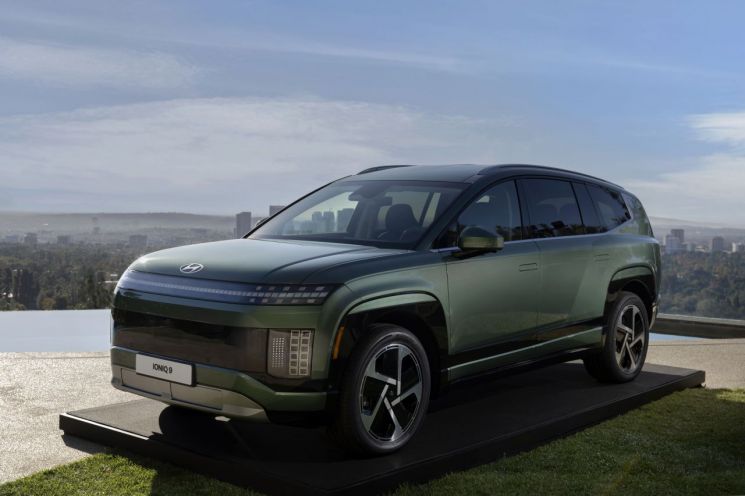 Hyundai's flagship electric SUV Ioniq 9, scheduled to be produced at Hyundai Motor Group Meta Plant America (HMGMA) in Georgia, USA. Provided by Hyundai Motor Company
However, the author has some doubts about whether this agreement can have practical binding power. In 2020, GM also declared joint development of low-cost models and robotaxis with Japanese automaker Honda, but it is currently canceled. GM had jointly operated the joint venture plant NUMMI (New United Motor Manufacturing Incorporated) in California with Toyota from the 1980s to 2010 but closed it after filing for bankruptcy in 2009. Now, in 2025, GM has changed its partner from Japan to Korea; whether it can overcome the onslaught of Chinese electric vehicle companies and achieve results remains to be seen.
What is clear is that while the U.S.-Japan alliance was common in the past global automotive industry, U.S.-Korea and Korea-Japan alliances were rare. But now, not only major automakers but also U.S. Big Tech companies like Google are sending love calls to Hyundai Motor. In future installments, we will analyze in detail why Hyundai Motor Group has emerged as a 'Global K-Mobility Star.'
© The Asia Business Daily(www.asiae.co.kr). All rights reserved.
![Clutching a Stolen Dior Bag, Saying "I Hate Being Poor but Real"... The Grotesque Con of a "Human Knockoff" [Slate]](https://cwcontent.asiae.co.kr/asiaresize/183/2026021902243444107_1771435474.jpg)













