Prosecutors Execute Arrest Warrant for President Yoon on 3rd Day
Standoff Due to Resistance from Security Office
Possibility of Evidence Tampering Due to Current Position
For the first time in constitutional history, an arrest warrant is being executed against a sitting president. Although former President Park Geun-hye and others have been detained in the past, those cases involved former presidents who were no longer in office after being impeached. The unprecedented execution of an arrest warrant against a sitting president has heightened tensions both inside and outside the political sphere.
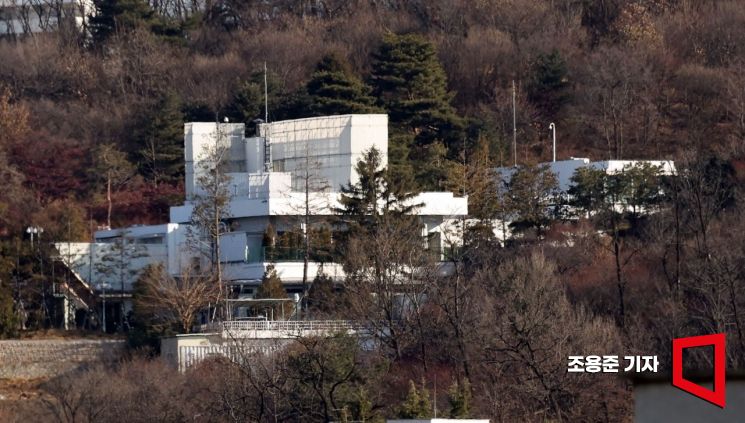 On the 3rd, when the High-ranking Officials' Crime Investigation Agency attempted to execute an arrest warrant for President Yoon Seok-yeol, the presidential residence in Hannam-dong, Yongsan-gu, Seoul was shrouded in silence. On that day, the agency presented the arrest warrant to the head of security in front of the residence building and requested cooperation for the arrest of President Yoon Seok-yeol, but the search was denied. Photo by Jo Yong-jun
On the 3rd, the High-ranking Officials' Crime Investigation Unit began executing an arrest warrant against President Yoon Seok-yeol. This unprecedented incident involves the president, who is constitutionally the 'head of state' and 'head of the executive branch,' becoming the target of an arrest by investigative authorities. On that day, prosecutors and investigators from the unit entered the presidential residence to execute the arrest warrant against President Yoon, but they have been in a standoff for over two hours due to resistance from the Presidential Security Service and its affiliated military units.
Although President Yoon’s duties were suspended following impeachment by the National Assembly, the execution of the arrest warrant against the sitting president is due to the gravity of the 'insurrection case' involving the declaration of martial law on the 3rd of last month. Previously, on the night of the 3rd of last month, President Yoon declared martial law and deployed martial law troops to the National Assembly and the Central Election Commission. According to the prosecution, it appears that President Yoon intended to neutralize the National Assembly and establish a separate emergency legislative body. Additionally, President Yoon reportedly attempted to occupy the Central Election Commission amid suspicions of election fraud in the general election. The High-ranking Officials' Crime Investigation Unit and the prosecution are treating this martial law incident as 'insurrection' and are conducting investigations accordingly.
Initially, some speculated that if the arrest warrant were executed, President Yoon might voluntarily appear outside the residence. However, during the execution process, security personnel physically attempted to block the arrest. Consequently, a confrontation ensued between the High-ranking Officials' Crime Investigation Unit and police executing the arrest and the Presidential Security Service resisting it.
Why Has It Come to Attempting to Arrest a Sitting President?
The occurrence of an arrest of a sitting president reflects divergent views within the political and legal communities. One side questions whether an arrest should be executed against a sitting president whose duties have already been suspended. However, the other side expresses concerns that despite the suspension, President Yoon, protected by the Presidential Security Service and others, might resist investigations by law enforcement, attempt to shift the narrative through statements by legal counsel, or even engage in evidence destruction.
Moreover, the issuance of the arrest warrant was partly self-inflicted. The High-ranking Officials' Crime Investigation Unit had requested President Yoon’s appearance three times, but he refused. Furthermore, on the 1st, President Yoon incited conflict by addressing far-right supporters gathered near the residence, stating, "The Republic of Korea is now in danger due to the rampage of forces infringing on sovereignty both inside and outside the country and anti-state forces," and "I will fight to the end with you to protect this country."
The opposition parties have also consistently called for the necessity of arresting President Yoon. They believe that to resolve the ongoing turmoil, ultimately, the arrest and detention of President Yoon are necessary. The opposition has raised concerns that despite the lifting of martial law and the passage of the impeachment motion in the plenary session, the political situation remains unstable and chaotic because President Yoon, accused of leading an insurrection, is fortifying himself in the presidential residence. The problem has intensified as President Yoon has used social media to politically assert his presence among supporters following last month’s aviation disaster.
However, there has been controversy over whether the High-ranking Officials' Crime Investigation Unit has the authority to investigate insurrection and the procedural aspects of issuing the arrest warrant.
Execution of Arrest Warrant Divides Political Circles Once Again
The political sphere is divided over the arrest warrant. The People Power Party raised procedural issues regarding the arrest warrant against President Yoon. Kwon Seong-dong, the party’s floor leader, criticized at a floor meeting held at the National Assembly, "The High-ranking Officials' Crime Investigation Unit has no authority to investigate insurrection but has abused its power to conduct such an investigation and even requested an arrest warrant," adding, "It’s like trying to operate an excavator with a Class 2 motorcycle license." He continued to claim the arrest warrant was illegal. Kwon pointed out, "Usually, the unit requests warrants from the Central District Court, but this time they applied to the Western District Court, raising accusations of biased judge shopping." Regarding the search warrant’s clause stating 'exceptions to the application of Articles 110 and 111 of the Criminal Procedure Act,' he said, "The judge arbitrarily deleted the clause requiring institutional approval for searches of military or official secret locations." However, when meeting reporters after the meeting, he refrained from commenting on responses after the arrest, saying, "I will speak later."
On the other hand, Park Chan-dae, the Democratic Party floor leader, warned, "Anyone who obstructs the execution of the arrest warrant will be punished for special obstruction of official duties and as an accomplice to insurrection," and cautioned the head and deputy head of the Presidential Security Service and the Capital Defense Command, "Do not misjudge the situation and cooperate with the execution of the arrest warrant against the insurrection ringleader." Park also criticized, "It is a bizarre situation where the insurrection ringleader has been watching far-right YouTube channels and inciting far-right forces from the residence for a month." No Jong-myeon, the Democratic Party floor spokesperson, called the obstruction of the warrant execution involving military forces "a clear second insurrection," urging, "Choi Sang-mok, acting president and deputy prime minister for economic affairs and minister of strategy and finance, must take responsibility and quickly resolve this situation."
© The Asia Business Daily(www.asiae.co.kr). All rights reserved.
![Clutching a Stolen Dior Bag, Saying "I Hate Being Poor but Real"... The Grotesque Con of a "Human Knockoff" [Slate]](https://cwcontent.asiae.co.kr/asiaresize/183/2026021902243444107_1771435474.jpg)
















