5 Major Banks' Fixed Deposit Interest Rates at 3.15~3.22%, Down About 0.10%P from Previous Month
In the month of December alone, the time deposits of major commercial banks decreased by more than 20 trillion won. This is analyzed to be due to seasonal factors with year-end fund demand concentrated, along with a reduction in deposit interest rates by banks, leading to a decline in 'last-minute deposit demand.'
According to the financial sector on the 3rd, the balance of time deposits and installment savings of the five major commercial banks (KB, Shinhan, Hana, Woori, NH Nonghyup) was recorded at 1,042.4784 trillion won. This is a 1.2% (12.2589 trillion won) decrease compared to the previous month (1,054.7373 trillion won). More than 10 trillion won worth of time deposits and installment savings decreased in just one month.
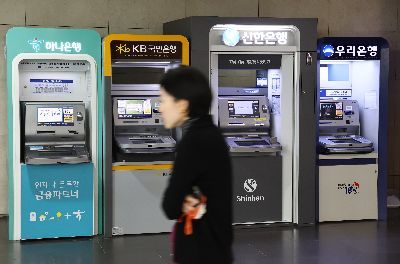
Specifically, time deposits were recorded at 927.0916 trillion won, down 2.23% (21.1285 trillion won) from the end of the previous month (948.2201 trillion won). Installment savings increased by 8.8696 trillion won to 115.3868 trillion won. Looking at time deposits alone, deposits decreased by more than 20 trillion won in one month.
The balance of time deposits at the five major commercial banks showed a continuous increase for seven months from April this year, when it recorded 872.882 trillion won, until the end of November (948.2201 trillion won). The amount of increase in time deposits over seven months reached a staggering 75.3381 trillion won. This was because demand rapidly concentrated on last-minute high-interest deposits amid the possibility of interest rate cuts by the U.S. Federal Reserve (Fed) and the Bank of Korea in the second half of the year.
However, recently, as deposit interest rates at each bank have been declining due to the influence of benchmark rate cuts, the 'last-minute' demand also seems to be decreasing. According to the Bankers Association, the interest rates for one-year time deposit products (simple interest) at the five major commercial banks remain at a maximum of 3.15% to 3.22% per annum, including preferential rates. This is about 0.10 percentage points lower on both the upper and lower ends compared to the average interest rate of 3.34% to 3.35% handled in the previous month. In particular, the year-end is also a period when market fund demand is concentrated.
During the same period, market funds are preparing to move to places where higher returns can be expected. Demand deposits at the five major commercial banks increased by 3.78% (23.005 trillion won) to 631.2335 trillion won. Investor deposits also increased by about 5 trillion won, from 49.8986 trillion won at the beginning of last month to 54.5555 trillion won as of the 30th. Demand deposits and investor deposits are generally classified as 'investment standby funds.'
A representative from a commercial bank said, “December is usually a period when household and corporate fund demand is concentrated, which likely had an impact,” adding, “As deposit interest rates are expected to continue declining for the time being, signs of money movement are also expected to accelerate.”
© The Asia Business Daily(www.asiae.co.kr). All rights reserved.
![User Who Sold Erroneously Deposited Bitcoins to Repay Debt and Fund Entertainment... What Did the Supreme Court Decide in 2021? [Legal Issue Check]](https://cwcontent.asiae.co.kr/asiaresize/183/2026020910431234020_1770601391.png)















