Korea Real Estate Board Announces 'Weekly Apartment Price Trends for the Fifth Week of December 2024'
Seoul Apartment Prices Stable This Week
Gyeonggi-do Down 0.02%
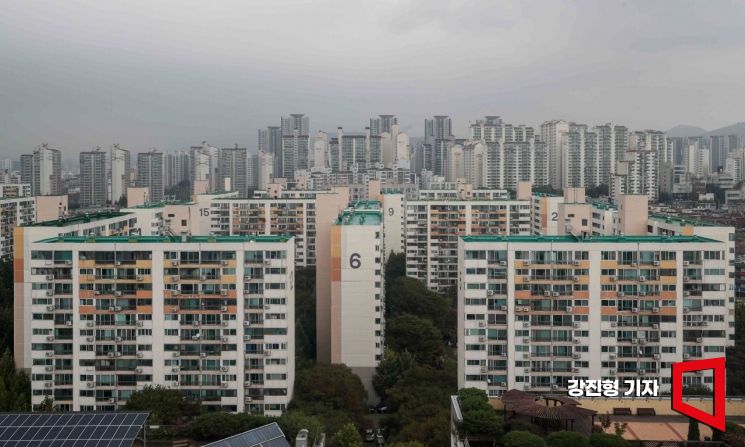 On the 15th, Seongsan Sijeong Apartment in Seongsan-dong, Mapo-gu, Seoul. Seongsan Sijeong Apartment is a complex completed in 1986, consisting of 33 buildings with up to 14 floors and 3,710 households. Photo by Jinhyung Kang aymsdream@
The upward trend in apartment sale prices in Seoul, which had continued since March last year, has stopped after 41 weeks. In many areas within Seoul, housing prices have declined. The causes include tightened loan regulations, the impeachment political situation, and the seasonal off-peak period, which have all frozen buyer sentiment.
According to the 'Weekly Apartment Price Trends for the Fifth Week of December 2024' released by the Korea Real Estate Board on the 2nd, apartment prices in Seoul showed no change (0.00%) this week. This marks the end of the 41-week rising trend that began in the fourth week of March last year.
Within Seoul, Songpa-gu (0.06%), Seocho-gu (0.03%), Yongsan, Gangnam, Jongno, Seongdong, Gangseo-gu (0.02%), and Yangcheon-gu (0.01%) maintained their upward momentum. However, Gangdong (0.00%→-0.02%) and Dongjak (0.00%→-0.01%) shifted to a decline. The drop widened in Geumcheon (-0.03%→-0.05%), Guro (-0.02%→-0.04%), and Eunpyeong, Gangbuk, Dobong, Gwanak (-0.01%→-0.02%).
A representative from the Korea Real Estate Board explained, "While localized increases are observed in areas with reconstruction issues or newly built complexes, overall buyer sentiment is weakening due to intensified wait-and-see attitudes amid the seasonal off-peak period."
Ham Young-jin, head of the Real Estate Research Lab at Woori Bank, said, "Last year's sharp price increases in Seoul heightened psychological burdens on buyers, and with the introduction of the third stage of the stress DSR (Debt Service Ratio) this year, household loan regulations have tightened further, which will slow down transaction volumes and price increases. Nevertheless, preferred areas such as Gangnam and riverside zones along the Han River, as well as complexes with strong waiting demand, are expected to maintain firm prices throughout this year."
Gyeonggi Province fell by 0.02%, the same as the previous week. Incheon also dropped by 0.09%, resulting in a two-week decline in apartment prices in the metropolitan area (-0.02%). However, some areas in Gyeonggi, such as Manan-gu in Anyang (0.13%), Dongan-gu in Anyang (0.10%), and Gwacheon-si (0.08%), recorded high growth rates. In Incheon, Gyeyang-gu (-0.16%) experienced a significant drop due to a large number of upcoming move-ins.
Nationwide housing prices fell by 0.03%, the same as last week. The five major metropolitan cities (-0.05%), other provinces (-0.04%), and Sejong (-0.07%) also continued their downward trends.
Kim Hyo-sun, chief real estate specialist at NH Nonghyup, said, "People will continue to refrain from transactions until the impeachment decision is finalized. While scarce listings in preferred areas may trade at asking prices, the overall chaotic situation will discourage transactions, leading to an increase in regions with falling prices in the first half of this year."
The nationwide jeonse (long-term lease) market maintained a stable trend following the previous week. The metropolitan area shifted from a slight decline (-0.01%) to no change (0.00%), and Seoul remained flat (0.00%). Provinces shifted from no change (0.00%) to a slight decline (-0.01%).
A representative from the Korea Real Estate Board stated, "In Seoul, some areas saw transactions at rising prices due to a shortage of listings in large and preferred complexes, but in regions with many move-ins, transactions were mainly at lower prices."
Prices fell in Gangdong-gu (-0.06%), Seongdong-gu (-0.05%), Dongdaemun-gu (-0.04%), and Mapo, Dongjak, Gwanak-gu (-0.03%), while Seocho, Gangseo, Jongno, Yongsan, Nowon, and Jung-gu (0.03%) saw increases.
© The Asia Business Daily(www.asiae.co.kr). All rights reserved.

















