Senior Spokesperson Shin Dong-wook: "No Exceptions in Law Enforcement"
Determines Issues with Execution of Public Corruption Investigation Office Arrest Warrants
"Must Exercise Maximum Restraint"
The People Power Party expressed concern on the 2nd that President Yoon Seok-yeol's letter, delivered to the anti-impeachment protesters gathered in front of his residence in Hannam-dong, Yongsan-gu, Seoul, stating "I will fight to the end," could lead to conflicts among the public. It is interpreted that they judged the letter to be inappropriate given the difficult state of national affairs, as it stirred conflict among supporters and increased the risk of clashes.
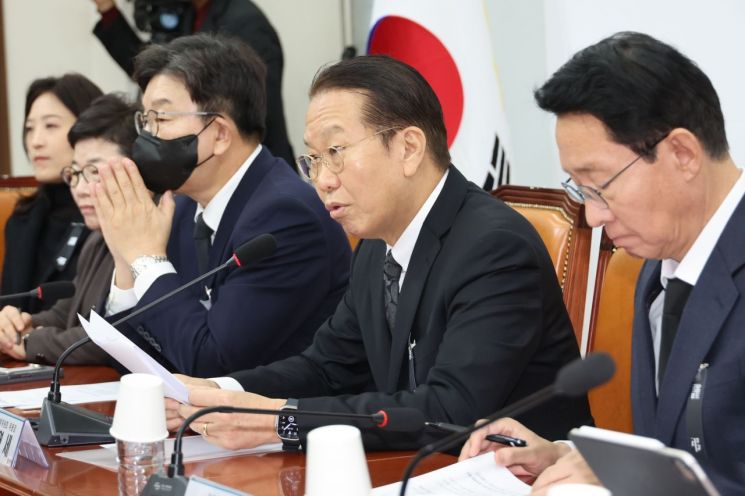
Shin Dong-wook, the senior spokesperson for the People Power Party, said at the National Assembly after an emergency committee meeting when asked by reporters about President Yoon's letter, "We judged that it is not an issue for the party to officially comment on," but added, "Basically, no citizen, including the president, should be exempt from law enforcement."
However, Shin noted that the current situation where the Corruption Investigation Office for High-ranking Officials (CIO) is attempting to execute an arrest warrant for President Yoon is not simply a matter of law enforcement, saying, "I think it should not proceed in any way that causes conflict within our society."
The People Power Party remained largely reserved in their remarks but expressed concern that President Yoon's letter, combined with the CIO's execution of the warrant, could ignite a spark for conflict. The CIO, which is investigating President Yoon on charges including rebellion, is reportedly scheduled to execute the arrest warrant that day. However, forcibly carrying out the warrant raises concerns about clashes with the Presidential Security Service. According to Articles 110 and 111 of the Criminal Procedure Act, the Security Service has so far prevented police searches of the presidential office. However, the search warrant issued alongside the arrest warrant by the CIO explicitly states that "Articles 110 and 111 of the Criminal Procedure Act do not apply," which is expected to be used as grounds to pressure the Security Service for cooperation. If tensions escalate between the Security Service and the CIO, it could lead to disputes among supporters of both ruling and opposition parties. After the issuance of the arrest warrant for President Yoon, supporters opposing impeachment have gathered in front of the presidential residence.
Senior spokesperson Shin said, "In this situation, I think many citizens will worry about possible clashes between law enforcement agencies and civilians," and added, "I hope the CIO exercises maximum restraint to prevent such incidents."
© The Asia Business Daily(www.asiae.co.kr). All rights reserved.

















